Markets · Finance · Technology · Container Shipping
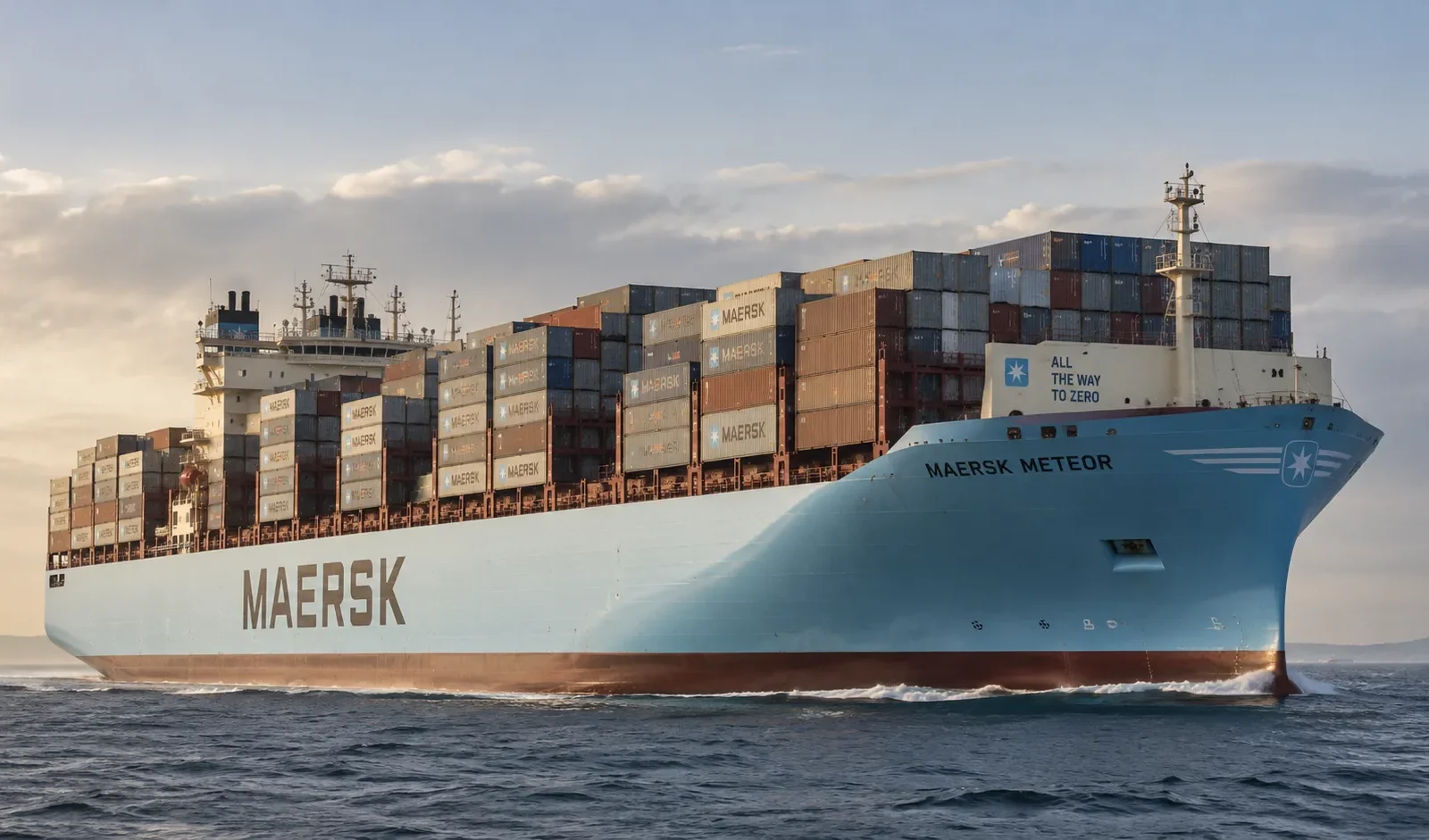
Maersk orders 26 container ships of 18,600 TEU each for delivery in 2029 and 2030, representing 483,600 TEU of nominal future capacity. The vessels will be equipped with dual-fuel engines capable of operating on liquefied gas, making the order a major long-term fleet-renewal commitment rather than a short-term response to today’s freight market.
What did Maersk order? Maersk said on 18 September that it had ordered 26 large 18,600-TEU container vessels as part of its ongoing fleet renewal. The ships are expected in 2029 and 2030 and will use dual-fuel engines capable of operating on liquefied gas.
Maersk Orders 26 Container Ships: 18,600 TEU Each
Maersk said the order forms part of its ongoing fleet-renewal programme, with deliveries expected across 2029 and 2030. The company disclosed two critical technical points: each vessel will have capacity of 18,600 TEU, and the ships will be fitted with dual-fuel engines able to operate on liquefied gas.
The phrase Maersk orders 26 container ships therefore describes a confirmed fleet-renewal programme rather than market speculation: the vessel count, capacity and delivery window were all reported on 18 September 2026.
The announcement is significant because it moves the discussion beyond short-term chartering and spot-freight conditions. A newbuilding delivered in 2029 or 2030 is a multi-year capital-allocation decision made against assumptions about future trade growth, network design, fuel availability, regulation and vessel obsolescence.
It also follows an earlier Maersk order announced in February for eight 18,600-TEU ships at New Times Shipbuilding. Those earlier vessels were also scheduled for 2029–2030 delivery and were described by Maersk as part of the same broader renewal strategy. The 18 September announcement did not identify the yards or contract value for the 26-vessel programme in the Reuters report.
Tide Signal read
The important story is not simply that Maersk orders 26 container ships. The stronger commercial signal is that It is that the carrier is committing large amounts of future capacity while trying to preserve deployment flexibility and fuel optionality. That is a different strategy from ordering only the largest hull that a yard can build.
26 Ships Represent 483,600 TEU of Nominal Capacity
At 18,600 TEU per vessel, the 26-ship order represents 483,600 TEU of total nominal capacity.
| Measure | Figure | Commercial meaning |
|---|---|---|
| Ships ordered | 26 | A major multi-year newbuilding commitment. |
| Capacity per ship | 18,600 TEU | Large enough for major east-west trades while below the 24,000-TEU megamax ceiling. |
| Total nominal capacity | 483,600 TEU | Large future capacity block, subject to replacement, redelivery and deployment decisions. |
| Delivery | 2029–2030 | Capacity enters the fleet years after the current freight cycle. |
This figure should not be interpreted as a guaranteed 483,600-TEU increase in Maersk’s operating fleet. A liner company can take delivery of new tonnage while simultaneously scrapping older ships, returning chartered vessels, selling assets or redeploying capacity into different loops.
The better question is how much net effective capacity Maersk will have after all of those decisions are made.
Why the 18,600-TEU Size Is Strategically Interesting
The 18,600-TEU class sits below the 24,000-TEU vessels that define the upper end of today’s container-ship market.
That difference matters because maximum nominal capacity is not always the same thing as maximum commercial flexibility. Very large vessels can deliver excellent unit economics when they operate full on deep, high-volume trades, but they require suitable terminals, cranes, berth depth, network density and cargo concentration.
Maersk’s February announcement for its earlier 18,600-TEU series explicitly highlighted deployment flexibility as a design priority. The carrier said those ships were intended to provide more deployment options than the very largest containerships.
That philosophy also fits a shipping environment in which route economics can change abruptly. Tide Signal’s Maritime Chokepoints analysis explains how Suez, Hormuz and Malacca can change voyage distance, vessel utilisation and effective fleet capacity.
Why the New Maersk Ships Are Dual-Fuel
Maersk said the 26 ships will have dual-fuel engines capable of operating on liquefied gas.
Dual-fuel capability is valuable because a ship ordered today will operate through several regulatory and fuel-market cycles. A vessel delivered in 2030 could remain commercially active well into the 2050s. Locking such an asset into one fuel pathway therefore creates technology and regulatory risk.
Maersk has already been pursuing a multi-fuel transition. Its recent fleet strategy includes methanol-capable vessels, liquefied-gas-capable ships and continued work on other propulsion pathways.
That does not mean LNG automatically solves shipping’s emissions problem. Lifecycle emissions, methane slip, fuel origin and future regulation all matter. The commercial value of dual-fuel machinery is the ability to preserve options as those variables evolve.
For the current European carbon-cost framework, Tide Signal’s EU ETS Shipping 2026 page explains the allowance-surrender system and the increasing carbon exposure facing shipping companies.
Fleet Renewal Is Not the Same as Pure Fleet Expansion
Maersk described the order as part of its fleet-renewal programme. That wording matters.
A liner operator can order a large number of ships without increasing its fleet by the same amount. New tonnage can replace:
- older owned vessels approaching disposal;
- less efficient ships with weaker fuel performance;
- chartered ships due for redelivery;
- vessels that no longer fit future network requirements;
- ships with less attractive emissions or operating profiles.
Maersk currently operates more than 700 container vessels across owned and chartered tonnage. Against that scale, 26 new ships are substantial, but the strategic effect depends on which existing capacity remains in the network when the deliveries arrive.
Maersk Is Ordering Into a Renewed Liner Fleet Race
The Maersk order comes as major container lines continue committing capital to new tonnage. CMA CGM has also been linked to another wave of very large dual-fuel vessels, while MSC has spent years expanding through newbuildings and secondhand acquisitions.
For Maersk, the strategic problem is two-sided. It must avoid under-investing while competitors build newer and potentially cheaper fleets, but it must also avoid over-ordering into a market that could face excess capacity later in the decade.
That balance is difficult because container shipping demand, route structures and effective capacity can change much faster than a shipbuilding programme.
China’s new infrastructure is also reshaping the long-term trade map. Tide Signal’s report on the Pinglu Canal opening examines how new inland-to-sea capacity could deepen southwest China’s trade connection with ASEAN.
Will Maersk’s 26 New Ships Push Container Rates Down?
Not now. The Maersk orders 26 container ships announcement belongs primarily in the 2029–2030 supply conversation. The ships are not due until 2029 and 2030, so they have no direct impact on today’s available liner capacity.
Even after delivery, the effect on freight rates will depend on how much old tonnage leaves the fleet, how much cargo demand grows and how the vessels are deployed.
Container freight is priced against effective capacity on specific trade lanes, not simply against the global number of ships. Blank sailings, port congestion, Suez or Cape routing, schedule recovery and equipment imbalance can all reduce usable weekly capacity.
Tide Signal’s Container Shipping Rates 2026 living page tracks current route-level spot benchmarks and explains why the global composite can move differently from individual trades.
Commercial takeaway
The 26-ship order is more relevant to the 2029–2030 supply balance than to September 2026 freight. Today’s rates can remain high even while a large future orderbook grows, because ships not yet delivered provide zero current transport capacity.
Network Flexibility Matters More as Suez Returns to the Equation
The order also arrives while container networks are again changing their routing assumptions. Maersk and Hapag-Lloyd recently said more Gemini services would return through the Suez Canal, shortening voyage distances compared with Cape of Good Hope diversions.
That matters for fleet economics. Shorter routes require fewer vessel-days to maintain the same weekly service frequency. If Suez routing becomes more stable, some effective capacity can return to the market without a single new ship being delivered.
The reverse is also true. Renewed disruption can absorb ships for longer voyages and tighten capacity quickly.
This is why Maersk’s preference for a large but flexible 18,600-TEU design deserves attention. A ship’s value to a liner network depends not only on how many boxes it can carry, but on how many service patterns it can perform efficiently.
The Ships Will Enter Service Into a Different Carbon-Regulation World
By 2029–2030, carbon pricing and fuel-intensity regulation will be materially more important to vessel economics than they are today.
That creates a long-duration design problem for any shipowner. A vessel ordered in 2026 must remain competitive under rules, fuel prices and emissions standards that may look very different by the time the ship reaches mid-life.
The choice of dual-fuel propulsion gives Maersk a degree of flexibility, but the ultimate emissions result will depend on what fuel is actually burned and how that fuel is produced.
Maersk is simultaneously exploring technologies further outside the conventional bunker model. Tide Signal’s Maersk nuclear-powered UK–US corridor analysis covers the separate Pink Corridor study and the regulatory barriers facing nuclear propulsion.
What the Container Market Should Watch Next
| Indicator | Why it matters |
|---|---|
| Shipyard allocation | Shows how Maersk is splitting construction risk and capacity across yards. |
| Owned vs chartered replacement | Determines how much of the 483,600 TEU becomes true net fleet growth. |
| Scrapping | Older-vessel removals could offset part of the delivery wave. |
| 2029–2030 container demand | Determines whether the new capacity is absorbed or contributes to oversupply. |
| Fuel pathway | The commercial value of dual-fuel machinery depends on future fuel availability and regulation. |
| Suez stability | Shorter routing could return effective capacity to the market before the ships are delivered. |
| Competitor orderbooks | MSC, CMA CGM and other carriers’ newbuilding programmes determine the wider supply balance. |
Tide Signal Analysis: Maersk Is Buying Flexibility as Much as Capacity
The headline is that Maersk orders 26 container ships. The deeper question is how much future capacity those ships ultimately add after replacement and redelivery decisions. The more important strategic number may be 18,600 TEU.
Maersk could have pursued only the very largest vessel class. Instead, its recent large-ship programme has emphasised a design that still offers substantial economies of scale while preserving more network flexibility than a 24,000-TEU megamax.
That matters because liner shipping is entering a period in which operators must manage several uncertainties at once: trade growth, Suez routing, fuel transition, carbon costs, ageing ships and a large industry orderbook.
The 26-vessel order gives Maersk a large block of future capacity. Whether it becomes expansion, replacement or a mixture of both will determine its eventual impact on freight markets.
Maersk Orders 26 Container Ships: Frequently Asked Questions
How many container ships has Maersk ordered?
Maersk said on 18 September 2026 that it had ordered 26 large container ships as part of its fleet-renewal programme.
How large are the new Maersk ships?
Each vessel will have nominal capacity of 18,600 TEU.
How much total capacity do the 26 ships represent?
At 18,600 TEU each, the order represents 483,600 TEU of combined nominal capacity.
When will the ships be delivered?
Maersk said deliveries are expected in 2029 and 2030.
What fuel will the new Maersk ships use?
The ships will have dual-fuel engines able to operate on liquefied gas. They are not limited to one fuel pathway.
Are the ships 24,000-TEU megamax vessels?
No. The confirmed order is for 18,600-TEU vessels, below the approximately 24,000-TEU upper end of the current container-ship market.
Will the order lower container shipping rates?
Not in the near term. The ships are not scheduled to arrive until 2029–2030. Their eventual effect will depend on demand growth, vessel scrapping, charter redeliveries, network routing and how much existing capacity they replace.
- Reuters — Maersk orders 26 large container vessels, 18 September 2026
- Maersk — 18,600-TEU vessel design and deployment-flexibility strategy, February 2026
- Maersk — company and fleet scale
- Reuters — Maersk and Hapag-Lloyd expand Suez Canal service return
Reporting status: 18 September 2026. Tide Signal will update this article if Maersk discloses further shipyard allocation, contract value, delivery phasing or additional technical specifications.