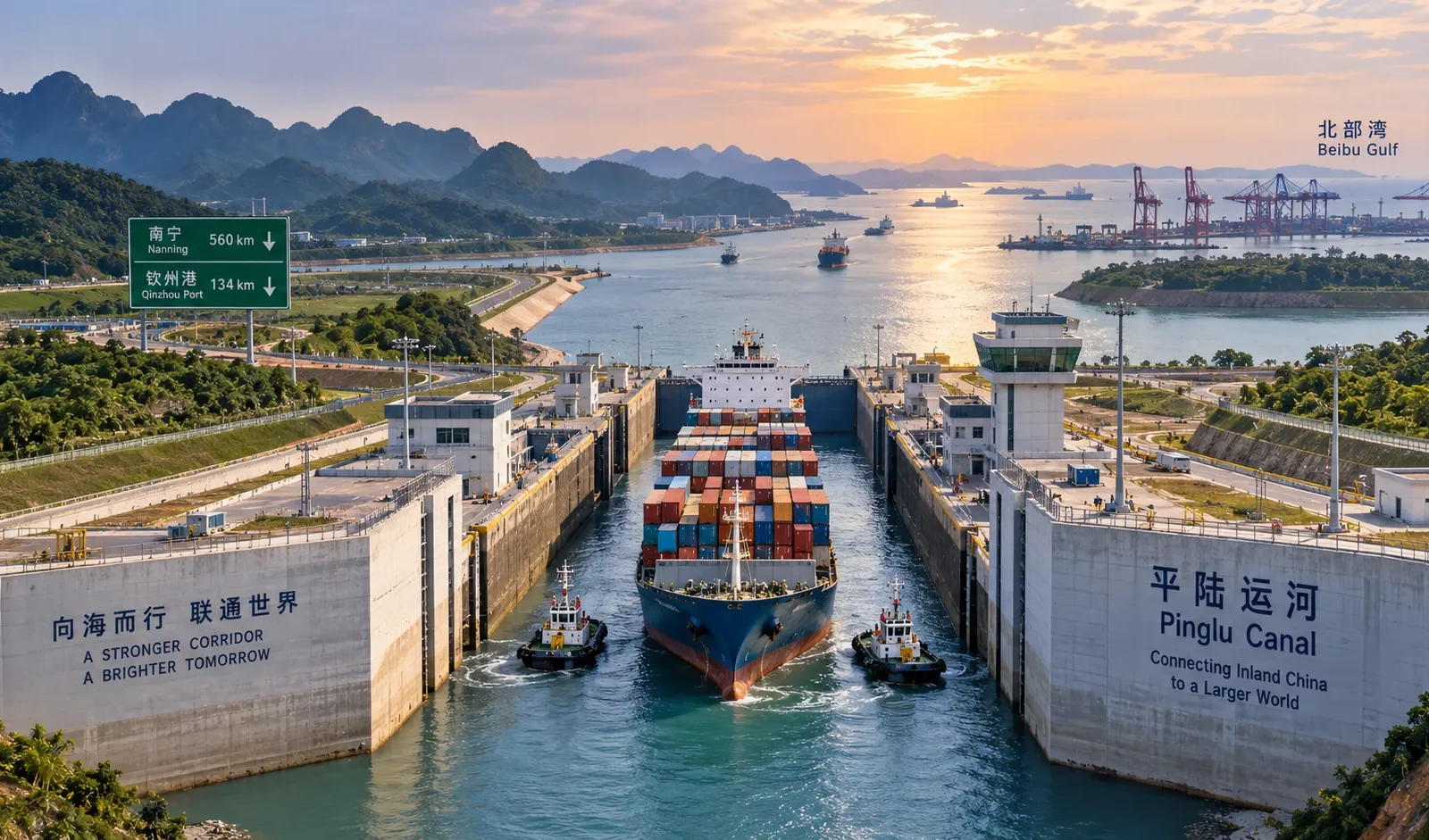
The Pinglu Canal opened to navigation on 16 September 2026, giving southwest China a new direct river-to-sea outlet toward the Beibu Gulf and Southeast Asia. The 134.2-kilometre waterway in Guangxi links the Xijiang inland shipping network with the coast, is designed for vessels of up to 5,000 tonnes and is expected by Chinese authorities to cut more than 560 kilometres from some inland routes to the sea.
That alone makes the project commercially important.
But the larger story is not the canal itself. It is the transport network the canal changes.
By shortening the route between inland manufacturing and commodity centres in southwest China and the Beibu Gulf, the Pinglu Canal could shift cargo away from longer river routes, roads and rail, increase the role of Qinzhou and the wider Beibu Gulf port system, and deepen waterborne trade links between China and ASEAN.
Chinese authorities estimate that the canal could reduce logistics costs on affected routes by 18% to 30% and save more than RMB 5 billion per year in transport costs. The project has a reported investment of about RMB 72.7 billion, or roughly $10.8 billion, and a designed one-way annual cargo capacity of 89 million tonnes.
Important: the 18–30% cost reduction, RMB 5 billion annual saving and 560 km route reduction are official estimates for affected transport flows. Actual savings will depend on cargo origin, destination, vessel size, lock waiting time, port handling, pilotage, tariffs and competing rail or road options.
What Is the Pinglu Canal?
The Pinglu Canal is a 134.2-kilometre inland waterway in the Guangxi Zhuang Autonomous Region of southern China.
It begins around the Pingtang River/Xijin Reservoir area near Nanning and runs south through the Qin River system toward Qinzhou and the Beibu Gulf.
The canal connects inland waterways linked to the Xijiang River with the sea, creating a much shorter outlet for parts of southwest China than the traditional inland route toward the Pearl River Delta and Guangzhou.
It is built to China’s highest inland-waterway standard and is designed to accommodate vessels of up to 5,000 tonnes.
The project forms a key part of the New International Land-Sea Trade Corridor, a multimodal network connecting western and southwestern China with ASEAN and other international markets.
Pinglu Canal Route: From Inland China to the Beibu Gulf
The strategic value of the canal comes from geography.
Much of southwest China is economically productive but inland.
Manufacturing centres and commodity flows in Guangxi, Yunnan, Guizhou and neighbouring regions historically depended on combinations of:
- rail to coastal ports;
- road freight;
- long inland-waterway routes toward the Pearl River Delta;
- or multimodal transfers between inland terminals and seaports.
The Pinglu Canal changes that geometry by connecting the inland waterway system directly to the Beibu Gulf.
Official project material states that the distance from Nanning via the Pinglu Canal to Qinzhou Port is approximately 291 kilometres, around 563 kilometres shorter than the previous inland-waterway route.
That difference is the commercial foundation of the entire project.
The Pinglu Canal does not create cargo. It changes the cost and distance required to move existing and future cargo to the sea.
That is what makes it potentially more important than its 134-kilometre length suggests. A shorter sea-access route can alter which port wins cargo, which mode is competitive and which industrial locations become commercially attractive.
Why 560 Kilometres Matters in Shipping
A 560-kilometre reduction in inland transport distance can affect much more than fuel consumption.
It can change:
- voyage time;
- barge and inland-vessel utilisation;
- crew and operating-day costs;
- fuel consumption;
- inventory transit time;
- terminal scheduling;
- working capital;
- cargo damage exposure;
- rail and road competitiveness;
- and the preferred export gateway.
For lower-value, high-volume commodities, distance is especially important because logistics can represent a large share of delivered cost.
A shorter route can therefore change whether a commodity remains competitive in an export market.
Pinglu Canal Could Cut Logistics Costs by 18% to 30%
Guangxi authorities estimate that the canal could reduce logistics costs by 18% to 30% for affected routes.
They also estimate more than RMB 5 billion in annual transport-cost savings.
These are planning estimates rather than guaranteed savings for every cargo.
The actual result will vary according to:
- cargo origin;
- final destination;
- ship or barge size;
- lock transit time;
- port handling charges;
- pilotage requirements;
- cargo-handling productivity;
- road or rail alternatives;
- seasonal water conditions;
- and the availability of backhaul cargo.
A Simple Logistics Example
Consider an illustrative cargo whose pre-canal inland transport cost is RMB 100 per tonne.
If the Pinglu route reduces total logistics cost by 18%:
RMB 100 × 18% = RMB 18 saving per tonne
New cost:
RMB 82 per tonne
At a 30% reduction:
RMB 100 × 30% = RMB 30 saving per tonne
New cost:
RMB 70 per tonne
On a 5,000-tonne cargo, that theoretical difference becomes:
| Illustrative saving | Per tonne | On 5,000 tonnes |
|---|---|---|
| 18% | RMB 18 | RMB 90,000 |
| 30% | RMB 30 | RMB 150,000 |
This is only an illustration, not a forecast for canal users, but it shows why relatively small per-tonne savings can become commercially meaningful on bulk cargoes.
Designed for 5,000-Tonne Vessels
The canal is designed for ships of up to the 5,000-tonne class.
This does not mean 5,000 GT or a fixed deadweight figure for every vessel. Chinese project descriptions use a domestic vessel-class convention based around 5,000-tonne inland/coastal ships.
Eligible users can include:
- multipurpose ships;
- dry bulk carriers;
- inland containerships;
- coastal vessels;
- and river-sea ships designed for direct trading between inland terminals and coastal ports.
Before opening, Chinese maritime authorities reportedly qualified hundreds of vessels and route-endorsed masters and deck officers for canal operations.
Three Major Ship Locks Control the Canal
The canal overcomes a substantial difference in water level between inland sections and the coast.
Three major stepped lock complexes were built:
- Madao;
- Qishi; and
- Qingnian.
The three hubs together manage a total level difference of roughly 65 metres.
That is equivalent to lifting or lowering ships through the height of a building of more than 20 storeys.
The locks are therefore not a minor infrastructure detail. Their operating efficiency will directly influence the canal’s real commercial capacity.
Why Lock Productivity Matters More Than Headline Capacity
A canal may have enough water depth and width for thousands of ships, but its effective capacity is often determined by bottlenecks.
For Pinglu, the critical variables will include:
- lock cycle time;
- number of vessels per lockage;
- traffic-direction scheduling;
- maintenance downtime;
- weather disruptions;
- water-management restrictions;
- pilot availability;
- and cargo peaks.
Official conference material states that the Madao lock can complete filling and discharge in about 16 minutes and can handle multiple 5,000-tonne vessels within an hour under designed conditions.
Real-world throughput will depend on the full traffic system, not the lock chamber alone.
89 Million Tonnes of Designed Annual One-Way Capacity
The Pinglu Canal has a designed annual one-way throughput capacity of 89 million tonnes.
This figure is important, but it should be interpreted correctly.
It is an engineering design capacity, not a forecast that 89 million tonnes will move through the canal immediately.
Actual utilisation will depend on:
- cargo generation;
- port capacity;
- industrial investment along the corridor;
- ship availability;
- tariffs;
- competing modes;
- and ASEAN trade growth.
New transport infrastructure often requires years for supply chains and industrial locations to adjust.
Which Cargoes Could Use the Pinglu Canal?
The most natural users are cargoes that benefit from low-cost water transport and are produced or consumed within the canal’s inland catchment.
Potential cargo groups include:
- coal;
- bauxite and alumina-related cargoes;
- ores and minerals;
- grain and agricultural products;
- fertiliser;
- steel products;
- cement and construction materials;
- machinery;
- automotive parts;
- plywood and forest products;
- containers;
- and project cargo.
Opening-day cargoes reportedly included automotive parts and plywood bound for Vietnam, demonstrating that the corridor is not limited to traditional dry bulk.
Why Beibu Gulf Port Is the Biggest Immediate Winner
The southern end of the canal connects directly into the Beibu Gulf port system, including Qinzhou.
That matters because cargo previously routed east toward the Pearl River Delta may now have a shorter alternative toward the Gulf of Tonkin.
Beibu Gulf Port has already grown rapidly.
Official figures cited before the canal opening show container throughput rising from roughly 2.28 million TEU in 2017 to more than 10 million TEU in 2025.
The port also has established services to major ASEAN destinations.
The canal therefore arrives into an existing port network rather than creating a seaport from scratch.
Pinglu Canal vs the Traditional Guangzhou Route
Before the Pinglu Canal, a large share of inland waterway cargo from this region had to travel eastward through the Xijiang/Pearl River system before reaching coastal gateways.
The new route turns south instead.
| Feature | Traditional inland route | Pinglu route |
|---|---|---|
| Direction | East toward Pearl River Delta | South toward Beibu Gulf |
| Sea-access distance | Longer for southwest origins | Potentially 560+ km shorter |
| Gateway focus | Guangzhou / Pearl River Delta | Qinzhou / Beibu Gulf |
| ASEAN orientation | Indirect for many southwest flows | Direct south-facing gateway |
Why ASEAN Is Central to the Project
ASEAN is one of China’s largest trading partners and a major destination for Chinese manufactured goods, machinery, vehicles, components and intermediate products.
It is also a source of:
- energy commodities;
- agricultural products;
- minerals;
- raw materials;
- and manufactured inputs.
Official Chinese data cited ahead of the opening put China–ASEAN trade at approximately RMB 4.34 trillion in the first half of 2026, up 18.2% year on year.
The canal is therefore opening into an already large and growing trade relationship.
Could the Canal Shift Cargo From Rail and Road?
Yes, particularly for cargo that is:
- heavy;
- low-value per tonne;
- not highly time-sensitive;
- produced near navigable waterways;
- or destined for ASEAN markets served efficiently from Beibu Gulf ports.
Inland water transport is generally slower than road and often slower than rail, but it can be materially cheaper for bulk and high-volume cargo.
The canal therefore changes the modal-choice equation.
A shipper may accept longer transit time if the freight saving is large enough.
Could the Canal Shift Cargo Away From Guangzhou?
Potentially, but not every cargo will move.
Guangzhou and the wider Pearl River Delta retain major advantages:
- huge terminal capacity;
- dense shipping connectivity;
- large local markets;
- mature logistics services;
- industrial clustering;
- and extensive container networks.
The Pinglu Canal does not replace those advantages.
Its strongest competitive case is for cargo where the shorter inland leg to Beibu Gulf outweighs differences in ocean service frequency, terminal cost or destination connectivity.
The Real Competition Is Total Delivered Cost
Shippers do not choose routes based on kilometres alone.
They compare total logistics cost.
A simplified route decision includes:
The Pinglu route wins only where the total is lower or where reliability is better.
Why Containers Could Matter as Much as Bulk
The canal’s 5,000-tonne vessel class makes it relevant to inland and river-sea container services.
Containerised manufacturing cargo has different economics from bulk:
- higher cargo value;
- greater schedule sensitivity;
- more frequent departures;
- and stronger dependence on port connectivity.
If Qinzhou can offer sufficiently frequent onward services to ASEAN, the canal could create a competitive inland-water container corridor.
That may be particularly attractive for factories in Guangxi and neighbouring inland regions.
The New International Land-Sea Trade Corridor
The Pinglu Canal is not an isolated infrastructure project.
It is a backbone component of the New International Land-Sea Trade Corridor.
That wider network combines:
- rail;
- road;
- inland waterways;
- ports;
- and international shipping services.
By early July 2026, official Chinese reporting said the network had reached 593 ports in 128 countries and regions.
The corridor’s rail services reportedly handled a record 1.425 million TEU in 2025, up 47.6% year on year.
That scale matters because the canal is entering a transport ecosystem that is already moving significant cargo.
Could Pinglu Increase River-Sea Shipping?
Yes.
One of the canal’s most interesting commercial possibilities is direct river-sea shipping.
Instead of:
inland vessel → inland terminal → truck/rail → seaport → ocean vessel
some cargo could potentially move:
inland/river-sea vessel → canal → coastal port or regional destination
Reducing handling steps can save:
- time;
- labour;
- terminal fees;
- cargo damage risk;
- and transfer costs.
Why Vessel Design Could Change
Infrastructure shapes ships.
If the canal develops strong cargo volumes, owners may increasingly optimise vessels around:
- 5,000-tonne class limits;
- lock dimensions;
- air draft;
- draught;
- container intake;
- cargo gear;
- fuel efficiency;
- and river-sea capability.
This could create a specialised regional fleet in the same way other river and canal systems influence vessel design.
What Could 89 Million Tonnes Mean in Ship Movements?
A simple theoretical calculation helps put the designed capacity into context.
If every voyage carried exactly 5,000 tonnes:
89,000,000 / 5,000 = 17,800 loaded vessel movements per year
That would equal roughly:
48.8 loaded movements per day
This is not a forecast.
Actual cargo sizes will vary, vessels may not load to 5,000 tonnes, and the 89-million-tonne number is designed one-way capacity rather than expected first-year traffic.
But the calculation shows the scale of traffic the infrastructure is intended to support eventually.
Lock Traffic Could Become the Key Commercial Metric
As the canal matures, shipping markets should watch:
- daily lock transits;
- average waiting time;
- cargo tonnes per transit;
- container volumes;
- empty-return ratios;
- average vessel size;
- and seasonal congestion.
These indicators will reveal whether the project is simply available or genuinely reshaping freight patterns.
What Does It Cost to Transit the Pinglu Canal?
Reported pre-opening information suggests lock-related charges are structured according to vessel tonnage and relevant regulations.
One published example indicated that a vessel carrying around 5,000 tonnes of cargo but registered at roughly 2,500 GT could face around RMB 2,500 for one lock transit under the cited tariff framework.
Final voyage economics, however, include more than lock charges.
Operators must account for:
- pilotage where required;
- port dues;
- towage if applicable;
- agency;
- bunkers;
- crew;
- canal waiting time;
- cargo handling;
- and onward ocean freight.
International Ships and Pilotage
Internationally trading vessels and larger sea-going ships are subject to safety and pilotage requirements when entering or leaving the canal system.
That is important because the Pinglu Canal is intended to connect inland shipping with international trade, but it remains a controlled inland navigation environment rather than an unrestricted sea lane.
Operational acceptance will depend on:
- vessel dimensions;
- certification;
- pilotage;
- crew route endorsements;
- navigation systems;
- and compliance with local traffic rules.
Navigation Technology and Traffic Control
Trial operations ahead of opening tested:
- lock passage;
- meeting and overtaking;
- turning;
- berthing;
- night navigation;
- tidal conditions;
- strong winds;
- and flood-related scenarios.
Test vessels used technologies including BeiDou positioning, sensors and drones to collect operational data.
For a new high-capacity inland waterway, traffic-management quality will be essential to avoid the canal becoming a congestion bottleneck.
Could Pinglu Become China’s Answer to an Inland Shipping Constraint?
That is the strategic logic.
Southwest China has long had an awkward logistics geography: economically active inland regions located relatively close to Southeast Asia but without a direct low-cost river-to-sea outlet.
The canal attempts to solve that mismatch.
Instead of moving east to reach the sea, cargo can move south.
This can make the Beibu Gulf more competitive as a gateway for inland China.
What Does the Canal Mean for ASEAN Ports?
More efficient access from southwest China could increase short-sea and regional cargo volumes toward:
- Vietnam;
- Thailand;
- Malaysia;
- Singapore;
- Indonesia;
- and other ASEAN markets.
Ports with frequent services to Qinzhou and Beibu Gulf may benefit from stronger cargo flows.
The effect will depend on liner schedules, regional feeder networks and direct services.
Vietnam Could Be an Early Beneficiary
Vietnam is geographically close to the Beibu Gulf and is deeply integrated into China-linked manufacturing supply chains.
Opening-day cargo reportedly included shipments bound for Can Tho, illustrating the canal’s ASEAN orientation from the beginning.
For Vietnamese importers and exporters, the canal could provide:
- shorter inland access to southwest Chinese suppliers;
- more multimodal options;
- and potentially lower regional freight costs.
Could Pinglu Affect Ocean Freight Rates?
Directly, probably only in specific trades.
The canal does not change the global supply of Panamax, Capesize or deep-sea containership capacity.
Its strongest immediate effect is inland and regional.
But indirect effects could emerge if it:
- shifts significant cargo toward Beibu Gulf;
- creates new feeder services;
- changes port-pair volumes;
- increases ASEAN short-sea demand;
- or alters where deep-sea containers are transshipped.
Why This Is Different From the Suez or Panama Canal
Pinglu should not be compared directly with the Suez or Panama canals.
Suez and Panama are global interoceanic chokepoints used by large deep-sea ships.
Pinglu is a regional river-to-sea logistics corridor designed for much smaller vessels.
Its importance comes from network efficiency, not from replacing a global ocean chokepoint.
| Canal | Primary role | Typical strategic effect |
|---|---|---|
| Suez | Asia–Europe deep-sea shortcut | Global vessel routing |
| Panama | Atlantic–Pacific shortcut | Global route optimisation |
| Pinglu | Inland southwest China–Beibu Gulf outlet | Regional logistics and port competition |
Environmental and Water-Management Questions
Large canal projects create environmental and water-management trade-offs.
Pinglu’s design includes water-saving lock technology intended to reduce lock water consumption.
Official project material says water-saving systems can reduce water use substantially compared with conventional lock arrangements.
However, long-term performance will still depend on:
- river flows;
- flood management;
- sedimentation;
- ecosystem impacts;
- water quality;
- and maintenance dredging.
These factors can affect navigation reliability as much as the original engineering design.
The Canal Could Reshape Industrial Geography
Transport infrastructure often changes where factories and warehouses are built.
If companies believe the canal provides reliable low-cost access to ASEAN, they may prefer sites closer to:
- inland ports;
- industrial parks;
- canal terminals;
- and Qinzhou/Beibu Gulf logistics hubs.
This is why the project’s economic impact may take years to emerge fully.
The largest effect may eventually come not from cargo that switches routes today, but from new industrial investment designed around the new corridor.
Could the Canal Support More Chinese Vehicle Exports?
Potentially for automotive components and some vehicle-related supply chains.
China’s vehicle exports are already reshaping the car-carrier market.
Tide Signal has analysed how China’s vehicle export boom is affecting PCTC shipping.
The Pinglu Canal operates at a different part of the logistics chain, but cheaper inland movement of components and manufactured goods toward ASEAN could reinforce the broader export system.
How Pinglu Fits the Wider Shipping Capacity Story
Tide Signal has recently examined how longer voyages can reduce effective dry bulk fleet capacity.
Pinglu represents the opposite mechanism.
Instead of making cargo travel farther, the canal is designed to make some cargo travel less distance.
Shorter transport chains can release vessel time, reduce fuel consumption and lower logistics cost.
That means infrastructure can alter effective transport capacity even when the number of ships does not change.
What the Pinglu Canal Does Not Do
The canal is significant, but several exaggerated interpretations should be avoided.
It does not:
- replace the Suez Canal;
- replace the Panama Canal;
- allow large ocean-going containerships to sail into inland China;
- guarantee 89 million tonnes of cargo immediately;
- automatically reduce every shipper’s logistics cost by 30%;
- or eliminate the need for rail and road transport.
Its importance is more specific: it creates a new lower-cost sea-access option for a large inland economic region.
What Could Limit Pinglu Canal Growth?
1. Lock Congestion
High traffic can create queues if demand grows faster than lock throughput.
2. Port Capacity
Qinzhou and nearby ports must absorb additional cargo without creating landside or berth congestion.
3. Service Frequency
Container shippers need reliable onward vessel schedules, not simply a shorter inland route.
4. Competing Rail Economics
Rail may remain better for higher-value and time-sensitive cargo.
5. Water Conditions
Floods, drought, sedimentation or water-management restrictions can affect inland navigation.
6. Cargo Imbalance
A route with strong exports but weak return cargo can create empty positioning costs.
7. Industrial Adoption
Shippers need time to redesign contracts, inventory systems and distribution networks around a new route.
What Could Make Pinglu Bigger Than Expected?
The canal could outperform early expectations if:
- ASEAN trade continues growing rapidly;
- Qinzhou adds more direct shipping services;
- industrial investment clusters along the corridor;
- rail or road costs rise;
- more river-sea vessel capacity enters service;
- container schedules become highly reliable;
- and major commodity producers adopt the route.
Key Metrics to Watch After the Opening
- Monthly cargo throughput: the clearest measure of real adoption.
- Lock transits: vessel numbers and waiting time will show whether bottlenecks emerge.
- Average vessel size: larger ships improve unit economics if locks and draught permit.
- Container volumes: important for higher-value manufacturing trade.
- Beibu Gulf Port throughput: confirms whether cargo is shifting toward the new gateway.
- New ASEAN services: shipping lines may respond if cargo density increases.
- Industrial investment: factories and logistics parks are the long-term multiplier.
- Actual cost savings: real shipper economics will matter more than planning estimates.
Pinglu Canal FAQ
When did the Pinglu Canal open?
The Pinglu Canal opened to navigation on 16 September 2026.
Where is the Pinglu Canal?
The canal is in Guangxi Zhuang Autonomous Region in southern China. It connects the Xijiang-related inland waterway system near Nanning with Qinzhou and the Beibu Gulf.
How long is the Pinglu Canal?
The canal is 134.2 kilometres long.
How much did the Pinglu Canal cost?
Official project information places total investment at about RMB 72.7 billion, roughly $10.8 billion depending on the exchange rate used.
What size ships can use the Pinglu Canal?
The canal is designed for vessels of up to the 5,000-tonne class.
How much distance does the Pinglu Canal save?
Chinese authorities estimate that some routes from southwest China to the sea can be shortened by more than 560 kilometres compared with the traditional inland-waterway route.
How much can the Pinglu Canal reduce logistics costs?
Official estimates suggest reductions of around 18% to 30% on affected transport flows. Actual savings will vary by cargo, origin, destination, vessel, waiting time, tariffs and competing transport modes.
What is the capacity of the Pinglu Canal?
The project has a designed annual one-way throughput capacity of 89 million tonnes.
How many locks does the Pinglu Canal have?
The canal has three major stepped lock complexes: Madao, Qishi and Qingnian.
Why is the Pinglu Canal important for ASEAN?
It creates a shorter inland-to-sea route from southwest China toward the Beibu Gulf, which has strong shipping links with Southeast Asian ports. This can reduce logistics distance and support more China–ASEAN cargo flows.
Is the Pinglu Canal like the Suez Canal?
No. Suez is a global deep-sea interoceanic route. Pinglu is a regional inland river-to-sea waterway designed for much smaller ships and focused on improving southwest China’s access to the coast.
Sources and Further Reading
- State Council Information Office / Xinhua — Pinglu Canal opening and route data
- Seatrade Maritime — Pinglu Canal and China–ASEAN trade
- CNSS — Investment, locks, route savings and opening details
- Guangxi project material — 89m-tonne designed capacity and project profile
- Chinese government reporting — vessel trials and New International Land-Sea Trade Corridor
- PortNews — vessel qualification, pilotage and transit-cost details