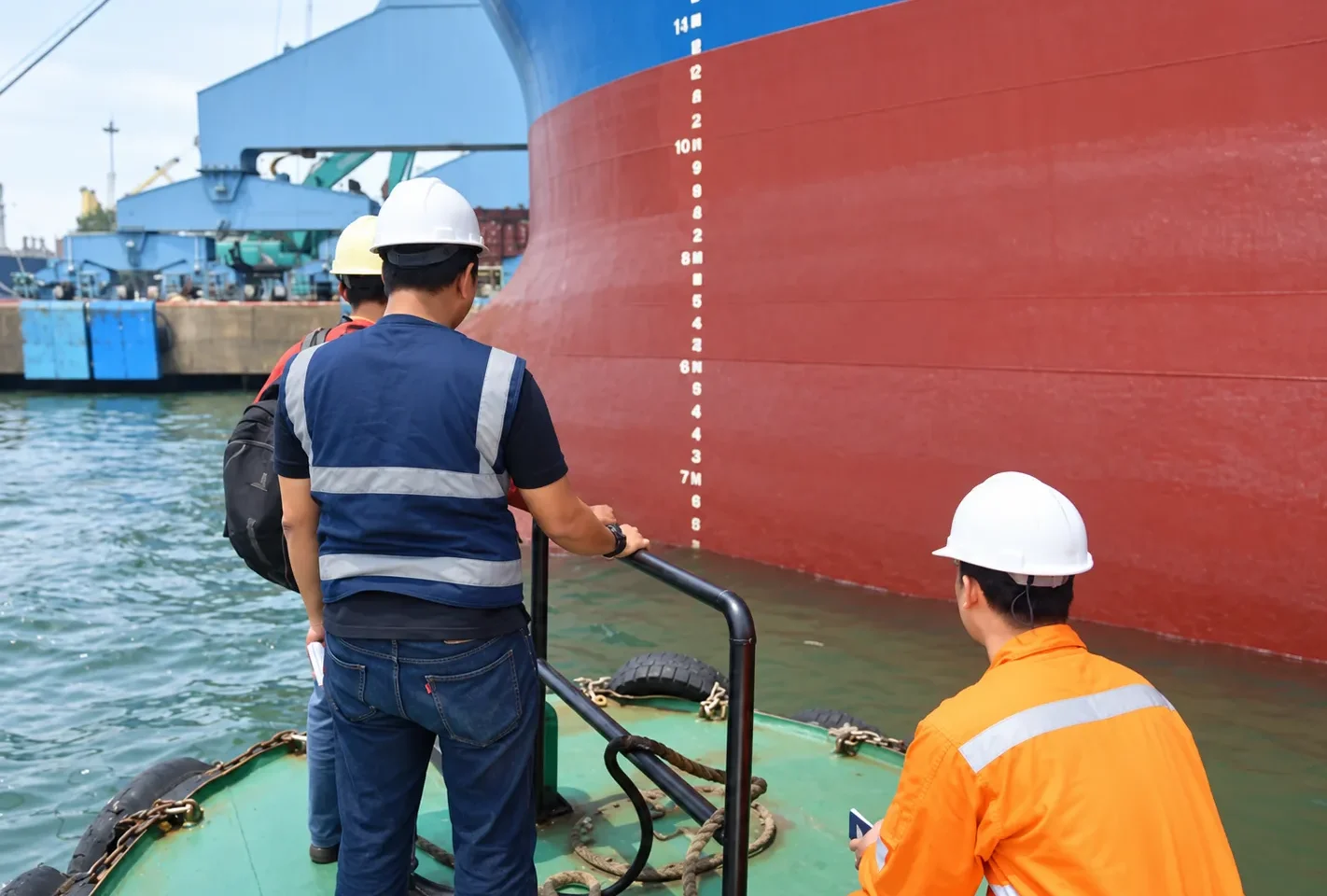
A draft survey is one of the most important practical cargo calculations in dry bulk shipping. It determines the weight of cargo loaded or discharged by comparing the vessel’s displacement before and after cargo operations, while correcting for ballast, bunkers, fresh water, dock-water density, trim, hull deflection and other known weights.
The principle is simple: a floating ship displaces a weight of water equal to its own weight. The practice is not. A few centimetres of draft-reading error, an incorrect ballast sounding, the wrong water density or a trim correction applied with the wrong sign can move the final cargo figure by tens or even hundreds of tonnes.
This Tide Signal guide explains the complete draft survey calculation step by step, including six-point draft readings, corrections to perpendiculars, quarter mean draft, hydrostatic interpolation, first and second trim corrections, density correction, ship’s constant, deductibles and a full worked cargo example.
Draft survey = change in corrected vessel displacement, adjusted for changes in non-cargo weights.
The calculation must use the vessel’s approved hydrostatic and tank data. Generic formulas are educational only; vessel-specific sign conventions, reference points and approved tables always take precedence.
What Is a Draft Survey in Shipping?
A draft survey, also spelled draught survey, is a method used to determine the weight of cargo on board a ship from the vessel’s displacement.
Britannia P&I describes the principle as comparing the vessel’s weight before and after loading, with allowances made for ballast and other known weights. The method is particularly important in bulk trades where cargo quantities can be large and shore-side weighing systems may use a different measurement method.
A draft survey is commonly used for cargoes such as:
- iron ore;
- coal;
- grain;
- bauxite;
- fertiliser;
- cement and clinker;
- salt;
- aggregates;
- mineral concentrates; and
- other dry bulk commodities.
The United Nations Economic Commission for Europe has also published a Uniform Code of Draught Survey for determining the weight of bulk coal cargoes, illustrating how established the method is in international bulk trade.
Draft Survey Formula: The Core Calculation
At its simplest, the cargo weight is:
For a loading operation where the initial and final surveys are both known, the cargo loaded can also be written as:
− (Final deductibles − Initial deductibles)
When lightship and constant are unchanged between the initial and final surveys, they cancel from the difference. This is one reason a carefully conducted pair of surveys can be more robust than trying to determine cargo from one isolated displacement figure.
In practice, however, each corrected displacement must first be built from several steps:
- Read the six drafts.
- Average port and starboard readings.
- Correct draft marks to the relevant perpendiculars if required.
- Assess list, hog and sag.
- Calculate the quarter mean draft.
- Interpolate the vessel’s approved hydrostatic data.
- Apply trim corrections if required by the vessel’s data.
- Correct displacement for actual dock-water density.
- Determine ballast, fuel, diesel, fresh water and other deductibles.
- Account for lightship and constant.
Step 1: Take the Six Draft Readings
A conventional draft survey uses six observed drafts:
| Position | Port | Starboard | Mean used |
|---|---|---|---|
| Forward | FP | FS | F = (FP + FS) / 2 |
| Midship | MP | MS | M = (MP + MS) / 2 |
| Aft | AP | AS | A = (AP + AS) / 2 |
The port/starboard average reduces the effect of list, but a significant list should not simply be ignored. It can affect tank soundings and make the survey less reliable.
Britannia recommends reading marks as close to the waterline as practical to reduce parallax. Waves, swell and poor access can distort the reading; wave-dampening devices, manometers, cameras or other suitable methods may be used where appropriate.
Example: Port and Starboard Mean Draft
Suppose the forward draft reads:
Forward port = 6.18 m
Forward starboard = 6.22 m
Then:
Forward mean = (6.18 + 6.22) / 2 = 6.20 m
The same process is repeated at midships and aft.
Step 2: Correct the Draft Marks to the Perpendiculars
Draft marks are not always located exactly at the forward perpendicular (FP), aft perpendicular (AP) or the reference positions used by the vessel’s hydrostatic data.
If a mark is displaced longitudinally from the required reference point and the vessel is trimmed, the observed draft at the mark will differ from the draft at the perpendicular.
A simplified geometric relationship is:
The sign depends on:
- whether the ship is trimmed by stern or by head;
- whether the mark is forward or aft of the reference point; and
- the vessel’s own sign convention.
Do not apply a generic sign rule without checking the vessel’s approved draft-survey or hydrostatic documentation.
Simple Geometry Example
Assume:
- trim by stern = 0.70 m;
- LBP = 225 m;
- draft mark offset from the reference position = 2.50 m.
Magnitude of correction:
0.70 × 2.50 / 225 = 0.00778 m = 0.78 cm
Less than one centimetre may look insignificant. On a large bulk carrier with a high TPC, however, even a centimetre can represent many tonnes of displacement.
Step 3: Identify Hog or Sag
A ship is not a perfectly rigid beam. The hull can flex longitudinally.
Hogging exists when the forward and aft ends are relatively deeper than the middle:
Sagging exists when the midship draft is deeper than the mean of the ends:
Worked Hog Example
Using corrected mean drafts:
Forward = 6.20 m
Midship = 6.52 m
Aft = 6.90 m
Mean of ends:
(6.20 + 6.90) / 2 = 6.55 m
Midship = 6.52 m, which is 0.03 m shallower than the mean of the ends.
Therefore the vessel is showing approximately 3 cm of hog in this simplified example.
Britannia recommends comparing the observed flex condition with the vessel’s normal behaviour. An unusual hog/sag pattern can be a warning that one of the draft readings should be checked again.
Step 4: Calculate the Quarter Mean Draft
The commonly used quarter mean, sometimes called the mean of means, gives extra weighting to the midship draft to account approximately for longitudinal hull deflection.
Worked Quarter Mean Example
Using:
F = 6.20 m
M = 6.52 m
A = 6.90 m
Then:
Quarter Mean = (6.20 + 6 × 6.52 + 6.90) / 8
= (6.20 + 39.12 + 6.90) / 8
= 52.22 / 8
= 6.5275 m
This draft is then used to enter or interpolate the approved hydrostatic information, subject to the vessel’s own procedure.
Step 5: Read and Interpolate the Hydrostatic Data
At the corrected mean draft, the surveyor needs vessel-specific hydrostatic values. Depending on the ship’s booklet, these can include:
- Displacement — total vessel weight at the tabulated reference density;
- TPC — tonnes per centimetre immersion;
- LCF — longitudinal centre of flotation;
- MCTC / MTC — moment to change trim by one centimetre;
- FWA or fresh-water allowance; and
- other vessel-specific correction data.
The quarter mean will rarely land exactly on a printed row, so linear interpolation is normally required unless the approved software/table provides the value directly.
Hydrostatic Interpolation Example
Suppose the hydrostatic table gives:
| Draft | Displacement |
|---|---|
| 6.52 m | 23,808 t |
| 6.53 m | 23,864 t |
The target draft is 6.5275 m, which is 75% of the interval from 6.52 to 6.53 m.
Difference in displacement:
23,864 − 23,808 = 56 t
Interpolated addition:
56 × 0.75 = 42 t
Interpolated displacement:
23,808 + 42 = 23,850 t
Step 6: Apply the First and Second Trim Corrections
Hydrostatic data are often tabulated on an even-keel basis, while the vessel may be trimmed. The displacement may therefore require correction.
The exact method must follow the vessel’s approved data. A generic draft-survey formula is useful for understanding the principle but should never override ship-specific hydrostatic instructions.
First Trim Correction
The first trim correction accounts for the fact that the ship trims about the longitudinal centre of flotation (LCF), which may not be exactly amidships.
Where:
- Trim is in metres;
- LCF is in metres from the stated reference;
- TPC is tonnes per centimetre;
- 100 converts metres of trim to centimetres in the TPC relationship; and
- LBP is length between perpendiculars in metres.
The sign convention is critical. Different vessel documentation may define forward/aft LCF and bow/stern trim differently. Britannia specifically warns that signs and reference points can differ between ships.
First Trim Correction Example
For an illustrative vessel:
- Trim by stern = 0.70 m;
- LCF = 1.80 m aft of amidships;
- TPC = 56.2 t/cm;
- LBP = 225 m.
Using a convention in which stern trim and aft LCF are both positive:
FTC = 0.70 × 1.80 × 56.2 × 100 / 225
FTC = +31.47 t
Second Trim Correction
The second trim correction, often associated with the Nemoto method, accounts for the change in MCTC/MTC around the mean draft.
A commonly used form is:
Where ΔMTC is the difference between MTC values above and below the mean draft at the interval specified by the vessel’s approved procedure.
Second Trim Correction Example
Assume:
- Trim = 0.70 m;
- ΔMTC = 12;
- LBP = 225 m.
Then:
STC = 50 × 0.70² × 12 / 225
= 1.31 t
If the tabulated displacement is 23,850 t:
Trim-corrected displacement = 23,850 + 31.47 + 1.31
= 23,882.78 t
Step 7: Correct Displacement for Dock-Water Density
Hydrostatic displacement is normally referenced to a stated water density, frequently 1.025 t/m³ for salt water.
Port water can be much less dense because of river discharge, rain, tidal mixing or brackish conditions. The measured draft may therefore correspond to a different vessel weight than the tabulated salt-water displacement.
NorthStandard’s draught-survey guidance gives the relationship:
Density Correction Example
Trim-corrected displacement = 23,882.78 t
Measured dock-water density = 1.018 t/m³
Hydrostatic reference density = 1.025 t/m³
Then:
Actual displacement = 23,882.78 × 1.018 / 1.025
= 23,719.68 t
The density correction has reduced the displacement by about 163 t.
That is why using “1.025 because it is seawater” without actually measuring the dock water can create a material cargo error.
How Should Dock-Water Density Be Measured?
Britannia recommends using a calibrated draft-survey hydrometer and notes that port-water density can vary with depth, location, tide and rainfall. Samples may therefore be required forward, midships and aft, approximately around half-draft depth, depending on conditions and survey procedure.
The same calibrated equipment should ideally be used for the initial and final surveys.
Step 8: Calculate Ballast, Bunkers and Other Deductible Weights
The corrected displacement includes everything that is physically contributing to the vessel’s weight.
To isolate cargo, non-cargo weights must be identified.
Typical deductibles include:
- ballast water;
- fresh water;
- fuel oil;
- diesel oil / marine gas oil;
- lubricating oil where applicable;
- bilges;
- sludge and slops where applicable;
- other measurable liquids; and
- any other known weight not included in lightship or constant.
Ballast Is Often the Largest Variable
Ballast calculations are frequently more sensitive than the basic displacement arithmetic.
The surveyor or responsible officer should normally:
- sound or gauge the ballast tanks;
- identify whether tanks are full, empty or slack;
- apply the correct trim/list correction from the approved tank tables;
- use the correct ballast-water density;
- confirm tank calibration data; and
- avoid ballast transfer while survey readings are being taken.
Britannia specifically warns against relying casually on supposedly empty or full tanks and recommends soundings and appropriate correction even where the tank status appears straightforward.
Step 9: Understand the Ship’s Constant
The ship’s constant is the difference between the vessel’s calculated actual light condition and the documented lightship after known weights have been accounted for.
It can represent accumulated or unrecorded weights such as:
- paint;
- mud or sediment;
- sludge;
- equipment changes;
- stores;
- spares;
- structural additions;
- crew effects; and
- other unaccounted weight.
The word “constant” is misleading because the value can change. Britannia explicitly notes that it is not truly constant and should be compared with historical values as a reasonableness check, not blindly accepted.
Constant Formula
For an initial survey on an empty vessel, cargo is zero, so the calculation becomes particularly useful.
Full Draft Survey Worked Example
The following example is illustrative. The ship, hydrostatic values and tank quantities are fictional but intentionally realistic enough to show the full logic of a bulk-carrier draft survey.
Vessel Assumptions
| Item | Value |
|---|---|
| LBP | 225.00 m |
| Lightship | 11,000.00 t |
| Hydrostatic reference density | 1.025 t/m³ |
| Loading condition | Initial empty / final loaded |
Part A — Initial Draft Survey
1. Corrected mean drafts
Forward = 6.20 m
Midship = 6.52 m
Aft = 6.90 m
Trim:
6.90 − 6.20 = 0.70 m by stern
Quarter mean:
(6.20 + 6 × 6.52 + 6.90) / 8 = 6.5275 m
2. Interpolated hydrostatic data at 6.5275 m
For this worked example, assume the ship’s approved hydrostatics give:
- Displacement = 23,850.00 t;
- TPC = 56.2 t/cm;
- LCF = 1.80 m aft of amidships under the example sign convention;
- ΔMTC around the mean draft = 12.
3. First trim correction
FTC = 0.70 × 1.80 × 56.2 × 100 / 225
= +31.47 t
4. Second trim correction
STC = 50 × 0.70² × 12 / 225
= +1.31 t
5. Trim-corrected displacement
23,850.00 + 31.47 + 1.31 = 23,882.78 t
6. Density correction
Initial dock-water density = 1.018 t/m³.
23,882.78 × 1.018 / 1.025 = 23,719.68 t
Therefore the initial corrected actual displacement is:
7. Initial deductibles
| Weight | Tonnes |
|---|---|
| Ballast water | 10,800.0 |
| Fuel oil | 1,050.0 |
| Diesel oil | 170.0 |
| Fresh water | 230.0 |
| Lubricating oil | 70.0 |
| Other measured liquids | 149.7 |
| Total deductibles | 12,469.7 |
8. Calculate the initial constant
Initial vessel is assumed cargo-free.
Constant = 23,719.68 − 11,000.00 − 12,469.70
= 249.98 t ≈ 250.0 t
This becomes a reasonableness reference for the final survey.
Part B — Final Draft Survey
1. Corrected mean drafts
Forward = 12.10 m
Midship = 12.42 m
Aft = 12.80 m
Trim:
12.80 − 12.10 = 0.70 m by stern
Quarter mean:
(12.10 + 6 × 12.42 + 12.80) / 8
= 12.4275 m
2. Interpolated final hydrostatic values
Assume:
- Displacement = 58,400.00 t;
- TPC = 63.5 t/cm;
- LCF = 2.20 m aft;
- ΔMTC = 18.
3. Final first trim correction
FTC = 0.70 × 2.20 × 63.5 × 100 / 225
= +43.46 t
4. Final second trim correction
STC = 50 × 0.70² × 18 / 225
= +1.96 t
5. Final trim-corrected displacement
58,400.00 + 43.46 + 1.96
= 58,445.42 t
6. Final density correction
Final dock-water density = 1.020 t/m³.
58,445.42 × 1.020 / 1.025
= 58,160.32 t
7. Final deductibles
| Weight | Tonnes |
|---|---|
| Ballast water | 2,050.0 |
| Fuel oil | 820.0 |
| Diesel oil | 125.0 |
| Fresh water | 190.0 |
| Lubricating oil | 60.0 |
| Other measured liquids | 110.0 |
| Total deductibles | 3,355.0 |
Part C — Calculate Cargo Loaded
Using the final ship condition:
Cargo = Final corrected displacement − Lightship − Constant − Final deductibles
= 58,160.32 − 11,000.00 − 249.98 − 3,355.00
= 43,555.34 t
Cross-Check Using the Difference Method
Change in corrected displacement:
58,160.32 − 23,719.68 = 34,440.64 t
Change in deductibles:
3,355.00 − 12,469.70 = −9,114.70 t
Therefore:
Cargo loaded = 34,440.64 − (−9,114.70)
= 43,555.34 t
The two methods agree.
Draft Survey vs Shore Scale: Why the Numbers May Differ
Suppose the terminal scale reports 43,620 t while the ship draft survey gives 43,555.3 t.
Difference:
43,620 − 43,555.3 = 64.7 t
Percentage difference relative to the shore figure:
64.7 / 43,620 × 100 = approximately 0.15%
This does not automatically prove a cargo shortage.
Britannia cautions against treating a shore scale and draft survey as if they were the same measurement system. Each method has its own measurement uncertainty, assumptions and possible errors. The charterparty, sale contract or cargo documentation should establish which figure is binding where that matters commercially.
Why TPC Matters So Much
TPC means tonnes per centimetre immersion.
If a Panamax bulk carrier has a TPC of 60 t/cm, then a one-centimetre draft error can correspond to roughly 60 tonnes of displacement around that condition.
A 2 cm reading discrepancy can therefore move the displacement by around 120 tonnes before other corrections are considered.
This is why:
- parallax matters;
- waves matter;
- painted mark condition matters;
- offshore-side reading matters;
- trim correction matters; and
- recording photographic evidence can be valuable.
Draft Survey and Water Density: Another Large Source of Error
Density errors can easily exceed the effect of a small arithmetic error.
Consider a corrected tabular displacement of 60,000 t.
If actual water density is 1.015 rather than 1.025:
Actual displacement = 60,000 × 1.015 / 1.025
= 59,414.6 t
The difference is about 585 t.
This does not mean the ship suddenly lost 585 tonnes. It means the same observed draft in lower-density water corresponds to a lower actual displacement than the salt-water hydrostatic figure.
What Is the Difference Between Draft, Trim, List, Hog and Sag?
| Term | Meaning | Why it matters |
|---|---|---|
| Draft | Vertical distance from waterline to keel/reference baseline | Primary observation used to determine displacement |
| Trim | Difference between aft and forward draft | Affects hydrostatic correction and tank quantities |
| List | Port/starboard inclination | Affects side drafts and tank soundings |
| Hog | Middle relatively shallower than ends | Affects representative mean draft |
| Sag | Middle relatively deeper than ends | Affects representative mean draft |
Draft Survey Before Loading vs After Loading
A conventional loading draft survey has two key stages:
Initial Survey
Conducted before loading. It establishes:
- initial corrected displacement;
- initial ballast and consumables;
- initial vessel condition;
- initial constant or a check against historical constant; and
- baseline draft readings.
Final Survey
Conducted after cargo operations. It establishes:
- final corrected displacement;
- remaining ballast and consumables;
- final drafts and density;
- final vessel condition; and
- cargo quantity from the difference.
No ballast transfer, bunkering or other material weight change should take place during the observations unless it is fully controlled, recorded and reflected in the calculation.
Draft Survey During Discharge
The same principle works in reverse for discharge.
In simplified form:
Or, using corrected displacements and deductibles:
Again, the real calculation must be based on the exact vessel condition and approved documentation.
10 Draft Survey Errors That Can Distort Cargo Quantity
1. Reading the Draft Mark from the Wrong Angle
Parallax can shift the apparent waterline. Read as close to the waterline and square to the mark as safely practical.
2. Ignoring Port/Starboard Differences
Averaging hides some list effect but does not make a heavily listed condition ideal for survey.
3. Forgetting Draft-Mark Corrections
If the marks are not at the hydrostatic reference positions, trim makes the observed mark different from the true draft at the perpendicular.
4. Using the Wrong Hydrostatic Draft
The survey must use the draft specified by the ship’s data. Moulded draft, keel correction and reference conventions must not be mixed casually.
5. Applying the Wrong Trim-Correction Sign
This is a classic error because LCF sign conventions differ between vessel documents.
6. Assuming Dock Water Is 1.025
A density error can move displacement by hundreds of tonnes on a large ship.
7. Treating “Empty” Ballast Tanks as Zero Without Verification
Residual water, mud or trim effects can invalidate the assumption.
8. Using the Wrong Tank Table for Trim or List
Slack tanks can be especially sensitive to vessel attitude.
9. Treating the Ship’s Constant as Truly Constant
Large unexplained movement in constant should trigger investigation.
10. Allowing Weight Changes During the Survey
Ballasting, deballasting, bunkering, fresh-water transfer or other weight movement can destroy the snapshot the survey is supposed to measure.
Practical Draft Survey Checklist for Chief Officers and Surveyors
Before draft readings
- Stop cargo/ballast/bunker transfers where required.
- Confirm mooring is complete and vessel is static.
- Check list and trim.
- Prepare approved hydrostatic and tank tables.
- Confirm lightship and historical constant.
- Confirm no major modification has changed lightship/constant.
During readings
- Read all six draft marks.
- Record sea state and visibility limitations.
- Use photo/video evidence where practical.
- Take calibrated dock-water density samples.
- Sound/gauge ballast and other relevant tanks.
- Record consumables consistently.
During calculation
- Correct marks to perpendiculars/reference points.
- Check hog/sag and unusual flex.
- Calculate quarter mean correctly.
- Interpolate hydrostatics carefully.
- Verify LCF sign convention.
- Apply first/second trim corrections only as appropriate to vessel data.
- Correct displacement for measured density.
- Apply tank trim/list corrections.
- Cross-check constant against previous surveys.
Before signing
- Reconcile calculations with the surveyor.
- Record any disagreement.
- Do not sign figures the vessel cannot support.
- Retain raw observations and supporting evidence.
How Draft Survey Connects to Cargo Intake and Voyage Economics
Draft survey is not only a surveyor’s exercise. It sits directly inside commercial shipping.
The cargo quantity can affect:
- bill of lading quantity;
- freight revenue;
- deadfreight exposure;
- shortage claims;
- cargo reconciliation;
- charterparty disputes;
- terminal figures;
- sale-contract quantity; and
- voyage margin.
For commercial context, Tide Signal’s Voyage Margin Calculator shows how cargo quantity and freight rate feed into gross freight, commissions, voyage costs and estimated voyage margin.
The contractual allocation of cargo, voyage and cost risk also depends on the fixture structure. Tide Signal’s Types of Charter Parties guide explains how voyage, time, bareboat and COA structures differ.
Draft Survey Does Not Replace the Ship’s Approved Loading Information
A draft survey is a cargo-quantity determination method.
It does not replace:
- the loading manual;
- stability calculations;
- longitudinal-strength limits;
- load-line restrictions;
- terminal loading sequence;
- maximum permissible drafts;
- air-draft limitations;
- cargo distribution requirements; or
- the Master’s responsibility for safe loading.
A vessel can have the “correct” total cargo quantity and still be loaded unsafely if weight distribution, shear force, bending moment, stability or local limits are wrong.
Draft Survey Formula Quick Reference
| Calculation | Formula |
|---|---|
| Port/starboard mean | (Port + Starboard) / 2 |
| Trim | Aft draft − Forward draft |
| Quarter mean | (F + 6M + A) / 8 |
| First trim correction | Trim × LCF × TPC × 100 / LBP |
| Second trim correction | 50 × Trim² × ΔMTC / LBP |
| Density-corrected displacement | Displacement × Actual density / Reference density |
| Cargo on board | Corrected displacement − Lightship − Constant − Deductibles |
| Cargo loaded | Δ corrected displacement − Δ deductibles |
Draft Survey FAQ
What is a draft survey?
A draft survey is a method of determining cargo weight from the ship’s displacement before and after loading or discharge, corrected for ballast, consumables, water density, trim and other relevant weights.
Is it draft survey or draught survey?
Both spellings are used. “Draft survey” is common in American and international commercial usage, while “draught survey” is the traditional British spelling. They describe the same method.
What is the draft survey formula?
The core relationship is cargo on board = corrected displacement − lightship − constant − deductibles. For cargo loaded between two surveys, the change in corrected displacement is adjusted for the change in ballast, fuel, fresh water and other non-cargo weights.
What is the quarter mean draft formula?
The commonly used formula is (Forward + 6 × Midship + Aft) / 8 after appropriate draft corrections. It gives extra weight to the midship reading to account approximately for hull deflection.
What is TPC in a draft survey?
TPC means tonnes per centimetre immersion. It indicates approximately how much additional weight is needed to increase the ship’s mean draft by one centimetre at a given condition.
What is MTC or MCTC?
MTC/MCTC is the moment required to change the vessel’s trim by one centimetre. It is used in trim-related calculations and is taken from the ship’s approved hydrostatic data.
What is LCF?
LCF is the longitudinal centre of flotation, the point about which the ship trims for small changes in longitudinal weight distribution. Its position and sign convention are essential to the first trim correction.
What is the ship’s constant?
The constant is the residual weight that remains after documented lightship and measurable non-cargo weights are removed from the calculated vessel weight. It can change over time and should not be accepted blindly.
Why is water density important?
Because the ship floats deeper in lower-density water and higher in denser water. Hydrostatic tables use a stated reference density, so the calculated displacement must be corrected to the measured dock-water density.
How accurate is a draft survey?
Accuracy depends on conditions, instrumentation, vessel geometry, draft-mark visibility, tank measurements, density sampling, hydrostatic data and the competence of the survey team. It should be treated as a measurement method with uncertainty, not an infallible scale.
Can a draft survey prove a cargo shortage?
It can provide strong evidence of shipboard quantity, but a difference between draft-survey and shore-scale figures does not by itself prove physical loss. The two methods have different uncertainties and contractual significance depends on the applicable documents.
Can loading or ballasting continue during the survey?
Material weight changes during the observation period should normally be stopped or strictly controlled and documented. Otherwise the survey no longer represents one stable vessel condition.
Why are six draft readings required?
Forward, midship and aft readings on both port and starboard sides help account for list and hull deflection and provide a more representative vessel draft than one or two marks alone.
Authoritative References and Further Reading
- Britannia P&I — Draft Survey Calculation on a Ship: Practical Guidance
- North / NorthStandard — Draught Surveys: A Guide to Good Practice
- UNECE — Uniform Code of Draught Survey and Equipment Specifications for Bulk Coal Cargoes
- SGS — Draft Survey and Marine Services