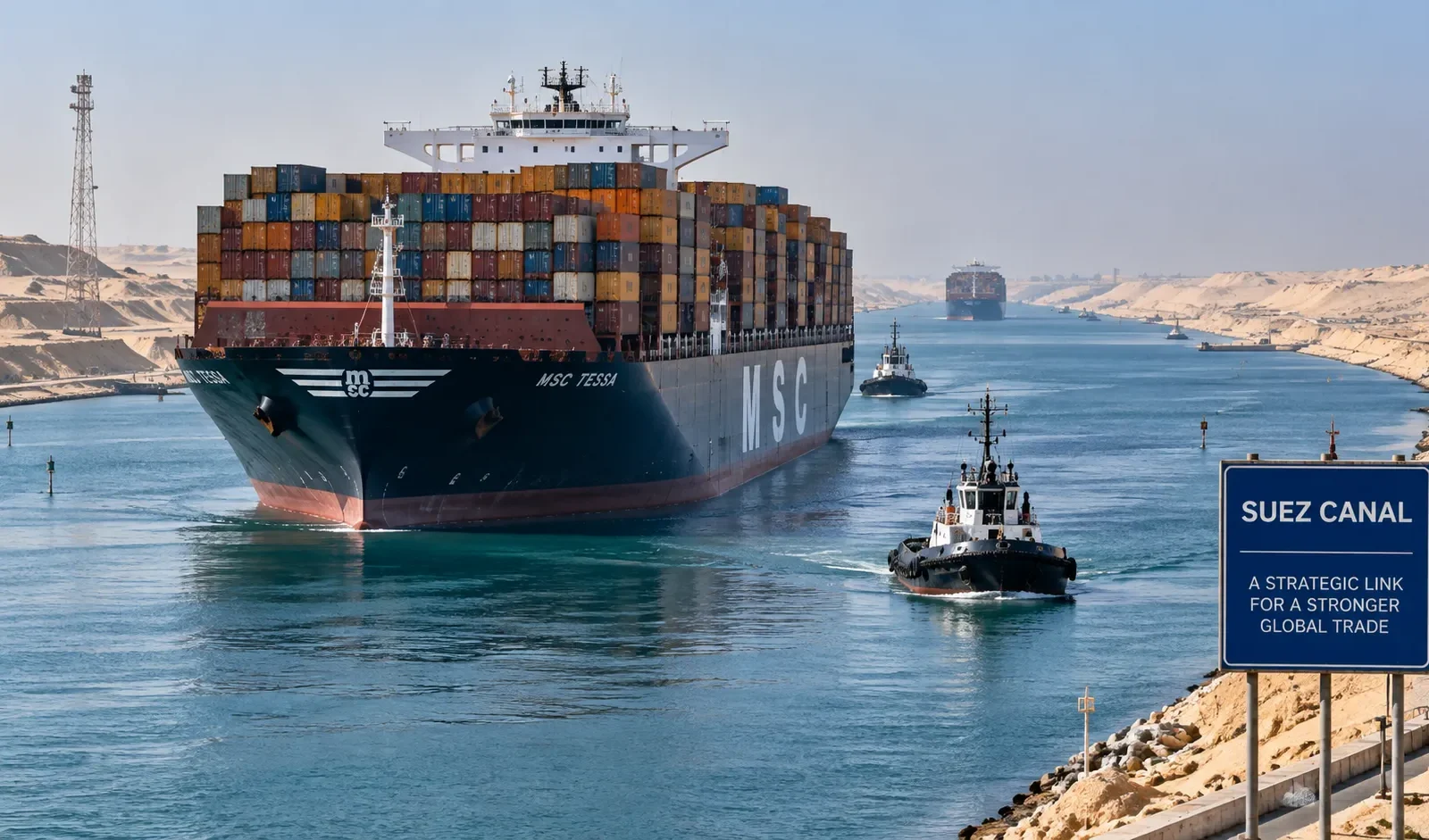
Suez Canal shipping is accelerating back into the Asia–Europe network — and the next disruption may come from speed, not delay.
Maersk and Hapag-Lloyd have expanded targeted trans-Suez operations through the Gemini Cooperation, including the AE19 and AE15 services, as carriers cautiously restore parts of the Red Sea–Suez corridor. The move cuts voyage time versus the Cape of Good Hope, but it also creates a less obvious operational risk: ships using two very different routings can now reach the same destination ports weeks apart from their original schedules — and sometimes much closer together than terminals planned for.
For the latest market context, see Tide Signal’s shipping week ahead.
That is why the return to Suez could produce a new phase of congestion even as transit times improve.
Market-monitoring data cited by Seatrade Maritime shows the problem clearly. In one Asia–North Europe comparison, average sailing time from Yantian to Rotterdam across Cape-routed services was around 41 days, while a vessel transiting via Bab el-Mandeb and the Suez Canal completed the route in 27 days.
That is not simply a 14-day efficiency gain. During a transition period, it can create a two-speed network: older sailings remain on the longer Cape route while newer sailings take the shorter Suez route. The faster ship can begin catching up with ships that departed earlier.
When enough services make that switch, the result can be vessel bunching, berth-window pressure, container-yard congestion, equipment imbalance and inland delays at destination ports.
Suez Canal Shipping Is Returning — But Not All at Once
The industry is not seeing a single coordinated return to the Red Sea and Suez Canal.
Instead, carriers are restoring individual services after route-by-route security assessments.
Maersk said on 9 September that the AE19 and AE15 Gemini services would transit through the Suez Canal rather than around the Cape of Good Hope. The company described the changes as a measured step towards a gradual return, while stressing that they do not represent a broad return of the entire East–West network.
That distinction is crucial.
If every service changed routing at the same time, networks could theoretically be re-phased around a common transit time. A staggered return is harder. Some strings continue around Africa, others move through Suez, and customers, terminals and inland networks must handle both schedules simultaneously.
Xeneta describes the recovery in similar terms. Its latest Red Sea recovery analysis says weekly deployed capacity crossing Bab el-Mandeb has risen sharply year on year, but remains only about 23% of pre-crisis levels. The recovery is being led by selected services and larger ships rather than a full restoration of the old network.
The Hidden Risk: Two Routes, One Destination
For almost three years, the Cape diversion became embedded in shipping schedules. Operators, terminals, warehouses and importers adapted to longer rotations and later arrivals.
A return through Suez reverses that logic quickly.
A vessel sailing via the Cape may require roughly two additional weeks on a typical Asia–North Europe voyage compared with a trans-Suez voyage. If the next weekly sailing switches to Suez, the newer departure can arrive only a few days behind the earlier vessel.
That is the core bunching risk.
| Network effect | Cape routing | Suez routing | Transition risk |
|---|---|---|---|
| Transit time | Longer | Shorter | Later sailing may catch earlier sailing |
| Port ETA | Built around Cape schedule | Moves forward materially | Berth windows can compress |
| Container flow | Longer inventory cycle | Cargo arrives earlier | Yard and warehouse peaks intensify |
| Fleet requirement | More ships needed per loop | Fewer ships may be needed | Capacity can be released back into market |
The shipping system therefore faces a paradox: the faster route can temporarily create more disruption because the network was built around the slower one.
Why Port Congestion Could Come Next
Container terminals work around planned windows, yard density, crane allocation, pilotage, tug availability, truck capacity, rail slots and empty-container flows.
They can absorb normal schedule variation. The harder problem is when several large vessels arrive much closer together than expected.
That can create pressure across six layers of the logistics chain.
1. Berth windows
A vessel arriving 10–14 days earlier than the Cape-based schedule may no longer fit the original terminal plan. If several services accelerate simultaneously, terminals have less flexibility to move ships without creating knock-on delays.
2. Crane and labour demand
Modern Asia–Europe container ships can exchange thousands of boxes in a single call. Two large vessels bunching together can sharply increase crane and labour requirements over a short period.
3. Yard density
Faster arrivals bring import containers into the terminal earlier. If consignees, hauliers and warehouses are still planning around the previous ETA, containers can remain in the yard longer than expected and reduce terminal fluidity.
4. Empty-container positioning
The Cape diversion changed where equipment accumulated and how quickly boxes returned into export circulation. Shorter loops can shift those flows again, creating temporary shortages in one location and surpluses in another.
5. Feeder and transshipment connections
Mainline vessels arriving ahead of plan can miss the feeder sequence originally built around their Cape ETA. Conversely, several mainline arrivals within a narrow period can overload feeder capacity.
6. Inland transport
Truck and rail networks do not instantly add capacity because a vessel arrives early. A surge in discharge volume can therefore move congestion from the quay to the gate or inland terminal.
This is why port waiting should be treated as a commercial risk rather than only an operational inconvenience. Tide Signal’s Voyage ETA Calculator separates sea passage time from port waiting for exactly this reason: a shorter ocean transit does not guarantee a shorter total cargo journey if the terminal cannot absorb the arrival.
The Network Is Already Under Pressure
The potential Suez bunching problem is arriving at a time when several container gateways are already dealing with operational stress.
Hapag-Lloyd’s early-September operational update reported yard density of around 69% at Jeddah, 73% at Salalah with berthing delays of up to 36 hours, more than 77% at Mundra, more than 90% at Nhava Sheva and delays of 48–72 hours at Colombo under the conditions reported by the carrier.
Those delays are not evidence that Suez returns have already caused congestion. They are important because they show that parts of the network have limited spare operational capacity while routing patterns are changing.
Maersk has also warned that congestion continues to affect major North European and Mediterranean gateways, while industrial action and weather-related disruption have added further pressure to schedule recovery.
That means the return to Suez is not happening into a perfectly balanced network.
It is happening into a network that is already managing typhoon disruption in Asia, port congestion, labour issues, inland bottlenecks and strong seasonal cargo flows ahead of the fourth quarter.
Why 14 Days Matters More Than It Sounds
Fourteen days is not simply two weeks removed from a voyage.
On a weekly liner service, it can represent two full sailing intervals.
Imagine Vessel A departs Asia on 1 September via the Cape. Vessel B departs one week later, on 8 September, but is routed through Suez and gains roughly 14 days.
Vessel B could theoretically reach Northern Europe about a week before Vessel A, despite having departed later.
Real networks are more complicated than that simplified example, but the principle is exactly why carriers and terminals must carefully phase the transition.
Departs Week 1
Cape route
Longer transit
Departs Week 2
Suez route
~14 days faster
Both vessels can converge on the same destination window
Maersk and Hapag-Lloyd Are Moving Gradually
The carriers appear well aware of the transition risk.
Maersk has repeatedly described its return to the Suez corridor as gradual and security-led rather than a full immediate restoration.
Its AE19 structural change was announced in August, followed by additional targeted changes involving AE15 and other services. The company has stressed that the decisions follow security assessments and do not yet amount to a blanket East–West return.
The Suez Canal Authority has also reported increasing Maersk container-ship traffic. On 22 August, the 17,200-TEU Bangkok Maersk made its first canal transit on an Asia–Europe operation. The authority said 57 vessels transited the canal that day with total net tonnage of 2.8 million tonnes.
The vessel’s master said routing through Suez instead of around Africa can save approximately 14 days, according to the Suez Canal Authority.
For shippers, that is the attraction.
For network planners, it is also the challenge.
Could Faster Suez Transits Push Container Rates Lower?
The impact on freight rates may become just as important as the impact on ports.
Cape diversions absorb ships because longer voyages require more vessels to maintain the same weekly service frequency.
When a service returns to Suez, its round-trip duration falls. That can reduce the number of ships required in the loop and release tonnage back into the wider market.
More effective capacity can place downward pressure on freight rates if cargo demand does not increase at the same pace.
But the effect will not necessarily be immediate or uniform.
Carriers can blank sailings, redeploy ships, slow steam, restructure service strings or use released capacity in other trades. Meanwhile, temporary congestion from bunching could reduce schedule efficiency and offset part of the theoretical capacity gain.
The result may be a market where structural capacity increases while short-term operational friction remains high.
That tension is one of the most important signals to watch in container shipping through the rest of 2026.
Suez vs Cape: The Commercial Trade-Off Is Changing Again
The Cape route became the default response to elevated Red Sea security risk because it avoided Bab el-Mandeb and the southern Red Sea.
Its disadvantage was always time and cost.
Longer distance means more vessel days, additional fuel consumption, greater fleet requirement and slower cargo cycles. Those costs helped support freight rates and tightened effective container-ship capacity.
Suez reverses those effects:
- shorter sea passage;
- lower fuel consumption for the same service;
- faster container turnaround;
- fewer vessel days per loop;
- potential release of fleet capacity;
- earlier cargo delivery;
- but renewed Red Sea security exposure.
For commercial operators, the choice is therefore not simply “short route versus long route”. It is a trade-off between transit efficiency, security risk, insurance exposure, schedule reliability and network stability.
Tide Signal’s War Risk Premiums in Shipping guide explains why a shorter physical route can still become more expensive when insurance, crew risk and operational restrictions rise.
What Shippers Should Watch Now
- More Gemini services switching to Suez: each new service increases the chance of overlapping Cape and Suez arrivals.
- North Europe berth waiting times: Rotterdam, Antwerp-Bruges, Hamburg, Bremerhaven and other gateways will show whether the transition is producing bunching.
- Mediterranean transshipment pressure: Port Said, Tangier, Jeddah and other hubs can reveal congestion before it reaches final destination ports.
- Schedule reliability: the key question is whether shorter transit becomes more reliable transit.
- Spot freight rates: sustained capacity release could change the supply-demand balance.
- Blank sailings and vessel redeployment: these will show how carriers absorb released capacity.
- Red Sea security: any deterioration could reverse routing decisions quickly.
What Could Stop the Suez Return?
The biggest variable remains security.
The Red Sea route may be shorter, but carriers will not fully normalise networks unless they believe the risk to ships, crews and cargo is manageable.
That is why the current return should be described as selective and reversible.
A single major security deterioration could send services back around the Cape and recreate longer voyage cycles almost immediately.
Operational planners therefore face an unusual problem: they must prepare for faster arrivals without assuming the faster route is permanent.
That uncertainty can itself reduce efficiency because terminals, shippers and inland operators need contingency plans for two routing regimes at the same time.
The Bigger Story: Shipping Is Moving From Diversion Risk to Reconnection Risk
For the past several years, the container market focused on the cost of avoiding the Red Sea.
The next phase may be about the cost of reconnecting it.
The Cape diversion stretched supply chains, absorbed ships and extended delivery times. A return to Suez can undo those effects — but not instantly and not neatly.
Networks that were deliberately slowed down now have to speed up again.
Berth windows have to move. Equipment cycles have to shorten. Inland delivery plans have to adjust. Ships can be released from loops. Cargo can arrive earlier than expected. Some services may return while others remain diverted.
That is exactly the environment in which congestion can emerge even though the underlying route has become more efficient.
The return to Suez solves one shipping problem but can create another.
Shorter Asia–Europe voyages reduce time and fuel exposure, but a staggered transition from Cape routing creates a two-speed network. If later Suez sailings catch earlier Cape vessels, the pressure moves from the sea passage to berth windows, yards, feeder connections and inland logistics. The next disruption may therefore come not from ships arriving late — but from too many arriving early.
Suez Canal Shipping FAQ
Are container ships returning to the Suez Canal?
Yes, selected services are returning. Maersk and Hapag-Lloyd have moved specific Gemini services including AE19 and AE15 back to trans-Suez routing. The companies describe the process as gradual rather than a full return of all East–West services.
Why can returning to Suez cause port congestion?
Suez voyages can be materially faster than Cape routings. During the transition, later Suez sailings may catch earlier Cape-routed vessels, causing several ships to arrive within compressed terminal windows.
How much time can the Suez route save?
The saving depends on the port pair and service. A recent market comparison cited a 27-day Yantian–Rotterdam Suez transit versus around 41 days for Cape-routed services, while the Suez Canal Authority has cited an approximately 14-day saving for a large Asia–Europe container ship.
Will the Suez return reduce container freight rates?
Potentially. Shorter round voyages can reduce the number of vessels required to maintain a weekly service, releasing effective capacity. Whether freight rates fall depends on demand, blank sailings, vessel redeployment, congestion and carrier capacity management.
Is the Red Sea route fully normal again?
No. Carriers are making service-specific routing decisions and continue to stress security assessments. The return remains gradual and could be reversed if the security situation deteriorates.
What should cargo owners monitor?
Shippers should monitor revised ETAs, port congestion, blank sailings, service-route changes, feeder connections, equipment availability and whether individual bookings are routed via Suez or the Cape.
Sources and Further Reading
- Maersk — Europe Market Update, September 2026
- Maersk — Structural changes to AE19 Gemini service
- Xeneta — Red Sea Signals Recovery Report
- Seatrade Maritime — Suez returns raise bunching fears
- Suez Canal Authority — Bangkok Maersk first transit
- Hapag-Lloyd — Middle East Operational Update, Week 36