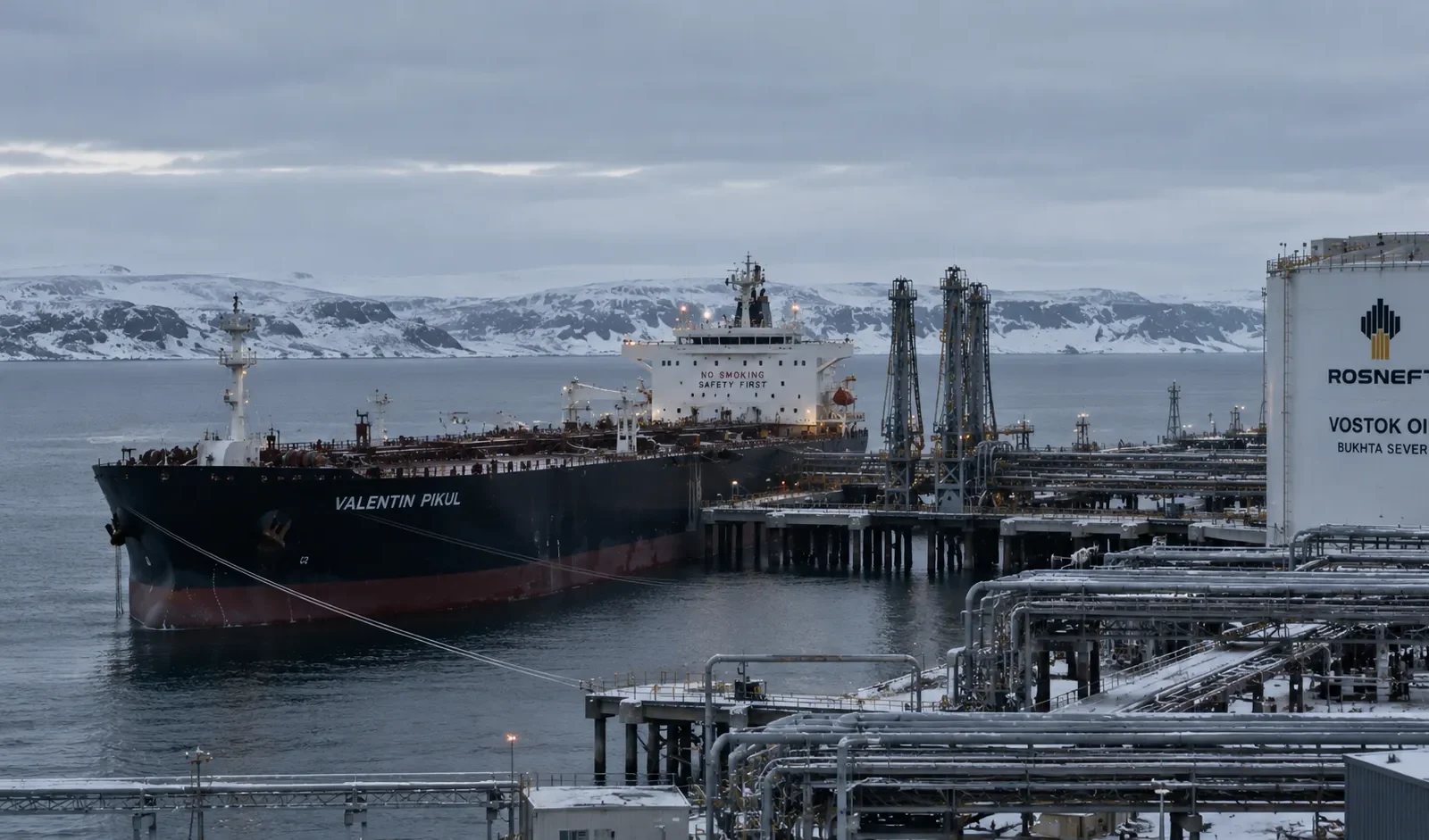
Vostok Oil first cargo loading has begun at Russia’s new Bukhta Sever terminal, moving one of the country’s largest Arctic energy projects from construction into physical crude exports. The first parcel is being loaded onto Valentin Pikul, a Russia-flagged tanker identified by U.S. sanctions authorities, while a second tanker is already positioned for the next cargo. The commercial test now shifts from building the infrastructure to proving that Russia can move large volumes through the Arctic reliably, legally and at scale.
Markets · Operations · Arctic Shipping
The Vostok Oil first cargo is a genuine logistics milestone, but it is not yet proof of a 30–50 million tonne export system. Russia has completed the pipeline-to-terminal chain and begun loading crude. The next phase depends on tanker availability, ice capability, seasonal navigation, sanctions exposure, financing, insurance and enough end-user demand to support a much larger Arctic fleet.
Vostok Oil First Cargo: What Happened
Rosneft announced on 6 September that the Vostok Oil project had been commissioned and that the first oil from the new production system was being loaded at Bukhta Sever onto Valentin Pikul.
The ceremony marked the opening of the Vankor–Payakha–Bukhta Sever main oil pipeline and the first use of the new Arctic terminal as an export outlet. Russian President Vladimir Putin joined by video link, while Rosneft CEO Igor Sechin was at Bukhta Sever.
The significance of the Vostok Oil first cargo is therefore physical, not merely political: crude has now moved through the newly built trunk pipeline to a dedicated deepwater Arctic terminal and into a tanker.
The first loading is confirmed by Rosneft. The larger claims about future production, export volumes and market impact remain company targets and analysis until those volumes are actually produced and shipped.
Bukhta Sever: A New Arctic Oil Gateway Built for Scale
The infrastructure behind the Vostok Oil first cargo is substantial. Rosneft says the new Vankor–Payakha–Bukhta Sever pipeline extends 790 km and has a design capacity of 100 million tonnes per year.
According to the company, 414 km of the route was built as a double-line system and a six-kilometre section passes beneath the Yenisei River.
At the port, Rosneft says the current complex includes:
- one oil-loading berth;
- two cargo berths;
- a berth for the port fleet;
- 14 storage tanks, each capable of holding 30,000 tonnes;
- 18 metres of water depth at the loading berth;
- a protective structure designed for heavy Arctic ice conditions.
The company says the berth can accommodate Arctic tankers around 120,000 dwt. Full development is planned to include a much larger tank farm.
Valentin Pikul: The First Loading Vessel Is Sanctions-Listed
The tanker used for the Vostok Oil first cargo adds a major sanctions dimension to the story.
The U.S. Treasury’s Office of Foreign Assets Control identifies Valentin Pikul, IMO 9885879, as a Russia-flagged tanker linked to Rosnefteflot. The vessel was identified in the 10 January 2025 Russia-related sanctions action.
OFAC’s designation record lists Valentin Pikul by IMO number and links it to Rosnefteflot. The U.S. Treasury’s accompanying release also identifies the vessel among Rosnefteflot-owned or operated ships targeted in the action.
An EU Council document published in 2026 also lists VALENTIN PIKUL — IMO 9885879 among vessels covered by restrictive measures related to Russian oil transport. The relevant document can be viewed in the Council of the European Union document register.
A tanker can be technically capable of loading cargo but commercially constrained by sanctions. Vessel acceptance, insurance, banking, port access, counterparties and service providers can all become part of whether the cargo can move through the wider international system.
That is why the sanctions angle should not be reduced to a label in the headline. It is a logistics issue. The more Vostok Oil scales, the more the project will need a repeatable chain of vessels, finance, insurance, technical support and cargo buyers that can operate within the applicable legal restrictions.
A Technical Detail: Rosneft Says Arc7, the Register Shows Arc6
There is an important technical discrepancy around Valentin Pikul that a serious maritime report should not ignore.
Rosneft and S&P Global’s report on the first loading describe Valentin Pikul as an Arc7 ice-class tanker.
However, the current Russian Maritime Register of Shipping vessel record for IMO 9885879 lists the ship with class notation KM(*) Arc6, deadweight 69,322.81 tonnes, length overall 257.30 metres and build date 25 December 2024.
This is exactly the type of technical detail that can affect how analysts assess navigation capability, fleet requirements and future winter operating patterns.
Akademik Gubkin Is Positioned for the Next Cargo
Rosneft says the Aframaxtype tanker Akademik Gubkin, approximately 120,000 dwt, was already waiting at anchorage to receive oil after Valentin Pikul.
That matters because a second loading would begin to show that the Vostok Oil first cargo is not a one-off ceremonial movement.
But it also illustrates the distinction between summer accessibility and year-round Arctic logistics. Conventional or lower-ice-class vessels can potentially participate during favourable navigation periods, while winter operations demand a much more specialised fleet and icebreaking support.
The U.S. Treasury’s January 2025 sanctions release also lists Akademik Gubkin, IMO 9842190, among Rosnefteflot vessels identified in the same action. That means sanctions exposure is not limited to the first loading ship.
From One Cargo to 50 Million Tonnes: The Scale-Up Gap
Rosneft’s stated targets are ambitious.
| Stage | Stated volume / capacity | Status |
|---|---|---|
| First cargo | Loading started September 2026 | Confirmed |
| Second half 2027 | 30 million tonnes | Rosneft target |
| 2030 | 50 million tonnes | Rosneft target |
| Potential later scale | Up to 100 million tonnes/year | Conditional on demand and economics |
| Pipeline design | 100 million tonnes/year | Infrastructure design capacity |
S&P Global reports that Rosneft is targeting 30 million tonnes of supply from the second half of 2027, rising to 50 million tonnes by 2030 and potentially 100 million tonnes per year if market demand and economic conditions support further development.
The company says total investment in the integrated project has reached around RUB4 trillion.
The crucial distinction is that pipeline capacity does not automatically equal export capacity. A 100 million tonne pipeline can only create a 100 million tonne seaborne system if production, storage, berths, tankers, icebreaking, buyers and sanctions-compliant logistics all scale with it.
Vostok Oil First Cargo: Five Critical Shipping Risks
This is why the Vostok Oil first cargo should be read as the beginning of a maritime test, not the completion of one.
The Northern Sea Route Is Central to the Project’s Economics
Vostok Oil is designed around a direct Arctic outlet. That makes the Northern Sea Route part of the project’s commercial architecture rather than an optional alternative.
For eastbound cargoes, the route can reduce distance compared with sending barrels from Russia’s western export ports through the Suez Canal. But headline distance savings are not the same as net voyage economics.
Operators must consider:
- ice-class requirements;
- icebreaker support;
- seasonal navigation windows;
- weather and ice uncertainty;
- specialised crewing and technical standards;
- sanctions-related insurance and banking constraints;
- possible shuttle-and-transfer logistics;
- the location of the final buyer.
For voyage-time sensitivity, Tide Signal’s Voyage ETA Calculator can compare sea time across alternative distances and speeds. For the commercial side, the Voyage Margin Calculator can test how freight, bunker and voyage costs change voyage economics.
What Vostok Oil Could Mean for the Tanker Market
If Rosneft reaches even its nearer-term targets, Vostok Oil could create a meaningful new stream of crude cargoes originating directly from the Russian Arctic.
The tanker-market effect would depend on how the transport chain is structured.
One model is direct Arctic-to-market delivery by ice-capable vessels. Another is a shuttle model in which specialised Arctic tankers move crude to a less ice-constrained transfer point, where cargo is reloaded onto conventional tonnage.
That second model would increase the importance of transfer logistics and vessel compatibility. Tide Signal’s Ship-to-Ship Operations guide explains the planning, mooring, fendering, hose, weather and pollution-control requirements behind STS transfers.
Vostok Oil does not automatically create a bullish Aframax or Suezmax story. The effect depends on cargo size, shuttle structure, destination, sanctions availability and the number of vessels effectively removed from mainstream trading to support the Arctic system.
Where sanctions restrict vessel interchangeability, the “effective fleet” can be smaller than the physical fleet. This is similar to the broader market effect seen when vessel-specific political or legal risk limits charterer acceptance. Tide Signal examined that dynamic in U.S. Strikes Iranian Oil Tankers: Gulf Tanker Risk Repriced.
Sanctions Turn Shipping Infrastructure Into a Compliance Question
The Vostok Oil first cargo is unusual because the project is entering commercial shipping with sanctions already embedded in parts of the vessel and corporate chain.
This does not mean every transaction involving Russian crude is automatically prohibited everywhere. Sanctions rules vary by jurisdiction, party, vessel, service and transaction structure. But a specifically listed vessel creates a much more direct compliance issue than general country risk.
For charterers, traders, banks, insurers, ports and service providers, due diligence can include:
- IMO-number verification;
- beneficial ownership and operator checks;
- sanctions-list screening;
- cargo origin and price documentation;
- insurance and P&I status;
- payment-bank acceptability;
- port and service-provider restrictions;
- STS and voyage-history review where relevant.
Tide Signal’s War Risk Premiums in Shipping explains a different but related mechanism: how political and security exposure becomes a direct commercial cost attached to ships and voyages.
Why Ice-Class Tankers May Be the Real Bottleneck
S&P Global identifies specialised tanker availability as a central challenge to scaling Vostok Oil. That is commercially credible because annual export targets in the tens of millions of tonnes require repeat voyages, not isolated liftings.
A 30 million tonne annual system requires roughly 2.5 million tonnes per month on average. At 50 million tonnes, the average rises to about 4.17 million tonnes per month.
Those are not predictions of actual 2027 or 2030 monthly exports. They simply illustrate the shipping scale implied by Rosneft’s annual targets.
What the First Cargo Proves — and What It Does Not
| The first cargo proves | It does not yet prove |
|---|---|
| The trunk pipeline can deliver crude to Bukhta Sever. | That 30 million tonnes will be exported in 2027. |
| The new terminal can load an oil tanker. | That the fleet can sustain year-round large-scale exports. |
| A dedicated Arctic export chain now exists physically. | That sanctions will not constrain future counterparties. |
| Russia has moved Vostok Oil into the shipping phase. | That the route is commercially superior for every buyer or season. |
Seven Things to Watch After the Vostok Oil First Cargo
- Second loading: whether Akademik Gubkin loads as planned and how quickly cargoes begin to follow one another.
- Actual cargo size: the quantity lifted by Valentin Pikul and subsequent tankers.
- Destination: whether crude moves directly to Asia, westbound, or through an intermediate transfer system.
- Ice-class fleet growth: deliveries, availability and actual operational use of Arctic-capable tankers.
- Sanctions enforcement: new vessel designations, port restrictions or service-provider action.
- Winter continuity: whether commercial loadings continue as Arctic navigation conditions become more demanding.
- 2027 run-rate: whether actual export volumes begin approaching the scale required for Rosneft’s 30 million tonne target.
For broader chokepoint and route-risk context, Tide Signal’s Maritime Chokepoints Explained examines how geography changes voyage planning and freight exposure. For today’s fuel-cost backdrop, see Bunker Fuel Shortage 2026.
Tide Signal Analysis: Vostok Oil Has Entered Its Harder Phase
Building a 790 km pipeline and a new Arctic oil terminal is an engineering achievement. But for shipping markets, the harder phase begins after the first loading.
Vostok Oil must now prove that it can convert physical infrastructure into a repeatable export system under some of the world’s most difficult operating conditions.
That means building or securing enough suitable tankers, maintaining winter navigation, managing sanctions exposure, keeping finance and insurance channels open where legally possible, and finding enough buyers to justify the cost of the Arctic logistics chain.
The Vostok Oil first cargo therefore matters because it changes the question.
The question is no longer: Will the terminal open?
It is now: How much crude can this system actually move, through which vessels, to which markets, and at what commercial cost?
Vostok Oil has crossed from infrastructure into shipping. The first cargo is real. The 30–50 million tonne scale-up remains to be proven. For tanker markets, the decisive variables are now ice-capable tonnage, sanctions, winter logistics and the economics of moving Russian Arctic crude to end users.
Vostok Oil First Cargo: Frequently Asked Questions
What is the Vostok Oil first cargo?
It is the first crude being loaded from Rosneft’s Vostok Oil system through the new Bukhta Sever Arctic terminal after commissioning of the Vankor–Payakha–Bukhta Sever pipeline.
Which tanker is loading the first Vostok Oil cargo?
Rosneft says the first oil is being loaded onto Valentin Pikul, IMO 9885879.
Is Valentin Pikul sanctioned?
Yes. OFAC identifies Valentin Pikul in its Russia-related sanctions action and links the vessel to Rosnefteflot. An EU Council document also lists the same vessel and IMO number under restrictive measures.
Is Valentin Pikul Arc7?
Rosneft describes the ship as Arc7, but the current Russian Maritime Register of Shipping record for IMO 9885879 shows class notation Arc6. Tide Signal therefore treats the class description as a documented discrepancy rather than presenting Arc7 as independently confirmed.
How large is Valentin Pikul?
The Russian Maritime Register of Shipping lists deadweight at 69,322.81 tonnes and length overall at 257.30 metres.
What tanker is expected to load next?
Rosneft says the approximately 120,000 dwt Akademik Gubkin was already waiting at anchorage to receive the next cargo.
How much oil does Rosneft plan to export from Vostok Oil?
Rosneft has stated a target of 30 million tonnes from the second half of 2027, rising to 50 million tonnes by 2030, with potential later expansion toward 100 million tonnes per year subject to demand and economic conditions.
Why is Vostok Oil important for shipping?
The project creates a new crude export stream directly from the Russian Arctic, potentially increasing demand for specialised ice-capable tankers, shuttle logistics and Northern Sea Route operations.
Related Tide Signal Analysis & Tools
- Ship-to-Ship Operations — STS planning, mooring, fenders, hoses and transfer risk.
- War Risk Premiums in Shipping — how political exposure reaches voyage cost.
- U.S. Strikes Iranian Oil Tankers — vessel-specific risk and tanker acceptance.
- Bunker Fuel Shortage 2026 — marine-fuel costs and voyage economics.
- Voyage ETA Calculator — compare passage time under alternative distance and speed assumptions.
- Voyage Margin Calculator — test freight, bunker and operating-cost assumptions.
- Types of Charter Parties — voyage and time-charter risk allocation.
- Maritime Chokepoints Explained — route geography and trade-flow risk.
- Rosneft — Vostok Oil Project Commissioned: Vladimir Putin Launches First Oil Shipment, 6 September 2026.
- S&P Global — Russia launches major Vostok Oil project with first Arctic loading, 6 September 2026.
- U.S. Treasury / OFAC — Russia-related designations, 10 January 2025.
- U.S. Treasury — sanctions targeting Russian oil production and exports, 10 January 2025.
- Russian Maritime Register of Shipping — Valentin Pikul, IMO 9885879.
- Council of the European Union — vessel listing including Valentin Pikul, IMO 9885879.
Reporting status: 7 September 2026. Confirmed facts are attributed to primary or authoritative sources. Rosneft production and export figures are identified as company targets, not achieved volumes. The Arc6/Arc7 discrepancy is disclosed because the current class-register record differs from Rosneft’s description.