China’s accelerating vehicle exports are tightening the global car-carrier market again. Rising charter rates, limited near-term capacity and automakers building their own fleets point to a structural change in automotive shipping.
China’s automotive export machine is expanding faster than the shipping system built to carry it.
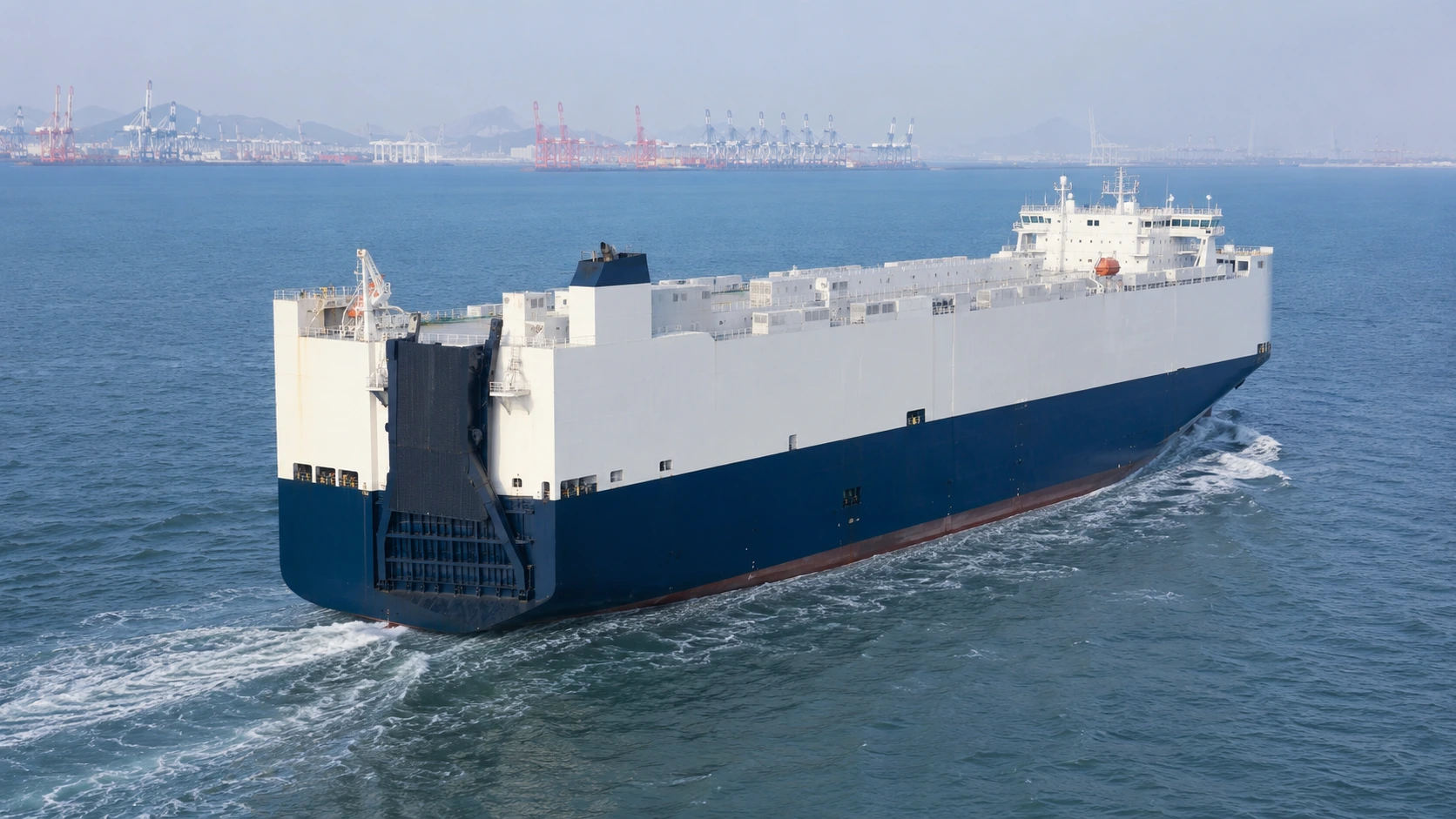
Vehicle exports increased sharply during the first half of 2026 and accelerated again in July, as weakening domestic demand pushed Chinese manufacturers to look more aggressively toward overseas markets. At the same time, charter rates for modern Pure Car and Truck Carriers, or PCTCs, have rebounded from their early-year levels.
The immediate result is a familiar shipping-market tension: a growing cargo base is competing for specialised tonnage that cannot be added quickly. But the longer-term development is more significant. Chinese automakers are no longer acting only as shippers. Some are becoming vessel owners, long-term capacity buyers and direct participants in global automotive logistics.
Exports are becoming essential to China’s automakers
China exported approximately 923,000 vehicles in July, an increase of 88.2% from the same month a year earlier, according to data cited from the China Passenger Car Association.
The export surge contrasted sharply with the domestic market. Chinese passenger-vehicle sales declined for a tenth consecutive month, falling more than 20% year on year. Exports of electric and plug-in hybrid vehicles increased particularly rapidly.
That divergence matters for shipping. International expansion is no longer an optional growth channel for many Chinese manufacturers. It is increasingly necessary to absorb production and defend factory utilisation as competition and oversupply intensify at home.
China’s monthly vehicle exports exceeded one million units for the first time in June. Estimates from automotive and maritime analysts now suggest total light-vehicle exports across all transport modes could approach 10 million units in 2026, compared with approximately 1.6 million in 2021.
Important distinction
The 10-million forecast covers vehicle exports across different transport modes. It should not be interpreted as ten million vehicles moving exclusively by sea or exclusively on PCTCs.
Car-carrier charter rates are rising again
The vehicle-carrier market had been expected to soften as a large newbuilding orderbook entered service. At the beginning of 2026, benchmark charter rates for a 6,500-CEU PCTC were reported near $45,000 per day, well below the exceptional levels recorded during the earlier market peak.
That correction has reversed rapidly. VesselsValue data cited in July placed the one-year rate for a 6,500-CEU vessel at approximately $67,000 per day, while newer ships were reportedly moving toward $100,000 per day by early August.
Published market reporting on 14 August indicated that charter rates had increased approximately 65% during 2026. The exact rate depends heavily on vessel size, age, fuel efficiency, specification, employment period and delivery position, but the direction is clear: export growth is absorbing capacity faster than many expected.
The market is not short of ships everywhere. It is short of the right ships, in the right position, with the right capacity and trading flexibility.
Why a large orderbook has not removed the pressure
The global PCTC fleet is expanding. Earlier industry analysis estimated that the delivery pipeline could increase capacity by approximately 40% over several years.
In theory, that should place substantial downward pressure on charter rates. In practice, several factors are absorbing the additional supply:
- Rapid growth in Chinese vehicle exports
- Longer average trading distances into Europe, Latin America and other overseas markets
- Manufacturers securing ships under longer-term arrangements
- Limited availability of modern, high-capacity and fuel-efficient vessels
- Trade disruption and route changes that reduce effective fleet productivity
The orderbook still creates a real risk of future oversupply. If export growth slows, trade barriers strengthen or overseas production replaces Chinese exports, the balance could change quickly. For now, however, the cargo growth is arriving fast enough to tighten the prompt market.
Automakers are building control over the freight chain
The most important structural development may be the decision by Chinese manufacturers to secure their own ocean capacity.
BYD completed a fleet of eight vehicle carriers in 2025, giving the company estimated annual transport capacity of more than one million vehicles. Its vessels include units capable of carrying between approximately 7,200 and 9,200 cars.
For an automaker, owning or controlling ships can provide several advantages:
- More predictable access to export capacity
- Reduced exposure to sudden charter-rate increases
- Greater control over sailing schedules and destination markets
- Better coordination between factories, terminals and overseas distribution
- The ability to support expansion into markets underserved by existing services
But vertical integration also transfers shipping risk to the manufacturer. Vessel utilisation must remain high, routes must be balanced and expensive assets must be managed through changing automotive and freight cycles.
This does not eliminate the role of traditional car-carrier operators. It changes the relationship. Shipping companies may increasingly compete not only for cargo but also for long-term partnerships, fleet-management contracts and overflow volumes from manufacturer-controlled networks.
Containers are becoming an overflow solution
When specialised vehicle capacity becomes scarce or expensive, containers offer an alternative. Chinese vehicles are increasingly being loaded into standard containers using specialised racking systems, particularly for smaller consignments or destinations without regular PCTC services.
Containerisation offers flexibility and access to a much wider port network. It can also support smaller exporters that cannot commit enough volume to justify dedicated vehicle-carrier space.
However, it is not a complete substitute. Loading and securing vehicles inside containers can be operationally complex, reduces the efficiency available from roll-on/roll-off operations and may create additional handling, battery-safety and insurance considerations.
For container lines, the spillover nevertheless creates a commercial opportunity. Carriers with suitable equipment, loading systems and inland connections can capture part of a fast-growing automotive logistics market.
The commercial implications for shipping
For PCTC owners, the renewed rate strength improves earnings visibility and supports asset values. Modern vessels with large capacity and lower fuel consumption should remain particularly attractive to charterers.
For charterers and automakers, capacity strategy is becoming a board-level issue. Relying entirely on the spot or short-period market creates exposure to rate volatility and a potential inability to move production when export opportunities arise.
Ports and terminals are also affected. Higher vehicle flows require storage space, charging and safety procedures for electric vehicles, efficient rail and road connections, and the ability to process large export batches without congestion.
Shipyards face a more complicated decision. The current market supports additional demand for efficient PCTCs, but the orderbook is already substantial. Ordering into a tight spot market can still result in vessels being delivered into a very different freight environment.
A structural trade shift, not only a freight rally
China’s vehicle-export boom is often presented as an automotive story. Its maritime consequences are becoming equally important.
The increase in charter rates demonstrates the near-term pressure on available car-carrier capacity. The movement of vehicles in containers shows how the wider shipping system is adapting. Manufacturer-owned fleets reveal a deeper shift toward control of the logistics chain.
The central question is therefore not simply whether PCTC rates can remain near current levels. It is who will control automotive shipping capacity if China sustains exports close to ten million vehicles a year.
That answer will shape charter markets, vessel ordering, terminal investment and the competitive position of both established shipping companies and the automakers now entering their business.