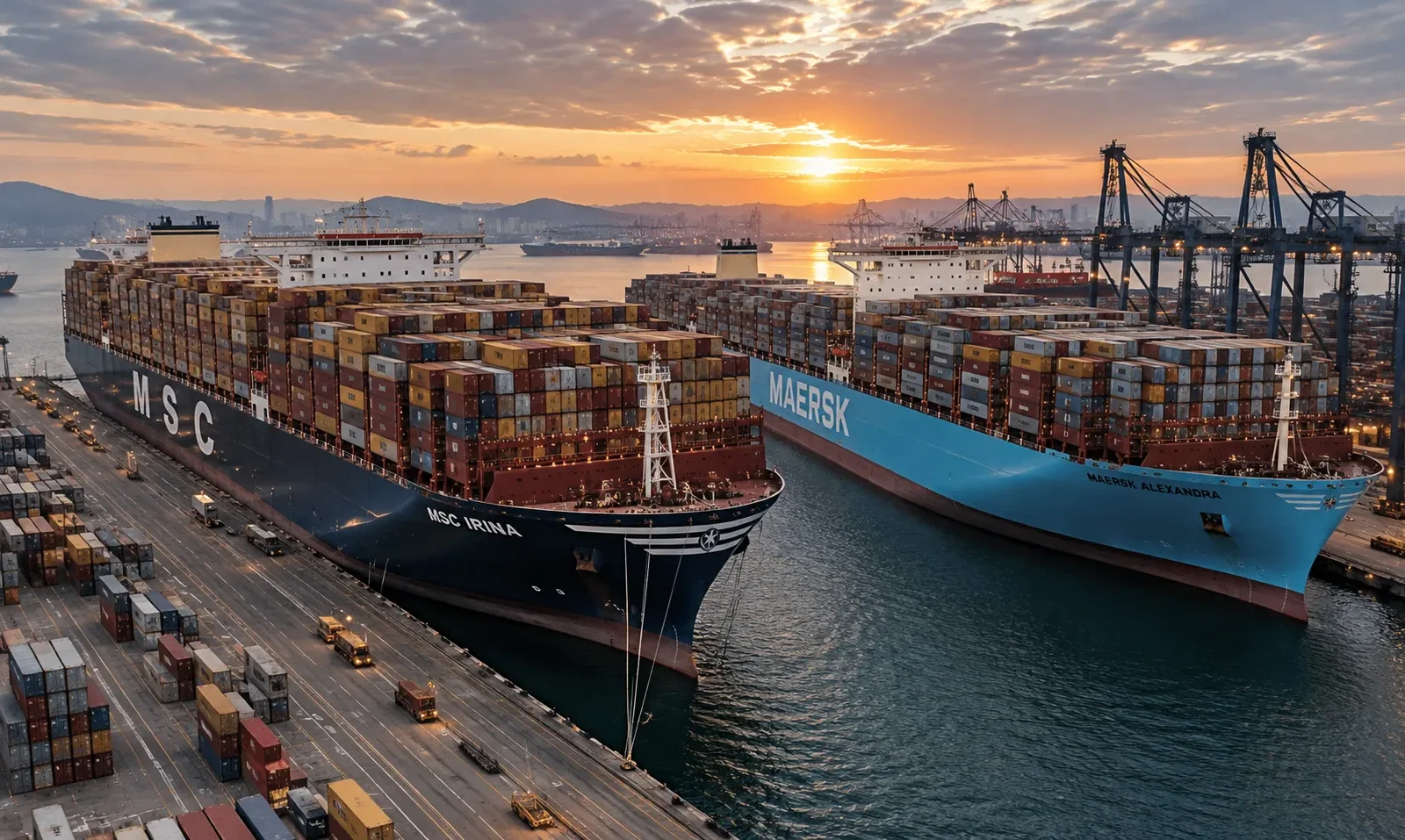
A Gigamax container ship carrying around 27,500 TEU could finally push container shipping beyond today’s 24,000-TEU ceiling. Alphaliner has revived a concept for a new generation of ultra-large containerships that would be only modestly larger than the biggest vessels now in service, yet capable of carrying more than 3,000 additional TEU.
No 27,500-TEU vessel has been ordered. No carrier has publicly committed to the class. But the concept matters because the economics behind ultra-large ships are changing again: fuel costs, carbon pricing, network concentration and ship-design optimisation are all making scale more valuable than it looked only a few years ago.
The proposed dimensions are important. A future Gigamax container ship would not necessarily be a 500-metre vessel requiring an entirely new port system. The concept is closer to an evolutionary extension of the present 24,000-TEU class: slightly longer, slightly wider, slower, fuller and more aggressively optimised around slot capacity.
Gigamax Container Ship: What Would a 27,500-TEU Vessel Look Like?
Alphaliner’s theoretical “Gigamax-25” concept is reported at about 414 metres in length and 63.3 metres in beam. That compares with roughly 400 metres by 61 metres for the largest current Megamax vessels.
The extra beam would allow containers to be stowed 25 rows across, while the design would extend cargo capacity further forward and support higher deck stacks through increased lashing-bridge height.
Industry reports describing the concept point to several likely design features:
- LNG dual-fuel propulsion;
- a design speed of about 18 knots or less;
- a fuller, highly optimised hull form;
- up to 13 tiers of high-cube containers on deck;
- 25 container rows across the beam; and
- additional container capacity over the forecastle area.
The commercial logic is straightforward: add significant slot capacity without increasing ship dimensions by the same proportion.
27,500 TEU vs 24,000 TEU: The Size Difference
| Specification | Current Megamax class | Gigamax concept | Approx. change |
|---|---|---|---|
| Nominal capacity | ~24,000 TEU | ~27,500 TEU | +3,500 TEU |
| Length | ~400 m | ~414 m | +14 m |
| Beam | ~61 m | ~63.3 m | ~+2.3 m |
| Rows across | Typically 24 | 25 | +1 row |
| Status | Commercially operating | Concept only | No confirmed order |
For reference, the 24,212-TEU CMA CGM Notre Dame is 399.9 metres long, 61.3 metres wide and has a reported draft of 16.5 metres. The Suez Canal Authority confirmed the vessel’s transit in June 2026, demonstrating how close today’s largest operating ships already are to the proposed Gigamax envelope.
Why a Gigamax Container Ship Could Make Economic Sense Again
The containership size race slowed around the 24,000-TEU level because the extra economies of scale became harder to capture. Bigger ships were technically possible, but the network around them became increasingly difficult to optimise.
The equation may now be changing.
Fuel prices, carbon-related costs and stricter emissions economics increase the value of carrying more containers on each long-haul sailing. If a ship can move materially more TEU without a proportionate rise in consumption, the cost per slot can fall.
That is the strongest argument for a Gigamax container ship.
Alphaliner’s concept suggests that a highly optimised vessel could carry roughly 7,000 more TEU than some older 20,500-TEU designs while consuming only marginally more fuel, according to industry reporting on the study.
The relevant measure is therefore not the ship’s absolute fuel bill. It is the fuel and carbon cost per transported TEU.
A larger vessel only creates value if the additional slots are actually filled.
The Gigamax case depends on high utilisation. A 27,500-TEU vessel sailing underloaded can lose the theoretical economies of scale very quickly.
Carbon Pricing Could Restart the Containership Size Race
For the last decade, the industry’s debate around vessel size was dominated by capital cost, port productivity and network flexibility.
Carbon economics adds another variable.
When fuel and emissions costs rise, a larger vessel can spread those costs across more slots. That is especially relevant on long-haul Asia–Europe services, where propulsion energy remains one of the largest voyage-cost components.
A larger mainline ship can spread:
- crew cost;
- technical management cost;
- capital cost;
- fuel consumption;
- route and canal costs; and
- carbon-related costs
across a greater nominal cargo base.
But there is no free scale. The vessel must still be filled, turned quickly and deployed on a route with enough cargo concentration to justify its size.
Can Ports Handle a Gigamax Container Ship?
This is the decisive question.
A shipyard can design a larger containership. The harder task is making sure the ports, terminals, cranes, channels, turning basins, feeder systems and inland networks can handle it without destroying the efficiency gained at sea.
Five constraints matter most.
1. Ship-to-shore crane outreach
A 25-row-wide vessel needs sufficient crane outreach to work the outboard row safely and productively. A terminal can have adequate berth length and draft but still be operationally constrained if its cranes do not reach far enough.
2. Berth length and mooring geometry
Fourteen additional metres is not dramatic at a major deep-sea terminal, but berth allocation is based on actual margins, adjacent ships, bollard positions, fender systems and manoeuvring space.
3. Turning circles and fairways
Longer and wider ships are more sensitive to local channel width, wind limits, tug requirements and manoeuvring restrictions.
4. Draft and under-keel clearance
The final loaded draft of any commercial Gigamax design may be more important than the headline TEU figure. Nominal capacity alone does not determine port compatibility.
5. Yard and landside capacity
This could be the largest constraint of all.
A terminal may be able to berth a 27,500-TEU vessel but struggle to absorb the cargo exchange. Larger calls create sharper peaks in crane demand, yard density, truck activity, rail slots and feeder connections.
The relevant question is therefore not simply whether the ship can enter the port. It is whether the port can process the ship without creating congestion elsewhere.
Bigger Ships Can Create Bigger Cargo Peaks
The port issue becomes even more important as Asia–Europe shipping begins to normalise through the Suez Canal.
Tide Signal recently examined why the return of container services to the Suez Canal could increase vessel bunching and port congestion risk. A future Gigamax container ship would amplify the same operational sensitivity because each call concentrates even more cargo into a single terminal window.
A larger exchange can mean:
- more crane demand over a shorter period;
- larger import-container peaks;
- greater feeder dependence;
- heavier truck and rail flows;
- more severe disruption when a berth window is missed; and
- larger knock-on effects when weather or equipment failures reduce productivity.
The ship is only more efficient if the terminal remains efficient alongside.
Could a 27,500-TEU Gigamax Container Ship Transit the Suez Canal?
Current 24,000-TEU-class ships already transit the Suez Canal.
The Suez Canal Authority confirmed the first canal transit of the 24,212-TEU CMA CGM Notre Dame in June 2026. The ship measures 399.9 metres by 61.3 metres with a reported draft of 16.5 metres.
A future Gigamax container ship would be only modestly longer and wider on the published concept dimensions. But no 27,500-TEU vessel exists today, so there is no confirmed Suez approval for such a class.
Actual compatibility would depend on the final design, loaded draft, displacement, manoeuvring characteristics and the Suez Canal Authority’s rules in force when the vessel enters service.
A Gigamax transit of Suez is plausible in dimensional terms, but it is not yet confirmed. Current 24,000-TEU vessels provide a useful benchmark, not an automatic approval for a future 27,500-TEU design.
Who Could Order the First Gigamax Container Ship?
Industry reporting around the Alphaliner concept has identified Maersk as a logical potential first mover, with MSC and COSCO also discussed as possible candidates.
That is market analysis, not a confirmed order.
The Maersk angle is particularly interesting because the carrier has not pursued the same 24,000-TEU flagship strategy as several competitors. A move directly toward 27,500 TEU would therefore represent a major strategic shift rather than a small incremental upgrade.
The structure of hub-and-spoke liner networks may also strengthen the theoretical case. Very large ships work best when they make fewer mainline calls and concentrate cargo through selected hubs.
The larger the ship becomes, the more important the feeder network becomes.
Why the Record Orderbook Makes the Timing Important
The Gigamax debate is emerging while container shipping is already going through one of the largest fleet-expansion cycles in its history.
Industry reporting in September placed the containership orderbook at roughly 14.7 million TEU across about 1,795 vessels, with ships above 10,000 TEU accounting for the majority of capacity on order.
That matters because the next move by the major liner companies could define the size ceiling for another decade.
If carriers continue ordering within the 16,000–24,000-TEU range, the current limit may survive the next fleet cycle.
If one carrier commits to a 27,500-TEU class and proves the economics, competitors will have to decide whether the extra scale is an advantage they can afford to ignore.
Would 27,500-TEU Ships Push Container Freight Rates Lower?
Not automatically.
A larger vessel increases potential slot supply, but freight rates depend on effective capacity relative to cargo demand.
A Gigamax container ship could reduce unit cost for the carrier and increase the number of slots available on an individual mainline sailing. If demand fails to keep pace, that can add downward pressure to rates.
But liner companies still control effective capacity through:
- blank sailings;
- slow steaming;
- service restructuring;
- vessel redeployment;
- scrapping older tonnage;
- hub-and-spoke concentration; and
- changes in sailing frequency.
The freight-market effect therefore depends on how carriers manage the additional capacity rather than on vessel size alone.
Why Gigamax Is Really a Network Story
The most important question is not whether naval architects can build the ship.
It is whether liner networks can use it efficiently.
A 27,500-TEU vessel needs deep and consistent cargo concentration. It is naturally suited to long-haul trunk routes linking a small number of major hubs.
Every extra direct port call makes the model harder because:
- more terminals need to be compatible;
- more berth windows must align;
- port time increases;
- cargo exchanges become larger and more complex;
- schedule recovery becomes harder; and
- utilisation can become uneven between calls.
That makes the Gigamax concept closely linked to the evolution of hub-and-spoke shipping.
The Gigamax Equation: Lower Cost per TEU vs Lower Flexibility
Lower fuel cost per slot
Lower carbon cost per slot
Fewer ship-days on trunk routes
Network concentration
Berth and crane constraints
Consequences of disruption
The balance will ultimately depend on fuel price, carbon cost, freight demand, ship utilisation, network design and port productivity.
What Could Stop the Gigamax Container Ship?
Low utilisation
The economics collapse if carriers cannot consistently fill the additional capacity.
Port productivity
If the larger cargo exchange adds hours alongside, some of the sea-going efficiency is lost at berth.
Infrastructure limits
Crane outreach, berth geometry, channel restrictions and turning areas may narrow the list of practical ports.
Network concentration risk
More cargo on fewer sailings means a casualty, mechanical failure or schedule disruption affects a larger volume of containers.
Fuel-transition uncertainty
A vessel ordered for the 2030s must remain viable through a rapidly changing fuel and emissions regime.
Existing overcapacity risk
The containership orderbook is already large. Carriers may prefer to absorb incoming tonnage before beginning another major size race.
What the Market Should Watch Next
- Orders above 24,500 TEU: the first firm contract would turn the concept into a market event.
- Maersk fleet strategy: any move beyond the current megamax ceiling would be strategically significant.
- Chinese and Korean yard activity: design enquiries can reveal whether the concept is moving closer to reality.
- Terminal crane orders: wider crane outreach may signal where ports expect the next ship-size step.
- Carbon economics: stronger fuel and emissions costs improve the case for scale only when utilisation remains high.
- Hub-and-spoke network growth: greater concentration around major hubs makes very large ships easier to deploy.
- Orderbook absorption: carriers must still manage the large amount of capacity already scheduled for delivery.
Has Container Shipping Found Its Next Size Class?
The 24,000-TEU ceiling has held for years because the next step offered uncertain returns.
The Gigamax container ship concept challenges that assumption.
If fuel and carbon economics continue to reward lower cost per slot, and if ports can absorb slightly larger dimensions without major reconstruction, 27,500 TEU may become commercially realistic.
But the real test will not be in the shipyard.
It will be in the network.
The barrier to 27,500 TEU is no longer whether a larger ship can be designed. It is whether the entire network around that ship can remain efficient.
A Gigamax container ship can lower unit costs only if carriers fill it, ports turn it quickly, cranes reach it, hubs absorb the cargo pulse and feeder networks move the boxes onward. If one of those links fails, economies of scale at sea can become diseconomies of scale ashore.
Gigamax Container Ship FAQ
What is a Gigamax container ship?
A Gigamax container ship is a proposed ultra-large containership class beyond today’s roughly 24,000-TEU Megamax vessels. Alphaliner has modelled a concept of around 27,500 TEU, approximately 414 metres long and 63.3 metres wide.
Has a 27,500-TEU containership been ordered?
No confirmed order has been publicly announced. The 27,500-TEU Gigamax remains a concept rather than an active commercial ship class.
How much larger is it than current 24,000-TEU vessels?
The concept is about 14 metres longer and roughly 2.3 metres wider than the largest current 24,000-TEU-class ships, while offering around 3,500 additional nominal TEU.
Why could a Gigamax container ship become economical?
Higher fuel and carbon costs can increase the value of carrying more containers per mainline sailing, reducing energy and emissions cost per slot when utilisation is high.
Can existing ports handle it?
Some major hubs already serving 24,000-TEU vessels may be able to accommodate the additional size, but crane outreach, berth geometry, draft, turning areas, yard density and inland capacity must be assessed terminal by terminal.
Could a 27,500-TEU ship transit the Suez Canal?
No commercial 27,500-TEU ship exists, so there is no confirmed approval. Current 24,000-TEU vessels already transit Suez, providing a useful dimensional benchmark. Final compatibility would depend on the actual design and Suez Canal Authority requirements.
Which carrier could order the first Gigamax?
Industry reporting around the Alphaliner analysis has identified Maersk as a logical potential first mover, while MSC and COSCO have also been discussed. No carrier has publicly announced an order.
Sources and Further Reading
- Shipping Italy — Alphaliner reopens the 27,500-TEU Gigamax debate
- Splash247 — Alphaliner makes the case for 27,500-TEU ships
- Suez Canal Authority — CMA CGM Notre Dame 24,212-TEU transit
- Suez Canal Authority — CMA CGM Vendome 24,000-TEU transit