Sea Legend is attempting to turn Arctic container navigation from an isolated trial into a scheduled commercial product. Its China–Europe Arctic Express programme calls for eight weekly sailings through Russia’s Northern Sea Route. The distance advantage is eye-catching; reliability, insurance, cargo demand and geopolitical exposure will decide whether the model can scale.
Sea Legend’s first 2026 Arctic Express sailing is scheduled to leave Ningbo-Zhoushan aboard the 1,740-TEU Dubai Tower, with arrival at Felixstowe planned for 5 September. The published programme moves beyond the single 2025 trial voyage to eight consecutive weekly departures during the Arctic navigation season.
From One Arctic Voyage to a Weekly Service
The commercial change is frequency. In 2025, the 4,890-TEU Istanbul Bridge completed Sea Legend’s first China–Europe Arctic Express voyage, sailing from Ningbo-Zhoushan to Felixstowe in about 20 days before continuing to other northern European ports. That voyage demonstrated technical feasibility during a favourable seasonal window.
The 2026 plan is more ambitious. Sea Legend has published eight departures from 15 August to 3 October, using seven named small and medium-sized container ships. Cargo is to be consolidated from Chinese ports including Dalian, Qingdao, Shanghai, Taicang, Fuzhou and Nansha before the ships depart from Ningbo-Zhoushan.
Felixstowe is positioned as the principal European gateway, with onward coverage marketed for ports and markets across northern, western and eastern Europe. Sea Legend describes the programme as the first regular weekly container service through the Arctic passage.
That description needs a commercial qualification: the service is seasonal and its schedule has yet to prove itself across eight consecutive voyages. The launch is therefore not evidence that Arctic liner shipping has already become routine. It is a live test of whether an operator can convert a route advantage into repeatable performance.
The Published 2026 Schedule
| Item | Published detail | Commercial relevance |
|---|---|---|
| First departure | 15 August 2026 | Starts the test of weekly schedule integrity. |
| First vessel | Dubai Tower, about 1,740 TEU | Smaller scale than conventional Asia–Europe mainline deployment. |
| First arrival | Felixstowe, planned for 5 September | The first measurable on-time-performance checkpoint. |
| Frequency | Eight weekly sailings through early October | Moves the concept from trial voyage to seasonal liner product. |
| Fleet | Seven small and medium-sized container ships | Creates flexibility but limits total slot scale. |
| Transit proposition | Approximately 20 days to the UK | Targets time-sensitive cargo and lower inventory time. |
Confirmed Facts, Operator Claims and Analysis
A published eight-sailing schedule, seven named vessels, a Ningbo-Zhoushan departure hub and Felixstowe as the first European gateway.
Around 20 days from China to the UK, with shorter distance and potential fuel and emissions advantages over southern routings.
The decisive indicators are utilisation, on-time arrivals, insurance cost, ice-related delay and whether the programme returns in 2027.
Why the Transit-Time Claim Matters
Sea Legend is marketing the Ningbo-to-Felixstowe transit at roughly 20 days. Chinese official and industry sources compare that with about 30 to 40 days or more for conventional maritime services through Suez, depending on the port pair, rotation, transhipment pattern and wider security conditions.
The comparison is commercially attractive but should not be treated as universal. A direct Arctic sailing and a multi-port conventional service are different products. The real advantage will vary by origin, destination, cargo cut-off, European onward connection and the reliability of the complete door-to-door chain.
For time-sensitive goods, even a modest reduction in sea transit can affect inventory financing, warehouse planning and product availability. The service has been associated with higher-value cargo categories such as new-energy equipment, batteries, automotive components and e-commerce goods. This connects the Arctic story with the wider expansion of Chinese exports already influencing specialised shipping markets, including the vehicle-carrier sector.
The Commercial Opportunities
A shorter direct transit can reduce the time capital remains tied up in cargo and may help shippers respond more quickly to European demand.
The route avoids Suez, Bab el-Mandeb and the Cape detour, giving selected cargoes another option when southern corridors become slower or less predictable.
Sea Legend does not need to replace major east–west loops to create value. A premium seasonal niche can work if customers pay for speed and consistency.
Felixstowe and onward links can position the service for cargo moving into UK, Benelux, German, Baltic and Nordic supply chains.
Route diversification has gained commercial importance because maritime chokepoints can affect effective fleet capacity, bunker exposure and schedule integrity even when they are not fully closed. The Arctic Express adds a northern option, but that option introduces a different set of risks.
Why This Is Not Yet a Suez Replacement
The first ship is a 1,740-TEU vessel—far smaller than the ultra-large ships employed on major Asia–Europe services. Eight seasonal voyages cannot provide the scale, year-round frequency or network depth of established liner alliances.
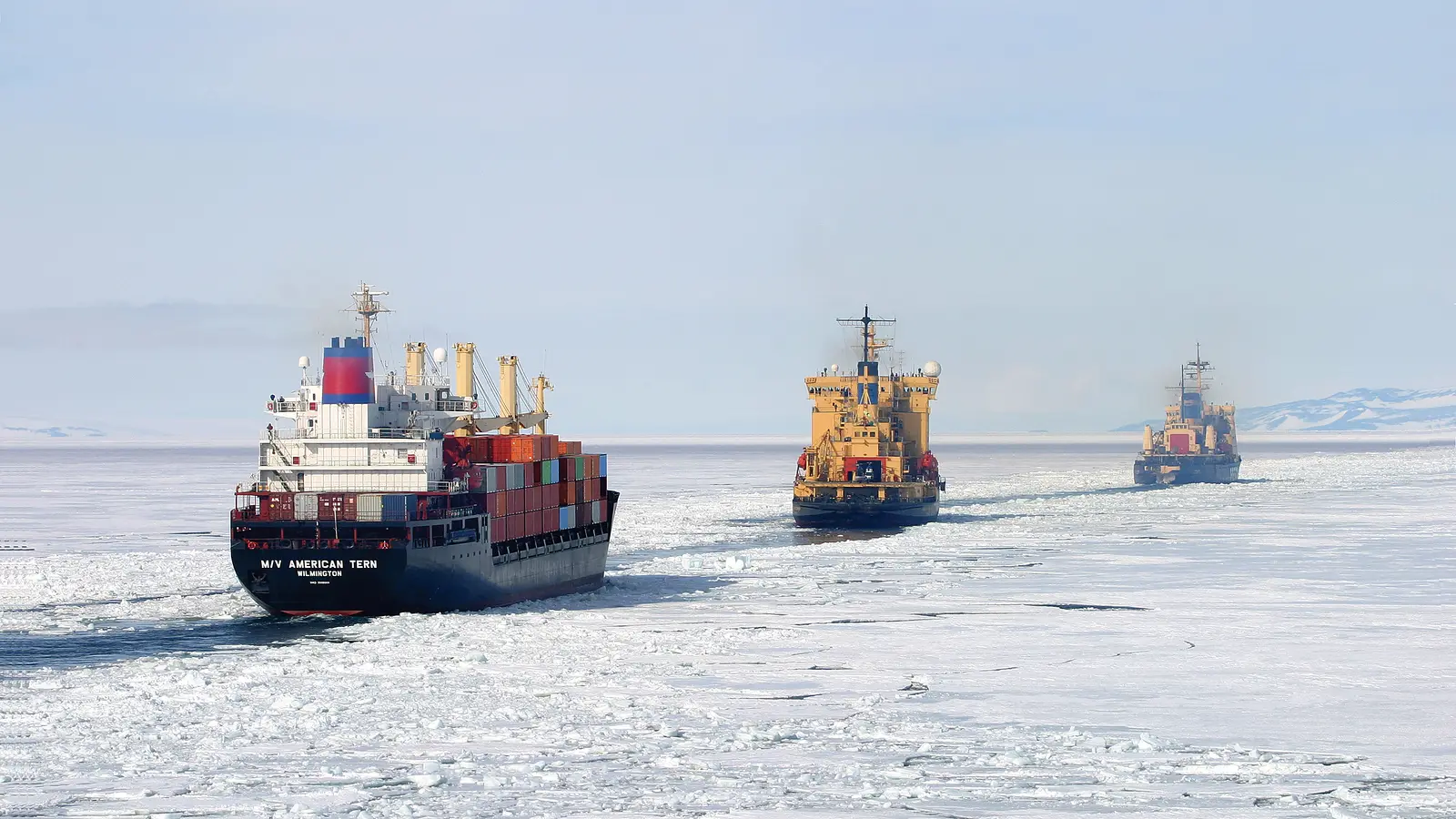
The Arctic navigation window is also limited. Ice conditions, fog, rapidly changing weather, charting constraints, communication coverage and the distance from emergency-response assets complicate schedule management. The International Maritime Organization’s Polar Code addresses ship design, equipment, operational planning, crew training, search and rescue and environmental protection, but compliance does not eliminate commercial uncertainty.
Experience from the Venta Maersk trial in 2018 remains relevant. Maersk reported that the voyage was completed safely, but required icebreaker assistance in the East Siberian Sea and was treated as a one-off operational test rather than the start of a regular service. Sea Legend’s programme is a larger commercial step, yet it faces the same fundamental question: can a seasonal shortcut deliver dependable liner performance?
Insurance, Compliance and Russian Exposure
The Northern Sea Route follows Russia’s Arctic coast and operates within a regulatory and service environment in which Russian authorities, infrastructure and ice-support capabilities play an important role. That creates geopolitical and compliance exposure beyond ordinary voyage planning.
Carriers, cargo owners, banks and insurers will need to examine sanctions screening, counterparties, payments, route permissions, insurance wording and emergency arrangements. A voyage can be technically possible while remaining unacceptable to a particular financier, insurer or customer.
Insurance cost is especially important. A shorter route saves little if the commercial advantage is consumed by additional premiums, ice services, specialised crewing, lower utilisation or schedule buffers. The relevant comparison is therefore not distance alone; it is the complete cost per delivered container.
Operationally, ships must also respect their certified limits. Tide Signal’s guide to ice navigation in shipping explains why visibility, machinery readiness, manoeuvring, crew preparation and changing ice conditions require a different risk framework from normal open-water trading.
The Decarbonisation Question Is More Complicated
A shorter voyage can reduce fuel consumption and voyage emissions if the comparison uses similar assumptions. Sea Legend and Chinese sources have promoted a substantial emissions advantage for the Arctic route. That claim should be independently tested against vessel size, fuel, speed, cargo utilisation, ice assistance and the full logistics chain.
The Arctic environment also changes the risk equation. Black-carbon emissions, pollution response, habitat sensitivity and the difficulty of containing an incident in remote waters matter alongside carbon dioxide. A lower voyage-emissions estimate does not automatically make every Arctic sailing environmentally preferable.
For owners and charterers, the result must also be understood within vessel-efficiency regulation and commercial carbon exposure. Tide Signal’s guide to CII in shipping explains how operational choices, speed and fuel consumption can influence ratings and commercial decisions, although CII alone cannot measure the wider environmental impact of an Arctic route.
Arctic Shipping Is Already Growing
The Arctic Express is part of a wider traffic trend. According to the Arctic Council’s PAME working group, 1,812 unique ships entered the Arctic Polar Code area in 2025, 40% more than in 2013. Aggregate distance sailed rose 95% over the same period, from 6.1 million to 11.9 million nautical miles.
Most Arctic activity is not trans-Arctic container liner shipping. Fishing, general cargo, resource projects, tankers and local supply trades dominate important parts of the traffic picture. That distinction matters: increasing Arctic ship numbers do not by themselves prove that a large east–west container market has emerged.
What Sea Legend is testing is narrower and commercially specific: whether time-sensitive China–Europe cargo can support a repeatable seasonal liner schedule through the Northern Sea Route.
What the Market Should Watch Next
- The first arrival: whether Dubai Tower reaches Felixstowe close to the planned 5 September date.
- Weekly continuity: whether the second and third departures operate on schedule, not only the inaugural sailing.
- Load factors: whether the service attracts enough paying cargo to support its specialised operating cost.
- Ice and weather delay: how route adjustments affect transit time across the full eight-voyage programme.
- European delivery performance: whether the time advantage survives port handling and onward connections.
- Insurance and compliance: whether underwriter appetite and sanctions controls remain commercially manageable.
- 2027 commitment: whether Sea Legend repeats, expands or reduces the programme after the season.
The headline is a 20-day Arctic voyage. The business story is schedule integrity. One fast sailing proves that a ship can make the passage; eight consecutive sailings would begin to show that a seasonal liner product can work. The first real verdict will not come at departure from Ningbo, but after the full programme’s arrival record, utilisation and cost are visible.
Final View
Sea Legend’s Arctic Express is consequential because it moves the Northern Sea Route one step closer to a structured commercial container service. It gives selected shippers a potentially faster path between China and northern Europe and creates a live test of route diversification beyond Suez and the Cape.
But the route remains seasonal, comparatively small and exposed to operational, environmental and geopolitical constraints. It should be judged as a specialised service—not as an immediate replacement for the established Asia–Europe network.
If Sea Legend completes the eight weekly voyages with credible utilisation and limited schedule slippage, the 2026 season could become an important milestone. If reliability or all-in cost weakens the proposition, the Arctic Express may remain a high-profile niche. Either outcome will provide the shipping market with valuable evidence.
Sources
- The Wall Street Journal: China Is Opening the First Regular Cargo Route Through the Arctic
- China Daily / Zhejiang: Regular Arctic Freight Service Set to Begin
- PortNews: Sea Legend Sets Weekly Arctic Boxship Programme
- International Maritime Organization: Polar Code
- Arctic Council / PAME: Arctic Shipping Update
- Port of Hamburg: Maersk Concludes Northern Sea Route Trial
Featured image: Military Sealift Command via Wikimedia Commons, licensed under CC BY 2.0. Cropped and converted to WebP by Tide Signal News.