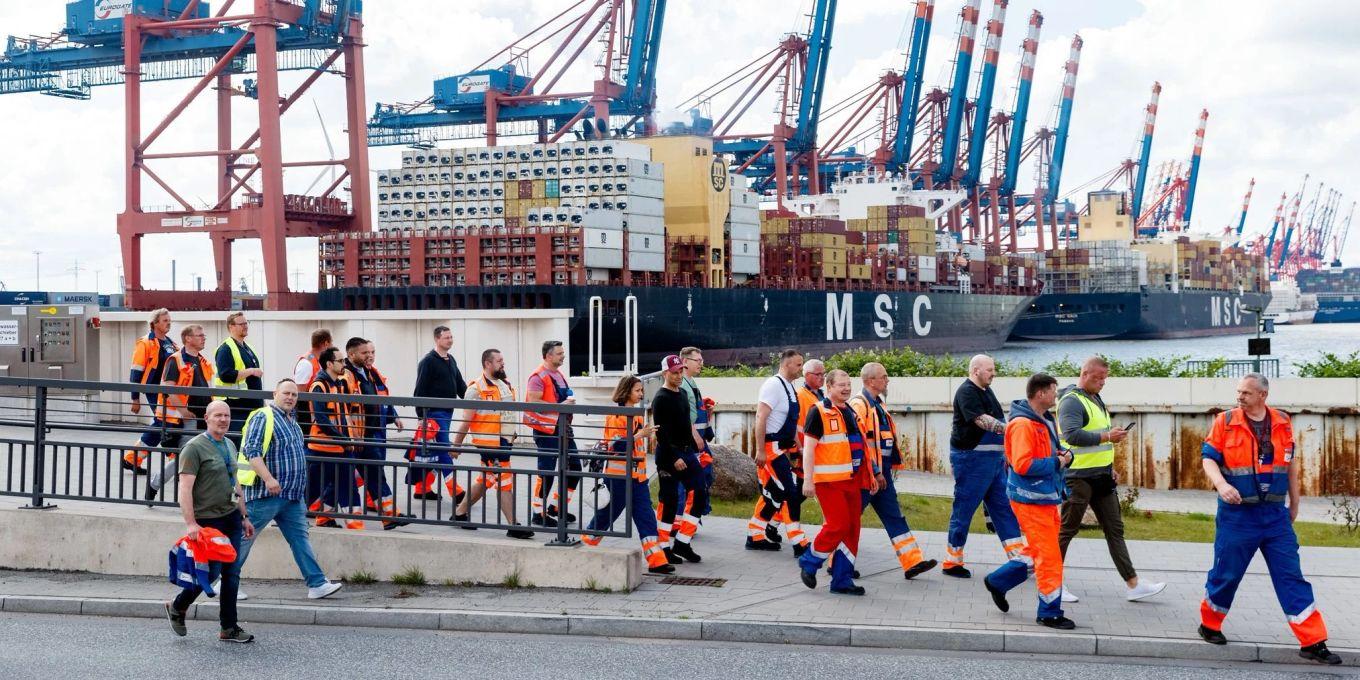
German port strike 2026 is approaching a decisive point as union members across Germany’s major seaports vote on whether the wage dispute should move toward indefinite industrial action. The negotiations cover a sector of around 11,000 workers at Hamburg, Bremen/Bremerhaven, Emden, Brake and Wilhelmshaven, making the outcome relevant to container shipping, automotive logistics, bulk cargoes and Germany’s wider supply chain.
The current ballot runs until the evening of 1 October 2026. It follows an earlier consultation in which 64.7% of participating workers rejected the latest 12-month employer proposal.
The crucial number now is 75%. If the required threshold is reached, ver.di’s federal bargaining commission will consider whether the negotiations have failed and whether the dispute should move toward indefinite strike action.
Are German ports on strike now? No indefinite German port strike is currently in force. The formal vote is still underway, and no new open-ended strike action had been announced in the latest carrier operational update. The next major decision point is the result after 1 October.
German Port Strike 2026: What Is Happening?
The German port labour dispute is part of the 2026 wage negotiations between the services union ver.di and the Central Association of German Seaport Operators, ZDS.
The collective agreement covers around 11,000 employees across the country’s principal seaport locations.
After the latest negotiating round, workers were consulted on a 12-month employer proposal. More than 5,500 people participated and 64.7% rejected the offer.
That rejection did not itself authorise an indefinite strike.
Instead, ver.di moved to a further membership process running from 18 September until the evening of 1 October 2026.
Which German Ports Could Be Affected?
The negotiations cover workers across Germany’s main seaport system, including:
- Hamburg — Germany’s largest container port and a major Asia–Europe gateway;
- Bremerhaven — a major container, automotive and transshipment centre;
- Bremen — part of the wider Bremen/Bremerhaven port system;
- Wilhelmshaven — home to Germany’s deep-water JadeWeserPort container terminal;
- Emden — an important European vehicle and industrial cargo gateway;
- Brake — an important bulk, agricultural and breakbulk port.
The commercial exposure therefore goes well beyond one terminal or one type of vessel.
A prolonged labour disruption could affect container lines, car carriers, bulk shipping, freight forwarders, inland rail operators, trucking companies and cargo owners using German gateways.
Hamburg Port Strike: Could Hamburg Stop Operating?
Hamburg is covered by the negotiations and could therefore be affected if further industrial action is authorised.
However, there is currently no confirmed indefinite closure of the Port of Hamburg.
The operational effect would depend on several factors: the ballot result, the subsequent decision by ver.di’s bargaining commission, the timing of any announced action and the terminals or shifts actually involved.
This distinction matters for anyone searching for a Hamburg port strike: a labour vote does not automatically mean that every container terminal closes immediately.
Bremerhaven Strike: What Could Be Affected?
Bremerhaven is also included in the bargaining round.
The port plays a major role in both container shipping and European automotive logistics. Disruption there can therefore affect not only liner schedules but also vehicle exports, transshipment movements and inland logistics connections.
As with Hamburg, however, no indefinite Bremerhaven shutdown has yet been announced.
What Happens on October 1?
The current ballot is scheduled to close on the evening of 1 October 2026.
If at least 75% of the members called to participate support rejection of the proposal and escalation toward indefinite strike action, ver.di’s federal bargaining commission will consider the next steps.
That does not mean every German port automatically stops work the moment the threshold is reached.
A further decision is required before the practical details of any indefinite industrial action — including the start time, participating locations and scope — become clear.
If the threshold is not reached, the bargaining commission can consider other options, including the possible acceptance of the employer proposal.
The event that changes vessel planning is not simply the ballot result. The crucial operational signal would be a confirmed strike announcement containing a start time, affected ports and the scope of the stoppage.
What Are German Port Workers Demanding?
Ver.di entered the 2026 negotiations seeking an 8.2% increase in hourly wages, with a minimum increase of €2.50 per hour and a 12-month agreement.
The minimum euro increase is intended to give a stronger relative benefit to workers in lower and middle wage groups than a percentage-only settlement.
The union has also argued for a relatively short agreement period rather than locking the sector into a longer wage settlement.
What Have German Port Employers Offered?
ZDS has presented both a 12-month and an 18-month proposal.
| Terms | 12-Month Proposal | 18-Month Proposal |
|---|---|---|
| Table wage increase | 3.4% | 5.1% |
| Guaranteed hourly increase | — | €1.20 |
| Container-sector allowance | +€416 | +€616 |
| Holiday pay | +€200 | +€300 |
| Duration | 12 months | 18 months |
ZDS argues that the offers represent substantial increases and has warned that prolonged disruption could undermine the competitiveness of German ports.
The employers have also highlighted the possibility that cargo flows could move toward competing North European gateways if customers face sustained disruption.
German Ports Have Already Seen Warning Strikes
The current dispute has already produced temporary industrial action.
German seaports experienced a 24-hour warning strike in August, followed by another stoppage in early September that was scheduled to last 48 hours.
Warning strikes and indefinite action create different operational risks.
A short stoppage normally has a defined window. Carriers and terminals can attempt to adjust vessel calls, gate operations and cargo planning around that window.
An indefinite strike creates much greater uncertainty because the end of the disruption is unknown.
Why a German Port Strike Matters to Shipping
A port strike does not affect only the vessels physically alongside when work stops.
Disruption can move through the entire container and logistics network.
1. Vessel schedules lose berth windows
If a vessel cannot berth or complete cargo operations at its scheduled time, the delay can move into the next port call.
On tightly planned North Europe services, even a short disruption can alter several subsequent arrivals.
2. Containers accumulate in terminals
When crane, yard or gate productivity falls, containers continue to build inside the system.
Operations may therefore remain under pressure even after workers return.
3. Export containers can miss vessels
Export cargo may face revised terminal cut-offs, reduced receiving windows or rolling to later sailings if the booked vessel can no longer maintain its schedule.
4. Import collections can be delayed
Import containers can remain inside terminals longer if discharge, customs release, gate activity or inland movement is disrupted.
5. Rail and truck schedules can be affected
Hamburg and Bremerhaven rely heavily on inland rail and road networks.
A sharp change in terminal throughput can produce missed rail slots, truck congestion, equipment imbalances and delayed deliveries well beyond the quay.
For the broader commercial impact of vessel waiting and disrupted port calls, see Tide Signal’s Port Delays in Shipping: Why Waiting Time Becomes Commercial Risk.
Why Port Congestion Can Continue After a Strike Ends
One of the most important characteristics of port disruption is that the operational impact can last longer than the stoppage itself.
If several vessels lose their original windows, they may restart operations in a cluster rather than in their original sequence.
The terminal then has to manage:
- delayed vessels;
- normally scheduled new arrivals;
- containers already occupying yard space;
- export boxes waiting for the next sailing;
- inland trains and trucks that have also moved away from their original schedules.
This is why a 24-hour or 48-hour interruption can generate several additional days of reduced schedule reliability.
Tide Signal’s Asia Port Congestion 2026 analysis explains the same effective-capacity mechanism: port waiting removes usable vessel time even when no physical ships leave the fleet.
German Port Disruption Could Overlap With Changing Suez Schedules
The labour dispute is developing while Asia–Europe liner networks are also adjusting routing patterns.
Selected services returning through the Suez Canal can shorten transit times relative to Cape of Good Hope diversions.
That is positive for voyage duration, but the transition can also create uneven arrival patterns as ships operating on different route structures reach North European gateways.
A German labour disruption would not cause that network transition, and the Suez transition would not cause the labour dispute.
However, if faster vessel arrivals and restricted terminal capacity occur at the same time, the two independent developments can amplify congestion.
Read the full network analysis: Suez Canal Shipping Returns — Why Faster Asia–Europe Transits Could Trigger the Next Port Congestion Wave.
Could a German Port Strike Increase Container Shipping Rates?
A prolonged strike could add to container shipping costs, but industrial action at German ports does not automatically mean global spot rates will rise.
The main link is effective capacity.
If vessels spend more time waiting, recovering schedules or making alternative port calls, each ship can perform less productive transport over the same period.
That can tighten effective supply without removing a single vessel from the physical fleet.
Additional costs may also arise through:
- port waiting time;
- schedule recovery;
- cargo re-routing;
- additional feeder movements;
- truck and rail rescheduling;
- storage and terminal charges;
- detention and demurrage exposure.
Container freight rates are also driven by cargo demand, deployed vessel supply, bunker costs, blank sailings, route diversions and congestion at other ports.
For current route-level benchmarks, see Tide Signal’s living Container Shipping Rates 2026 page.
Could Cargo Shift From Germany to Rotterdam or Antwerp?
Alternative North European gateways become increasingly important when one port system faces prolonged disruption.
Carriers can change berth windows, omit calls or move selected cargo through another port if maintaining the original rotation becomes impractical.
ZDS has specifically warned that sustained disruption could encourage cargo flows to move toward competing European ports.
But cargo diversion does not eliminate congestion.
Large volumes redirected toward Rotterdam, Antwerp-Bruges or other gateways can transfer pressure into those terminals, feeder systems, rail corridors and trucking networks.
What Should Shippers Watch Before October 1?
The strongest signals are confirmed operational announcements rather than speculation.
- Ballot result: whether the required threshold is reached.
- Ver.di decision: whether indefinite industrial action is actually authorised.
- Strike start time: the key point for operational planning.
- Ports involved: whether action affects Hamburg, Bremerhaven, Wilhelmshaven and other locations simultaneously.
- Terminal notices: gate restrictions, cargo receiving changes and revised cut-off times.
- Carrier notices: vessel delays, omissions, diversions and alternative discharge ports.
- Rail and trucking restrictions: inland disruption can continue even after quay operations restart.
German Port Strike 2026 Timeline
What Happens Next?
The most important update will arrive after the ballot closes.
If the threshold is reached and further industrial action is authorised, the search and operational focus will immediately move from German port strike vote toward practical questions such as:
- When will the German port strike start?
- Is Hamburg port on strike?
- Is Bremerhaven port closed?
- Which German terminals are affected?
- How long will the strike last?
- Which shipping services are being diverted?
Tide Signal will update this same URL as the German port strike 2026 story develops. Maintaining one authoritative page preserves the search history and avoids creating competing pages for the same search intent.
German Port Strike 2026: Frequently Asked Questions
Are German ports on strike right now?
No indefinite German port strike is currently in force. Union members are voting through 1 October on whether the dispute should move toward indefinite industrial action.
When does the German port strike vote end?
The current ballot is scheduled to close on the evening of 1 October 2026.
How many German port workers are involved?
The collective bargaining agreement covers around 11,000 employees at German seaports.
Which German ports could be affected?
The bargaining round covers Hamburg, Bremen/Bremerhaven, Emden, Brake and Wilhelmshaven.
Is Hamburg port going on strike?
Hamburg is covered by the negotiations, but no indefinite Hamburg port shutdown has yet been announced. Further action depends on the ballot and subsequent union decisions.
Is Bremerhaven on strike?
No indefinite Bremerhaven strike is currently in force. Bremerhaven is included in the negotiations and could be affected by future action if it is authorised.
What percentage is needed for possible indefinite strike action?
The current process requires a 75% threshold before the union’s federal bargaining commission considers the next steps toward indefinite industrial action.
What are German port workers demanding?
Ver.di is seeking an 8.2% increase in hourly wages, with a minimum increase of €2.50 per hour and a 12-month agreement.
Could a German port strike affect container shipping rates?
A prolonged disruption could reduce effective vessel capacity and increase logistics costs. However, freight rates are also determined by cargo demand, vessel supply, bunker costs, blank sailings and congestion across the wider network.
What happens after October 1?
The ballot result will determine the next stage of the labour dispute. If the required threshold is reached, the federal bargaining commission will consider whether negotiations have failed and whether further strike action should follow.
Primary Sources
- DGB — German Seaport Workers Reject Employer Offer — consultation result, 64.7% rejection, October 1 ballot deadline and 75% threshold.
- ver.di publik — German Seaport Bargaining Round — union wage demand and bargaining background.
- ZDS — Employer Offer Variants — 12-month and 18-month wage proposals.
- ZDS — Statement on Indefinite Strike Ballot — employer position on the vote and potential cargo diversion.
- Hapag-Lloyd — Week 38 Europe Operational Update — ballot timing, 75% threshold and current strike status.
- Hapag-Lloyd — German Seaport Warning Strike Updates — August and September warning-strike operational notices.