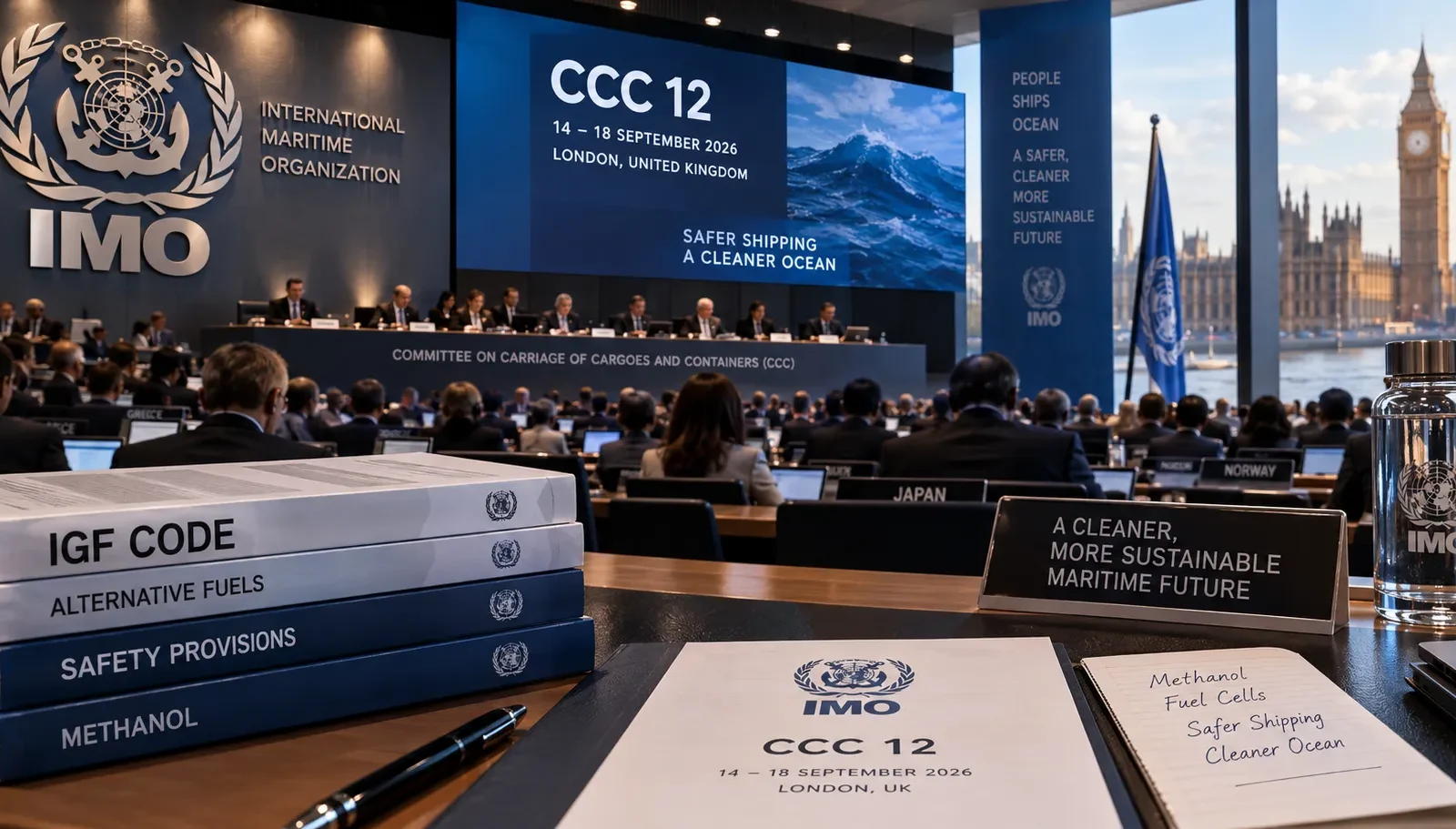
IMO CCC 12 opens in London from 14 to 18 September 2026 with one of shipping’s most important alternative-fuel safety files back on the table: how methanol, ethanol and fuel-cell systems move from interim guidance toward a more mature international regulatory framework.
The meeting does not create a new mandatory methanol code overnight. But it matters because the International Maritime Organization’s Sub-Committee on Carriage of Cargoes and Containers is expected to continue work on revised methanol/ethanol safety provisions and fuel-cell rules that sit inside the broader evolution of the IGF Code — the international safety framework for ships using gases or other low-flashpoint fuels.
For shipowners, yards, class societies, engine makers, naval architects and technical managers, that makes IMO CCC 12 more than a committee meeting. The decisions and draft text emerging from this work can affect future ship design, fuel-system layout, ventilation, hazardous-area arrangements, fire protection, bunkering interfaces, automation, emergency shutdown philosophy and ultimately the commercial confidence to order alternative-fuel tonnage.
The regulatory direction has been building for years. IMO already has interim safety guidelines for ships using methyl or ethyl alcohol as fuel under MSC.1/Circ.1621, and interim guidelines for fuel-cell power installations under MSC.1/Circ.1647.
What changes now is maturity. The industry has moved from “can these technologies be used safely?” toward “what permanent, harmonised requirements should apply when they become normal fleet choices?”
IMO CCC 12: What Is Actually on the Alternative-Fuel Agenda?
The latest IMO work plan and recent class-society summaries identify three closely related areas of work around the meeting:
- revision and further development of safety provisions for ships using methyl/ethyl alcohol as fuel;
- continued work on provisions for fuel-cell power installations; and
- broader development of the IGF Code and associated alternative-fuel safety framework.
Earlier IMO work plans described CCC 12 as the session for further development or finalisation of mandatory provisions for methyl/ethyl alcohols and further development of mandatory provisions for fuel cells.
More recent post-CCC 11 reporting adds an important nuance: because time ran out at CCC 11, the methanol/ethanol and fuel-cell texts continued through correspondence and intersessional work. DNV’s current work-plan summary says the revised methanol/ethanol interim guidelines are expected to reach approval in 2027, while revised fuel-cell guidelines are expected around 2028. Lloyd’s Register separately notes that associated mandatory IGF Code amendments for methanol are expected to be concluded in 2027, with an estimated entry into force in 2028.
That means the correct way to describe IMO CCC 12 is not “new methanol rules become mandatory this week”.
The better description is:
IMO CCC 12 is one of the key drafting stages that can determine what the future mandatory safety framework will look like.
CCC 12 does not itself make every methanol or fuel-cell provision mandatory. The Sub-Committee develops and agrees technical text. Final approval, adoption and entry into force depend on the relevant IMO committee process and amendment timetable.
Why Methanol Shipping Rules Matter Now
Methanol has moved faster than many alternative fuels from concept to commercial deployment.
Major liner operators have already ordered and delivered methanol-capable ships, engine manufacturers have commercial dual-fuel platforms, and bunker suppliers are building experience with methanol handling and transfer.
The regulatory challenge is that methanol behaves very differently from conventional fuel oil.
Methanol is a low-flashpoint fuel, is toxic if ingested or absorbed in sufficient quantity, burns with a flame that can be difficult to see in daylight and requires different thinking around:
- fuel storage;
- tank location and protection;
- fuel preparation spaces;
- double-wall piping;
- leak detection;
- ventilation;
- hazardous-area classification;
- fire detection and extinguishing;
- bunkering stations;
- emergency shutdown; and
- crew protection.
The IMO’s existing interim guidelines gave designers and administrations a common safety basis. But an interim circular is not the same thing as a mature mandatory chapter embedded into the IGF Code.
That is why the work around IMO CCC 12 matters to newbuilding decisions being made now.
From Interim Guidelines to the IGF Code
The International Code of Safety for Ships using Gases or other Low-flashpoint Fuels — the IGF Code — provides mandatory safety criteria for ships using gas or low-flashpoint liquids as fuel.
Its core purpose is to reduce risk to the ship, crew and environment through requirements covering machinery arrangement, fuel containment, piping, ventilation, hazardous areas, fire safety, control systems and other design elements.
The Code was initially built around natural gas, but IMO has progressively expanded the alternative-fuel framework through interim guidelines and planned amendments.
| Technology | Current IMO basis | Current direction | Why operators should care |
|---|---|---|---|
| Methanol / ethanol | MSC.1/Circ.1621 interim guidelines | Revised guidance + future IGF Code amendments | Design standardisation and approval certainty |
| Fuel cells | MSC.1/Circ.1647 interim guidelines | Revision and further regulatory development | Machinery-space safety, ventilation and system integration |
| Ammonia | Dedicated interim safety work now well advanced | Implementation, training and operational experience | Toxicity, bunkering and crew protection |
Tide Signal has already examined the separate ammonia pathway in its Ammonia as Marine Fuel: IMO Rules, Bunkering and What to Watch at CCC 12 guide. The methanol and fuel-cell discussion is different because those technologies already have older interim IMO guidance that is now being revised and pushed toward the next regulatory stage.
What Could Change for Methanol-Fuelled Ship Design?
The exact CCC 12 outcomes will only be clear once the session concludes and IMO publishes the final meeting summary and documents. But the areas that matter operationally are already well defined by the current safety framework and the work being carried forward.
1. Fuel containment and tank protection
Methanol tanks must be protected against collision, leakage and unacceptable heat exposure. Designers also need to manage tank location, cofferdams, structural protection and the consequences of a release.
As rules become more harmonised, shipyards gain greater certainty over which arrangements will be accepted across administrations and class societies.
2. Fuel piping and double barriers
Low-flashpoint fuels require stricter containment philosophy than conventional oil fuel. Fuel pipes running through enclosed spaces can require double-wall arrangements, protected routing, leak detection and controlled ventilation.
A mandatory framework can reduce the amount of project-by-project interpretation.
3. Ventilation and hazardous areas
Ventilation is one of the core safety barriers in alternative-fuel ship design.
Rules need to define how fuel-preparation rooms, tank connection spaces, bunkering stations and other enclosed areas are ventilated, monitored and classified.
4. Fire detection and suppression
Methanol fires behave differently from conventional hydrocarbon fires. The safety philosophy therefore needs suitable detection, extinguishing and containment provisions.
5. Bunkering arrangements
Commercial deployment depends on repeatable, safe bunkering procedures.
That means the ship-side design has to work with port infrastructure, transfer connections, drip containment, emergency release arrangements, communications and shutdown logic.
6. Control and emergency shutdown systems
Alternative-fuel safety depends heavily on automation.
A leak or abnormal condition must trigger the correct isolation, ventilation response, alarm and machinery state without creating a second hazard.
Why Fuel Cells Are a Different Regulatory Problem
Fuel cells do not simply replace a diesel engine with another engine.
They convert chemical energy into electrical power electrochemically, meaning ship designers must think about a new combination of fuel handling, ventilation, electrical architecture, thermal management and machinery-space safety.
The IMO’s interim fuel-cell guidelines already establish a safety basis, but the technology can be paired with different fuels and different cell chemistries.
That creates regulatory questions around:
- fuel-cell space arrangement;
- gas detection;
- ventilation;
- thermal runaway or overheating scenarios;
- electrical isolation;
- emergency shutdown;
- fire detection;
- fuel reformers where fitted;
- interfaces with batteries and power-management systems; and
- integration with conventional propulsion or auxiliary machinery.
For a shipowner, the practical question is not whether fuel cells can work technically. Demonstration projects have already shown that they can.
The commercial question is whether the safety, class and statutory approval pathway becomes standard enough to support larger fleets and repeat orders.
IMO CCC 12 Could Reduce One of Alternative Fuel’s Biggest Hidden Costs
Alternative-fuel projects carry a cost that does not appear directly in the bunker price.
Regulatory uncertainty.
When a technology is governed mainly through interim guidelines, alternative design approvals and class-specific rules, the owner, yard and designer may need more engineering work to prove that the arrangement achieves equivalent safety.
That can mean:
- additional hazard studies;
- more approval meetings;
- alternative-design documentation;
- greater class involvement;
- more conservative equipment choices;
- additional contingency in project schedules; and
- less certainty over resale or future regulatory treatment.
A clearer mandatory rule set does not remove engineering complexity, but it can reduce uncertainty around what “acceptable” looks like.
For shipowners, regulatory certainty can be almost as important as fuel availability.
A fuel pathway becomes easier to finance and order when builders, class societies, flags and operators are working from the same mature international design standard rather than relying heavily on project-specific interpretation.
What Methanol Rules Mean for Newbuildings Already Being Ordered
Owners do not have the luxury of waiting until every future rule is final before ordering ships.
A vessel contracted in 2026 may deliver years later and operate for two decades or more.
That means current methanol newbuildings have to be designed against:
- the existing IGF Code framework;
- MSC.1/Circ.1621;
- flag-state requirements;
- class rules;
- yard standards;
- engine-maker specifications; and
- expected future regulatory development.
Classification societies are already filling that gap. Lloyd’s Register, for example, maintains dedicated rules for ships using gases and low-flashpoint fuels including methanol, ammonia and hydrogen.
The regulatory work at IMO CCC 12 therefore matters even before a future amendment formally enters into force, because it can influence how owners future-proof newbuildings being specified today.
Seafarer Training Is Moving at the Same Time
Hardware rules are only one side of the transition.
The IMO has also developed a new training framework for seafarers working with alternative fuels and new technologies.
Generic interim training guidance was issued through STCW.7/Circ.25, while fuel-specific interim training guidelines for ships using methyl or ethyl alcohol were issued in July 2026 through STCW.7/Circ.26.
That matters because a methanol-fuelled ship is not simply a conventional vessel with a different bunker specification.
Deck and engine personnel may need new competencies around:
- fuel properties and toxicity;
- personal protective equipment;
- bunkering controls;
- leak response;
- fire behaviour;
- gas detection;
- emergency shutdown systems;
- ventilation failures; and
- fuel-system isolation.
The combination of ship-design rules and crew-training guidance is a clear signal that methanol is moving into a more mature regulatory phase.
FuelEU and EU ETS Make the Safety Rules Commercially Relevant
IMO safety regulation does not operate in isolation from climate regulation.
In Europe, FuelEU Maritime already links a ship’s commercial performance to the greenhouse-gas intensity of energy used onboard, while EU ETS Shipping places a direct allowance cost on covered greenhouse-gas emissions.
That creates a powerful connection:
environmental regulation can make alternative fuels commercially attractive, but safety regulation determines whether those fuels can be deployed at scale.
A shipowner can model lower lifecycle carbon intensity, pooling value or future allowance exposure — but the fuel still needs an approved tank arrangement, bunkering system, machinery concept and crew-safety framework.
This is why the work of IMO CCC 12 belongs in the same boardroom discussion as FuelEU, EU ETS and fleet renewal.
Methanol Is Not Automatically “Green”
One of the biggest mistakes in the alternative-fuel debate is to treat the fuel name as the emissions result.
Methanol can be produced from different feedstocks and energy pathways.
Fossil methanol, bio-methanol and e-methanol can have very different lifecycle greenhouse-gas profiles.
That distinction is especially important under FuelEU Maritime, which evaluates energy on a well-to-wake basis rather than looking only at exhaust CO₂.
A ship can therefore be technically methanol-capable without automatically achieving a low-carbon compliance outcome.
The safety rules and the carbon rules answer different questions:
| Framework | Main question | Commercial impact |
|---|---|---|
| IMO / IGF Code | Can the fuel and machinery system be used safely? | Ship design, approval, build cost and operation |
| FuelEU Maritime | What is the lifecycle GHG intensity of the energy used? | Compliance balance, pooling, penalties and fuel choice |
| EU ETS | How many covered emissions create allowance liability? | Direct carbon cost |
Could Mandatory Methanol Rules Change Existing Ships?
This is an area where owners should avoid jumping ahead of the final legal text.
Future IGF Code amendments typically define application dates and may distinguish between new ships and existing ships.
The exact applicability of any future methanol amendments will depend on the final adopted text, construction-date definitions, transitional provisions and flag-state implementation.
For that reason, it is too early to state that every existing methanol vessel will need major retrofits.
What is reasonable now is to monitor whether future requirements create differences between:
- existing ships built under current interim guidance;
- ships contracted before adoption but delivered later;
- ships constructed after a future entry-into-force date; and
- retrofit projects converting conventional tonnage to methanol capability.
Fuel Cells: Where the Commercial Opportunity Could Be
Fuel cells remain less mature commercially than methanol dual-fuel engines, but their value proposition is different.
They can offer high electrical efficiency, low local emissions and very quiet operation, and can potentially support:
- hotel loads;
- auxiliary power;
- hybrid propulsion;
- zero-emission port operation;
- peak shaving; and
- integration with batteries.
The technology may therefore enter shipping first through partial-load and hybrid applications rather than immediately replacing the main engine on the largest oceangoing ships.
A stronger international regulatory framework would make those applications easier to standardise across different ship types.
What Shipowners Should Watch During IMO CCC 12
- Methanol / ethanol text: whether the Sub-Committee closes major technical gaps or pushes unresolved issues into further work.
- IGF Code pathway: how quickly revised methanol guidance can translate into mandatory amendments.
- Fuel-cell provisions: whether the rule set becomes more detailed around installation, ventilation, control and fire safety.
- Toxicity requirements: the methanol/ethanol revision has specifically been linked to consistency in how toxicity is addressed.
- Application dates: any clearer indication of expected approval, adoption or entry-into-force timing.
- Alternative-design reliance: whether the new framework reduces the need for project-specific approval approaches.
- Interaction with other fuels: how methanol, hydrogen, ammonia, LPG, batteries and carbon-capture technologies fit into the wider IMO safety work plan.
What IMO CCC 12 Does Not Decide This Week
Because alternative-fuel regulation is commercially sensitive, headlines can easily overstate what one meeting does.
CCC 12 does not decide:
- which fuel will “win” shipping’s energy transition;
- whether methanol is automatically low-carbon;
- the final commercial price of methanol or hydrogen;
- whether every existing methanol ship must be modified;
- whether every fuel-cell ship design is now standardised; or
- the final adoption date of provisions that still require higher-level IMO approval.
Its role is more technical — and arguably more important for long-term fleet design.
The Sub-Committee develops the safety architecture that allows future technologies to move from isolated projects into normal international shipping.
Why This Week Matters for the 2030 Fleet
Ships being ordered now will still be operating in the 2040s.
That means owners are making long-life asset decisions before fuel prices, carbon regulation and global bunker infrastructure have fully stabilised.
The most valuable regulatory signal is therefore not “which fuel is cheapest today?”
It is:
which technologies are moving toward a stable, globally recognised safety framework?
Methanol is already further along that path than many alternatives. Fuel cells are moving more slowly, but the continued work at IMO CCC 12 shows that IMO expects them to form part of the future ship-technology landscape.
The next fuel transition will not be decided by fuel price alone. It will be decided by whether ships can be designed, approved, crewed, bunkered and operated safely at scale.
IMO CCC 12 matters because it sits directly inside that process. Methanol already has commercial momentum. Fuel cells have technical promise. The regulatory work now determines how quickly both can move from special projects toward repeatable international ship designs.
IMO CCC 12 FAQ
When is IMO CCC 12?
IMO CCC 12 is scheduled for 14–18 September 2026 at the International Maritime Organization in London.
What is IMO CCC 12 working on?
The Sub-Committee’s alternative-fuel work includes further development and revision of safety provisions for methyl/ethyl alcohol as fuel and fuel-cell power installations, together with broader IGF Code work.
Are methanol rules already mandatory?
The IGF Code is mandatory for ships within its scope, while methanol-specific safety is currently supported by IMO interim guidelines under MSC.1/Circ.1621, class rules and flag-state approval. Associated mandatory IGF Code provisions are still being developed.
When could mandatory methanol IGF Code amendments enter into force?
Recent Lloyd’s Register reporting indicates that the associated mandatory IGF Code amendments are expected to be concluded in 2027 with an estimated entry into force in 2028. Final timing depends on the IMO approval and adoption process.
Are fuel-cell rules mandatory yet?
IMO currently has interim guidelines for fuel-cell power installations under MSC.1/Circ.1647. The framework remains under further development and revision.
Why are methanol rules important to shipowners?
Clearer international rules can reduce design uncertainty, standardise approval expectations and improve confidence around newbuildings, retrofits, bunkering systems, class approval and long-term fleet investment.
Does methanol automatically reduce emissions?
No. The lifecycle emissions result depends on how the methanol is produced. Fossil methanol, bio-methanol and e-methanol can have very different well-to-wake greenhouse-gas profiles.
Where can operators follow the wider alternative-fuel picture?
Tide Signal’s ammonia fuel guide, FuelEU Maritime 2027 briefing and EU ETS Shipping 2026 guide cover the parallel safety and carbon-compliance pressures shaping future fleet decisions.
Official Sources and Further Reading
- IMO — Meeting schedule: CCC 12, 14–18 September 2026
- IMO — CCC work plan for methanol/ethanol and fuel-cell provisions
- IMO — International Code of Safety for Ships using Gases or other Low-flashpoint Fuels
- IMO — Seafarer training for alternative fuels and new technologies
- DNV — CCC 11 alternative-fuel work plan and expected timelines
- Lloyd’s Register — CCC 11 summary and expected methanol IGF Code timeline
- Lloyd’s Register — Rules for ships using gases and low-flashpoint fuels