China Arctic Express has completed its first advertised 2026 China-to-UK sailing, with the 1,740-TEU Dubai Tower reaching Teesport on 9 September after departing Ningbo on 15 August. The voyage is commercially significant not because the Arctic has suddenly replaced Suez, but because Sea Legend is attempting something more difficult than a one-off transit: a scheduled seasonal container service.
China Arctic Express reaches Britain after 25-day voyage
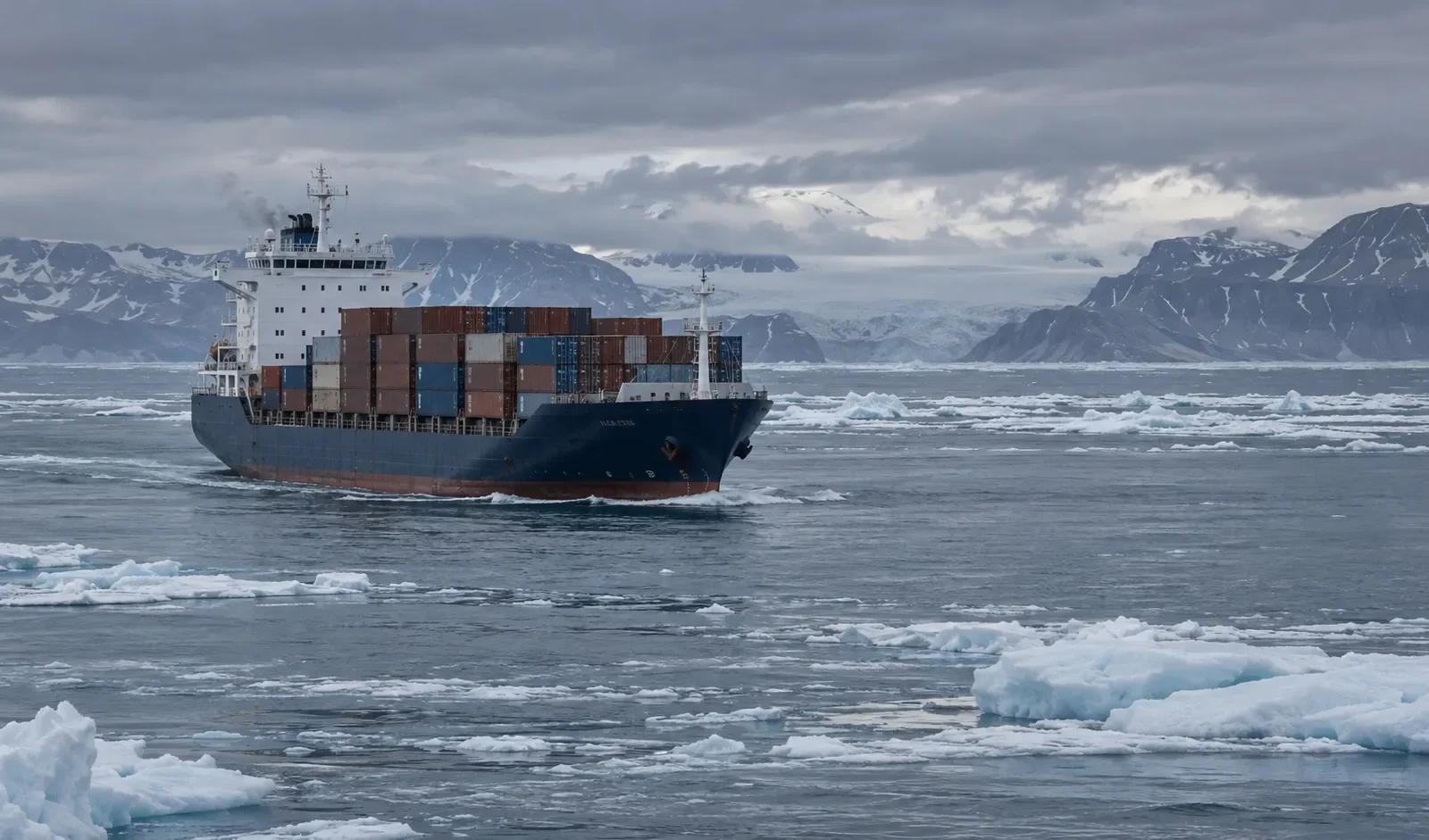
The container ship Dubai Tower arrived at Teesport in northeast England on 9 September after sailing from Ningbo, China, on 15 August and transiting the Northern Sea Route along Russia’s Arctic coast. The vessel has a nominal capacity of 1,740 TEU and is registered in Liberia.
According to Seatrade Maritime, AIS data placed the ship at Teesport’s QEII berth after the Arctic crossing. Sea Legend is offering eight weekly voyages during the 2026 summer ice season under its China Arctic Express service.
That distinction matters. Arctic transits by commercial vessels are not new. What Sea Legend is testing is whether a sequence of advertised sailings can be sold as a repeatable container product between East Asia and northern Europe rather than as an isolated demonstration voyage.
The operator’s initial schedule had Dubai Tower departing Ningbo on 15 August and reaching Felixstowe on 5 September. Instead, the first UK call was recorded at Teesport on 9 September. Teesport had not been listed in the original published rotation.
Dubai Tower Arctic voyage: the key facts
| Vessel | Dubai Tower |
|---|---|
| Nominal capacity | 1,740 TEU |
| Registry | Liberia |
| China departure | Ningbo, 15 August 2026 |
| UK arrival | Teesport, 9 September 2026 |
| Elapsed time | Approximately 25 days from the reported Ningbo departure to the UK arrival |
| Route | Northern Sea Route through the Russian Arctic |
| Service | Sea Legend China Arctic Express |
| 2026 programme | Eight advertised weekly voyages during the seasonal Arctic navigation window |
| Original UK schedule | Felixstowe, with an advertised arrival of 5 September |
A separate published sailing programme reported by PortNews listed seven vessels for the eight-sailing programme, with Dubai Tower scheduled to perform two voyages. The fleet mix is made up of small and medium-sized container ships rather than the very large vessels deployed on the main Asia–Europe loops.
That smaller scale is commercially important. It lowers the absolute cargo requirement needed to fill a sailing and may give the operator more flexibility while testing a new route. But it also means that the economics should not be compared mechanically with the huge liner networks using Suez, where vessel size, port productivity, alliance networks, feeder connections and weekly schedule density operate on a completely different scale.
Why the China Arctic Express matters for container shipping
The Northern Sea Route offers a much shorter geographic connection between parts of East Asia and northern Europe than the conventional passage through the Indian Ocean, Red Sea, Suez Canal and Mediterranean. It also avoids the Cape of Good Hope diversion that has become commercially important whenever Red Sea security deteriorates.
That makes the route strategically interesting at a time when shipping companies are again being forced to price geopolitical risk into voyage planning. Tide Signal has previously examined how maritime chokepoints can alter routing decisions, and how war-risk premiums can turn a theoretically shorter voyage into a more expensive commercial proposition.
The China Arctic Express introduces a different trade-off. A ship can reduce geographic exposure to the Red Sea and Suez system, but in exchange it enters a high-latitude operating environment with ice, weather, remoteness, specialised regulatory requirements and political dependence on a route that runs along Russia’s northern coast.
In other words, the Arctic does not remove risk. It changes the risk profile.
For charterers and liner operators, the real comparison is not “Arctic versus Suez” on distance alone. It is total voyage economics, schedule reliability, insurance, operational limits, network connectivity and geopolitical exposure.
Why the Teesport arrival is an important operational detail
One of the most interesting parts of the first sailing is that the vessel did not make the originally advertised first UK call at Felixstowe. It arrived at Teesport instead.
Seatrade reported that Dubai Tower called at the QEII berth, a facility designed primarily for bulk and project cargo rather than conventional container operations. No public explanation in the cited reporting establishes why the port call changed, so the reason should not be inferred.
Commercially, however, the change illustrates one of the central challenges facing any new liner product. A fast sea passage is only one component of transit performance. The service must also integrate berth availability, terminal handling, cargo delivery, customs procedures, equipment flows and inland transport.
A route can save days at sea and still lose part of that advantage if the destination-port network is not equally efficient.
This is why voyage-duration headlines should be treated carefully. A ship’s passage time and the cargo owner’s true door-to-door transit time are not the same metric.
The same logic applies in conventional commercial shipping. A proper voyage estimation does not stop at nautical miles and speed. Port time, bunkers, canal exposure, waiting, operational restrictions and the vessel’s commercial position all affect the final result.
Can the Northern Sea Route really compete with Suez?
Not yet on the evidence of one sailing.
The first China Arctic Express arrival demonstrates that the route can support a container voyage between China and Britain during the navigable season. It does not establish that the service can match the scale, frequency, resilience or year-round economics of the established Asia–Europe liner system.
The strongest argument in favour of the Arctic route is obvious: distance and time. Reuters-linked reporting on the voyage described the Arctic passage as significantly quicker than routing through Suez or around the Cape of Good Hope. Sea Legend’s earlier schedule marketed an approximately three-week China-to-Europe transit.
But liner shipping is not won by the fastest individual sailing. Customers buy reliability.
For the China Arctic Express to become a meaningful commercial alternative, Sea Legend would need to demonstrate several things across the full series of voyages:
First, schedule consistency. The operator must show that ships can enter, cross and exit the Arctic corridor within predictable windows despite changing ice and weather conditions.
Second, sufficient cargo demand. Short transit times are valuable only if shippers are willing to book enough containers at rates that cover the additional operational, insurance and route-specific costs.
Third, reliable European port integration. A scheduled service needs dependable berth windows, handling capability, equipment availability and onward connections.
Fourth, repeatability across different vessels. The eight-voyage programme uses several ships. Performance therefore needs to be assessed across the fleet, not only on Dubai Tower.
Fifth, a credible seasonal business model. A route that works for a limited Arctic navigation period is not automatically a substitute for a year-round service. It may instead become a premium seasonal product for selected cargoes.
Ice, insurance, sanctions and operational risk
The Northern Sea Route introduces operating conditions that are fundamentally different from a normal Asia–Europe voyage.
1. Polar navigation and weather
The International Maritime Organization’s Polar Code addresses ship design, construction, equipment, operations, training, voyage planning, search and rescue and environmental protection in polar waters.
IMO specifically identifies poor weather, limited navigational information, remoteness and ice as additional hazards. Cold temperatures can affect machinery and emergency systems, while ice can create additional loads on the hull, propulsion system and appendages.
This makes the route highly sensitive to operational limits. A small deterioration in conditions can matter more than it would on a conventional open-water passage.
2. Search and rescue and emergency response
Remoteness is a commercial risk as well as a safety risk. IMO notes that rescue and clean-up operations in polar regions can be difficult and costly because assistance is far away and infrastructure is limited.
For an operator, that can influence insurance terms, contingency planning, spare-parts strategy, voyage planning and the level of redundancy required before entering the route.
3. Insurance economics
A shorter voyage does not automatically mean a cheaper voyage. Premiums and terms for Arctic operations can reflect ice exposure, remoteness, vessel characteristics, season, crew competence and route-specific hazards.
The relevant commercial calculation therefore resembles the same principle used in any voyage estimate: the operator must compare total expected revenue and total expected cost, not simply nautical miles.
Higher insurance or contingency costs can offset part of the bunker and time savings generated by a shorter route.
4. Russian route dependence and sanctions exposure
The Northern Sea Route runs through waters closely connected to Russian Arctic administration and infrastructure. That creates a geopolitical dimension that is absent from an ordinary route comparison.
This does not mean that every vessel using the route is sanctioned or that an Arctic transit is automatically prohibited. It does mean that owners, charterers, insurers, banks, cargo interests and service providers must examine counterparties, payments, port calls, assistance arrangements and applicable sanctions carefully.
Tide Signal’s coverage of the Vostok Oil Arctic export route shows how quickly Arctic logistics can become intertwined with sanctions screening, vessel availability and financial compliance.
5. Bunker planning
Fuel economics are another major variable. A shorter passage can reduce consumption, but Arctic navigation may involve different speeds, operating margins and contingency requirements. Bunker planning also needs to account for the limited flexibility available once a vessel is committed to a remote route.
That issue has become more important as the wider market faces renewed fuel-price volatility and tighter supply conditions. Tide Signal’s analysis of the 2026 bunker fuel squeeze shows why even modest changes in fuel price can materially alter voyage economics.
The environmental argument will remain part of the commercial debate
The growth of Arctic shipping is controversial because the commercial benefit of shorter voyages is connected to a region undergoing rapid environmental change.
The Clean Arctic Alliance has criticised the expansion of regular Asia–Europe shipping through the Arctic and highlighted black-carbon emissions, pollution risks and impacts on Arctic ecosystems and communities.
Black carbon is particularly sensitive in the Arctic because dark particles settling on snow and ice can reduce reflectivity and contribute to additional warming. IMO has also encouraged the use of cleaner fuels and measures to reduce black-carbon emissions from ships operating in or near Arctic waters.
The environmental argument therefore creates a strategic problem for carriers. The route may reduce voyage distance, but it can also create reputational and regulatory exposure if customers or governments view increased Arctic shipping as inconsistent with climate commitments.
That could be particularly relevant for cargoes linked to renewable-energy supply chains, electric vehicles or other products marketed on sustainability grounds.
The real test begins with voyages two to eight
The arrival of Dubai Tower is a milestone for Sea Legend, but the more important data will come from the remaining sailings.
A single successful crossing answers one question: can the voyage be completed?
A scheduled service must answer much harder questions:
Can the ships maintain advertised transit times? Can the operator fill the vessels? Will European ports accommodate the service consistently? How much does Arctic-specific insurance add? Are shippers willing to pay for faster transit? Does the bunker saving survive real-world weather and speed assumptions? How often is operational support required? What happens when ice conditions deteriorate? And can cargo owners accept a product that is seasonal rather than year-round?
Those are the metrics that will decide whether the China Arctic Express becomes a niche premium corridor, a recurring seasonal alternative, or simply another high-profile experiment.
There is also a network question. The established Suez-based liner system is not merely a line drawn between China and Europe. It is an enormous network of hubs, feeder services, alliances, equipment pools and inland connections. The Arctic route can be geographically shorter while still being commercially weaker if the surrounding network is thin.
This is why the next seven voyages matter more than the first headline.
What shipping professionals should watch next
The first metric is the schedule performance of the remaining China Arctic Express sailings. If later vessels reproduce a roughly three-to-four-week China-to-Europe transit without major disruption, the operator will have stronger evidence that the service can be marketed as more than a one-off shortcut.
The second is port consistency. The switch from the originally advertised Felixstowe call to Teesport makes the European terminal strategy worth watching closely.
The third is vessel performance across the seven-ship fleet. Different ship sizes, ice capabilities and operating profiles may produce different commercial results.
The fourth is cargo composition and freight pricing. High-value, time-sensitive cargo may tolerate higher route-specific costs more easily than low-margin commodity container traffic.
The fifth is the Arctic navigation season itself. The economic value of the route depends heavily on how long predictable commercial operations can be maintained each year.
The sixth is regulation and environmental policy. Arctic shipping rules, fuel restrictions and black-carbon measures could materially change the cost structure over time.
Finally, the industry should watch whether larger established carriers change their position. A seasonal service operated by smaller vessels is one market. Adoption by major global liner companies would be a different event entirely.
Bottom line
Dubai Tower has provided Sea Legend with the first completed UK arrival of its advertised 2026 China Arctic Express programme. The 1,740-TEU ship reached Teesport around 25 days after its reported Ningbo departure, demonstrating the time-saving potential of the Northern Sea Route during the summer navigation window.
But the voyage also exposes the limits of judging a new shipping corridor by distance alone.
The Arctic route must compete on total economics: sea time, bunker consumption, insurance, reliability, port integration, sanctions compliance, vessel suitability, cargo demand and schedule resilience. It must also operate under the mandatory safety and environmental framework that applies to polar shipping.
For now, the China Arctic Express is best understood as a scheduled seasonal test with potentially important implications for Asia–Europe trade. If the remaining voyages perform reliably, it could establish a new niche in container logistics. If they do not, Suez and the Cape will remain slower in geographic terms but far stronger as global networks.
Sources: Seatrade Maritime; PortNews; International Maritime Organization — Polar Code; Clean Arctic Alliance.