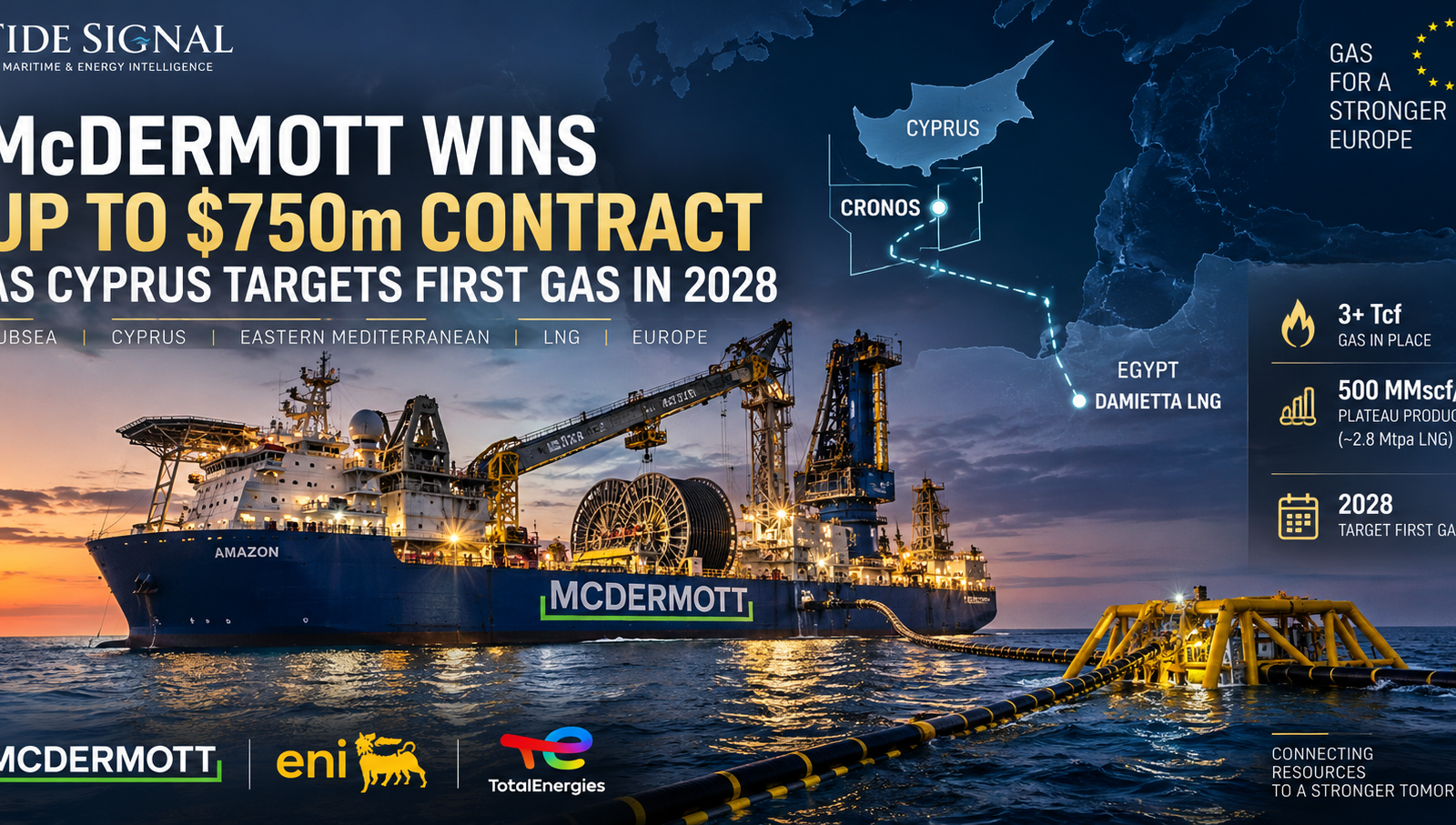
McDermott Cronos contract activity has moved into a major execution phase after Eni Cyprus awarded the offshore contractor a subsea package classified in the $500 million–$750 million range for the development of Cyprus’ first gas project.
Cronos is no longer only an exploration success. With final investment approval, subsea contracting and a 2028 production target now in place, the project is moving toward becoming Cyprus’ first producing gas development and a new source of LNG supply for Europe.
McDermott has secured one of the most important offshore awards in the Eastern Mediterranean this year as Eni advances the Cronos gas field toward production.
Eni Cyprus has awarded McDermott a major subsea contract for the Cronos development in deepwater offshore Cyprus, covering project management, engineering, procurement and installation support.
McDermott describes the award as “substantial”, a contract category corresponding to approximately $500 million to $750 million. The company said the award is its first subsea project with Eni and expands its footprint in the Eastern Mediterranean.
The official award was announced by McDermott on September 8 .
The contract lands only weeks after Eni and TotalEnergies took the final investment decision for Cronos, transforming the discovery from an appraisal story into an executable offshore development.
Cronos connects Cyprus offshore gas, subsea construction, Egypt’s existing processing infrastructure and Europe’s LNG market in a single project. That makes the award relevant far beyond the contractor itself.
McDermott Cronos Contract Reaches Up to $750 Million
The McDermott Cronos contract covers the offshore subsea execution support required to move the development toward first production.
McDermott’s stated scope includes:
Coordination of the subsea development and offshore execution programme.
Technical design and subsea project integration.
Supply-chain support for offshore infrastructure and installation activities.
Marine construction capability for execution offshore Cyprus.
The project will be executed through McDermott’s Subsea and Floating Facilities organisation, drawing on resources from Houston, Perth, London and Kuala Lumpur.
McDermott also highlighted its marine construction fleet and its deepwater construction vessel Amazon as part of the technical capability supporting the award.
The $500m–$750m figure reflects McDermott’s value range for a contract classified as “substantial.” Tide Signal is not presenting $750m as a disclosed fixed final contract price.
Cronos Is Cyprus’ First Gas Development
Cronos is located in Block 6 in deep waters approximately 185 kilometres southwest of Cyprus.
Eni operates Block 6 with a 50% interest, while TotalEnergies holds the remaining 50%.
The field was discovered in 2022 and successfully appraised in 2024. Eni says it contains more than 3 trillion cubic feet of gas initially in place.
On July 28, Eni and TotalEnergies took the final investment decision to develop the project.
The official FID announcement is available from Eni and TotalEnergies .
Discovery → FID → subsea contract → first gas. Cronos is moving from geological potential into an offshore execution programme.
Four Subsea Wells Will Feed the Development
The current development concept calls for four subsea production wells.
Plateau output is expected to reach around 500 million standard cubic feet of gas per day.
That is equivalent to roughly 2.8 million tonnes per annum of LNG, according to the project partners.
| Project metric | Cronos |
|---|---|
| Location | Block 6, offshore Cyprus |
| Operator | Eni — 50% |
| Partner | TotalEnergies — 50% |
| Gas initially in place | More than 3 Tcf |
| Subsea wells | 4 |
| Plateau production | ~500 MMscf/d |
| LNG equivalent | ~2.8 Mtpa |
| Target start-up | 2028 |
Cyprus Gas Will Flow Through Egypt
One of the most commercially important features of Cronos is that the project does not require Cyprus to construct an entirely new LNG export chain from scratch.
Gas will be transported by subsea pipeline from Cypriot waters to Egypt.
Eni says the gas will be processed through existing Zohr infrastructure before being transferred to the Damietta LNG plant for liquefaction and export.
This infrastructure-led development model is commercially significant because it can reduce the need for a new standalone liquefaction facility, shorten project execution time and make use of existing regional assets.
Cronos is not simply a Cyprus upstream project. It is an Eastern Mediterranean gas-routing project built around the ability to connect new offshore production with existing Egyptian LNG infrastructure.
Why Damietta LNG Matters
Damietta provides Cronos with access to an established LNG export route rather than forcing Cyprus to develop a complete domestic liquefaction system before monetising the field.
Eni has said the development can help restore structural LNG exports through Egypt and strengthen the Eastern Mediterranean’s role as a regional gas hub.
TotalEnergies expects to market half of the project’s LNG volumes — approximately 1.4 Mtpa — while Eni will market the other half.
The partners are targeting international markets, with Europe expected to remain the primary destination.
What the Contract Means for Offshore Shipping
For maritime markets, the Cronos project creates a more interesting story than the headline contract value alone suggests.
Deepwater gas development requires a chain of offshore services that can involve engineering vessels, construction tonnage, subsea installation support, logistics, supply boats, ROV capability and specialist project personnel.
The precise vessel programme has not yet been fully detailed publicly.
McDermott has, however, specifically highlighted the technical value of its Amazon deepwater construction asset and its wider marine construction fleet.
Deepwater production infrastructure and connection work.
Offshore execution supported by specialist vessels.
Supply-chain movements between Cyprus, Egypt and project bases.
Gas monetisation ultimately feeds the LNG export chain.
Could Cronos Create New LNG Shipping Demand?
Not immediately.
The McDermott award itself does not create LNG-carrier demand today. First production is targeted for 2028.
Once gas begins flowing through Egypt and is liquefied at Damietta, however, approximately 2.8 Mtpa of additional LNG-equivalent output could support a larger export programme.
Actual LNG-carrier demand will depend on production performance, destination markets, cargo scheduling, vessel size, voyage distance and the way Eni and TotalEnergies structure their LNG portfolios.
Tide Signal does not treat 2.8 Mtpa as a guaranteed number of LNG cargoes or vessels. Shipping demand will depend on the final operating and commercial programme.
Why 2028 Is the Critical Date
The project partners are targeting production start-up in 2028.
That timeline is commercially ambitious for a deepwater gas development, but the ability to connect Cronos to existing Egyptian infrastructure is designed to accelerate time to market.
The project’s next milestones will therefore be less about exploration and more about engineering execution, procurement, subsea construction and installation readiness.
For offshore contractors, the move from FID into execution creates a substantially different risk profile: schedule discipline and technical delivery become as important as geological certainty.
Cyprus Moves Closer to Becoming a Gas Exporter
Cronos carries strategic importance for Cyprus because it is the country’s first gas development to move formally into execution.
Successful start-up would allow Cyprus to move from offshore discovery and appraisal toward actual hydrocarbon production and export.
Eni has described the project as a milestone in positioning Cyprus as a European gas producer and exporter.
It also strengthens the argument for deeper energy integration between Cyprus and Egypt, with existing Egyptian facilities becoming the processing and LNG-export bridge for East Mediterranean gas.
The Eastern Mediterranean Energy Hub Takes Shape
Cronos fits into a wider regional strategy built around using existing infrastructure wherever possible.
Egypt already has gas-processing assets, pipeline systems and LNG export terminals. Cyprus has offshore discoveries that require commercial routes to market.
Connecting the two can reduce duplication and potentially improve project economics.
That does not mean every East Mediterranean discovery will necessarily follow the same development model.
But Cronos will be closely watched as a test of whether regional infrastructure-sharing can turn offshore discoveries into marketable LNG faster than building entirely new export systems.
The strategic value of Cronos lies partly in what does not need to be built. Existing Zohr and Damietta infrastructure allows the partners to focus capital on bringing offshore gas into an already established export chain.
What Europe Gets From Cronos
Europe remains the central target market for Cronos LNG.
TotalEnergies has framed the project as part of the diversification of European gas supply, while Eni has highlighted the project’s role in its growing LNG portfolio.
Cronos will not transform Europe’s gas balance on its own.
But approximately 2.8 Mtpa of additional LNG-equivalent production is commercially meaningful when combined with the strategic value of a Mediterranean supply source located relatively close to European markets.
It also adds optionality at a time when LNG sourcing, shipping routes and security exposure remain central concerns for European energy buyers.
What McDermott Gains
For McDermott, the award delivers more than contract backlog.
It is the company’s first subsea project award from Eni and expands McDermott’s presence in a region where offshore gas development is attracting renewed strategic attention.
Successful execution could strengthen the company’s positioning for future deepwater opportunities tied to Cyprus, Egypt and the wider Eastern Mediterranean.
The contract also provides a showcase for McDermott’s integrated model combining engineering, procurement, subsea expertise and marine construction capability.
What Investors and Contractors Should Watch Next
Progress from project design into offshore execution.
Subsea equipment and supply-chain packages could reveal more of the project scope.
Confirmation of vessels, installation windows and offshore campaign timing.
The Cyprus-to-Egypt connection is fundamental to the development model.
Schedule performance will determine how quickly first Cypriot gas reaches market.
Cargo destinations and portfolio strategy will shape future shipping demand.
Contract Value: What Is Actually Confirmed?
The contract-value language deserves precision.
McDermott itself announced a “substantial” contract.
McDermott’s contract classification places substantial awards within an approximate $500 million–$750 million range.
Tide Signal therefore uses “up to $750m” in the headline while retaining the full $500m–$750m range in the article.
This does not mean Eni publicly disclosed a fixed $750 million award value.
The Bigger Commercial Picture
Cronos brings together several themes that matter across the maritime and energy sectors.
It creates deepwater subsea work for contractors, strengthens Cyprus’ path toward production, increases the strategic use of Egypt’s energy infrastructure and creates a potential new source of LNG export volumes from the Eastern Mediterranean.
Most importantly, the project has passed the point where its commercial story depends mainly on geological promise.
Capital has been committed. A development concept exists. A major subsea contractor has been selected. And first gas has a target date.
Cronos Moves From Discovery to Execution
The McDermott award is one of the clearest signs yet that Cyprus’ Cronos project has entered its development phase.
A contract classified between $500 million and $750 million, four planned subsea wells, a 2028 production target and access to existing Egyptian LNG infrastructure give the project a defined commercial route from offshore reservoir to export market.
For Cyprus, it represents the country’s first gas development.
For Egypt, it reinforces the strategic value of Zohr and Damietta as regional energy infrastructure.
For McDermott, it adds a major deepwater subsea project and a first subsea award with Eni.
For shipping, the real story begins when the offshore construction campaign moves from engineering plans into the water.
Tide Signal has prioritised direct company disclosures and project-partner announcements for contract scope, FID, development design and production targets.
Subsea contract award — 8 September 2026 →
PROJECT OPERATOR EniCronos final investment decision and development plan →
PROJECT PARTNER TotalEnergiesProduction, LNG and 2028 project targets →
INDEPENDENT REPORTING ReutersFID, Europe LNG strategy and project background →
Methodology: Contract scope is based on McDermott’s official announcement. The $500m–$750m figure refers to the value band associated with McDermott’s “substantial” contract classification and is not presented as a fixed disclosed award price. Production and LNG targets are based on Eni and TotalEnergies project disclosures.