The AD Ports buyout proposed by Abu Dhabi’s L’IMAD would bring the listed ports and logistics group back under full sovereign control at an implied value above $8.6 billion. The headline number is the 23% premium. The more important story is why the majority owner now believes AD Ports may be better funded away from the public market.
ADQ, a wholly owned subsidiary of L’IMAD, already controls 75.42% of AD Ports Group. It has announced its intention to offer AED 6.25 in cash for each remaining share. The offer is voluntary and conditional; it is not a completed acquisition.
What Has Actually Been Offered?
AD Ports Group said on 17 August that it had received notice of L’IMAD’s intention, through ADQ, to acquire the shares ADQ does not already own. Minority shareholders who accept the eventual offer would receive AED 6.25 in cash for each share.
The price is deliberately pitched well above the market. It represents a 23% premium to the 14 August close of AED 5.10, a 25% premium to the one-month volume-weighted average price of AED 5.02 and a 31% premium to the three-month VWAP of AED 4.76. It is also 95% above the AED 3.20 subscription price used before AD Ports listed on the Abu Dhabi Securities Exchange in February 2022.
ADQ currently holds 3.839 billion shares, equal to 75.42% of the company. Based on that stake and the AED 6.25 offer price, acquiring the remaining minority interest would require roughly AED 7.8 billion if all outstanding shares are ultimately purchased. L’IMAD says sufficient resources are available to fund the cash consideration.
The Premium Is Not the Real Story
A 23% premium gets the attention, but the offer document is unusually clear about the problem L’IMAD is trying to solve. It describes AD Ports as strategically important to Abu Dhabi and says its next phase of growth is likely to be complex, capital intensive and long term.
That matters because the needs of a large infrastructure platform do not always sit comfortably with the expectations of listed-market investors. Ports, vessels, logistics networks and economic zones absorb capital long before every project produces a mature return. Acquisitions add another layer: they can accelerate growth, but they can also lift leverage and reduce the room available for dividends.
L’IMAD’s own filing makes that tension explicit. It says AD Ports may need to consider equity raises or place further pressure on its balance sheet, while recent transactions and elevated leverage could constrain dividend capacity. Its conclusion is straightforward: full ownership would give the company more freedom to pursue capital investment, acquisitions and operational transformation without the same short-term funding and return expectations.
The Balance Sheet Explains the Timing
The offer arrived only three days after AD Ports reported its strongest quarterly results on record. Revenue in Q2 2026 rose 47% year on year to AED 7.08 billion. EBITDA increased 49% to AED 1.74 billion, while total net profit almost doubled to AED 836 million.
Those are strong numbers. They do not, however, remove the financing question.
Net debt stood at AED 22.73 billion at the end of June, up AED 1.27 billion during the quarter. Net debt to EBITDA improved to 3.7 times from 3.9 times in Q1, but the absolute debt burden remains significant. Organic capital expenditure was AED 1.45 billion in the quarter. Free cash flow to the firm was negative AED 1.03 billion after including the AED 1.1 billion purchase of an additional 30% stake in Global Feeder Shipping; excluding that acquisition, FCFF would have been only AED 73 million positive.
| Metric | Q2 2026 | Why it matters |
|---|---|---|
| Revenue | AED 7.08bn +47% YoY |
The operating platform is still expanding rapidly despite a difficult regional backdrop. |
| EBITDA | AED 1.74bn +49% YoY |
Earnings growth is strong enough to support the strategic case, but growth itself requires capital. |
| Net profit | AED 836m +88% YoY |
The buyout is not being proposed because the group is loss-making or operationally distressed. |
| Net debt | AED 22.73bn | Large acquisitions and infrastructure investment keep financing and leverage at the centre of the story. |
| Net leverage | 3.7x | Leverage improved sequentially, but remains high enough to influence dividends and future funding choices. |
The Market Has Already Repriced the Deal
Investors reacted immediately. AD Ports shares finished Monday at AED 5.86, up 14.9% from the previous close and just below the AED 6.25 offer price.
That gap matters. A conditional cash offer normally trades below its proposed consideration while investors price the time needed to complete the transaction and the risk that conditions are not met. In this case, the offer still requires the formal process, regulatory approvals, satisfactory due diligence, any required third-party consents and the offeree documentation.
So the market reaction is strong, but it is not the same thing as completion. Until the offer becomes unconditional and the required steps are satisfied, AED 6.25 remains an offer price rather than a guaranteed exit price.
Hormuz Has Raised the Value of Network Resilience
The timing also carries a maritime angle that goes beyond corporate finance. AD Ports has been operating through severe disruption around the Strait of Hormuz, a shock that has reduced traffic and forced cargo owners, ship operators and logistics providers to rethink normal routes.
In Q2, AD Ports said UAE container throughput fell 65% year on year and UAE bulk and general cargo volumes dropped 67% as the regional situation hit ports inside the Gulf. Yet the wider group still produced record financial results. The reason was not that the disruption disappeared. It was that AD Ports could redirect activity across a broader network.
The group expanded cargo and feeder services through Fujairah Terminals and Khor Fakkan Port on the Gulf of Oman, developed overland corridors across the UAE, added truck capacity, increased rail frequency with Etihad Rail and deployed additional warehousing and air-cargo solutions. It also said 27 container vessels and five bulk vessels were serving alternative shipping corridors during the quarter.
That is strategically valuable because a modern port company is no longer only a landlord beside deep water. The strongest platforms increasingly combine terminals, vessels, road and rail links, warehousing, economic zones and digital systems. When one route is disrupted, the value of the network is measured by how much cargo can still move.
Tide Signal has previously examined why Hormuz shipping risk can remain commercial even when the waterway is technically open. The AD Ports response during Q2 is a practical example of the same idea: resilience is not simply avoiding a closed route; it is having enough alternative capacity to keep trade flowing.
What Minority Shareholders Are Being Asked to Trade
For minority investors, the decision is not complicated in form but it is meaningful in substance. The offer provides immediate cash at a substantial premium to the pre-announcement price. In exchange, shareholders give up their participation in whatever value AD Ports may create if its international expansion and infrastructure programme succeed over a longer horizon.
Immediate liquidity, a 23% premium to the last close before the announcement and a clear cash value for a listed holding that may otherwise face a period of heavy investment and limited dividend flexibility.
Future exposure to a strategic ports, shipping and logistics platform whose owner intends to continue funding acquisitions, infrastructure and operational expansion.
This is why the AD Ports buyout cannot be judged on the premium alone. The premium compensates investors for leaving now. It does not answer the separate question of what the business could be worth after another cycle of investment.
What the AD Ports Buyout Could Change
If L’IMAD reaches full ownership, AD Ports would sit entirely inside a sovereign investment structure that already treats ports and logistics as a strategic platform. The practical advantage is flexibility. Capital could be committed with a longer time horizon, acquisitions could be assessed without the same quarterly market signalling, and dividend policy could become secondary to network expansion when management believes the trade-off is justified.
There is also a wider signal for maritime finance. Infrastructure-heavy shipping businesses often live between two clocks. Public equity wants visible returns, balance-sheet discipline and regular proof that capital is working. Strategic infrastructure can require years of spending before the network effect becomes obvious. When those clocks move too far apart, ownership structure becomes part of the strategy.
That does not mean private or sovereign ownership is automatically better. Public markets impose transparency and valuation discipline, and minority shareholders provide an external price signal. But L’IMAD has effectively decided that, for the next stage of AD Ports’ development, flexibility is more valuable than the benefits of a public float.
What Happens Next?
- Formal offer document: shareholders still need the complete terms, timetable and acceptance mechanics.
- Regulatory process: the offer is subject to UAE approvals and any other required competition or foreign-investment clearances.
- Due diligence: ADQ has made satisfactory completion of due diligence one of the stated conditions.
- Board recommendation: the AD Ports offeree circular and board recommendation will be a key step for minority holders.
- Acceptance level: investors will watch how much of the remaining 24.58% is tendered and whether full ownership is ultimately achieved.
- Capital allocation after the deal: if the transaction completes, the next question is where L’IMAD allows AD Ports to spend more aggressively — infrastructure, fleet, logistics corridors or acquisitions.
The AD Ports buyout is best read as a capital-structure decision, not simply an M&A event. The company is growing, profitable and strategically useful — exactly the reasons its future investment bill is likely to stay large. Abu Dhabi appears willing to remove the tension between that long investment cycle and the shorter expectations of public shareholders. If the deal completes, the real test will come later: whether full ownership lets AD Ports invest faster while keeping leverage under control and turning its port, shipping and logistics network into stronger long-term cash generation.
Sources and Further Reading
- AD Ports Group — voluntary conditional cash offer announcement, 17 August 2026
- Abu Dhabi Securities Exchange — ADQ announcement of intention to make an acquisition offer
- AD Ports Group — Q2 2026 financial results
- Reuters — L’IMAD plans to acquire full ownership of AD Ports
- Mubasher — AD Ports market price and 17 August session data
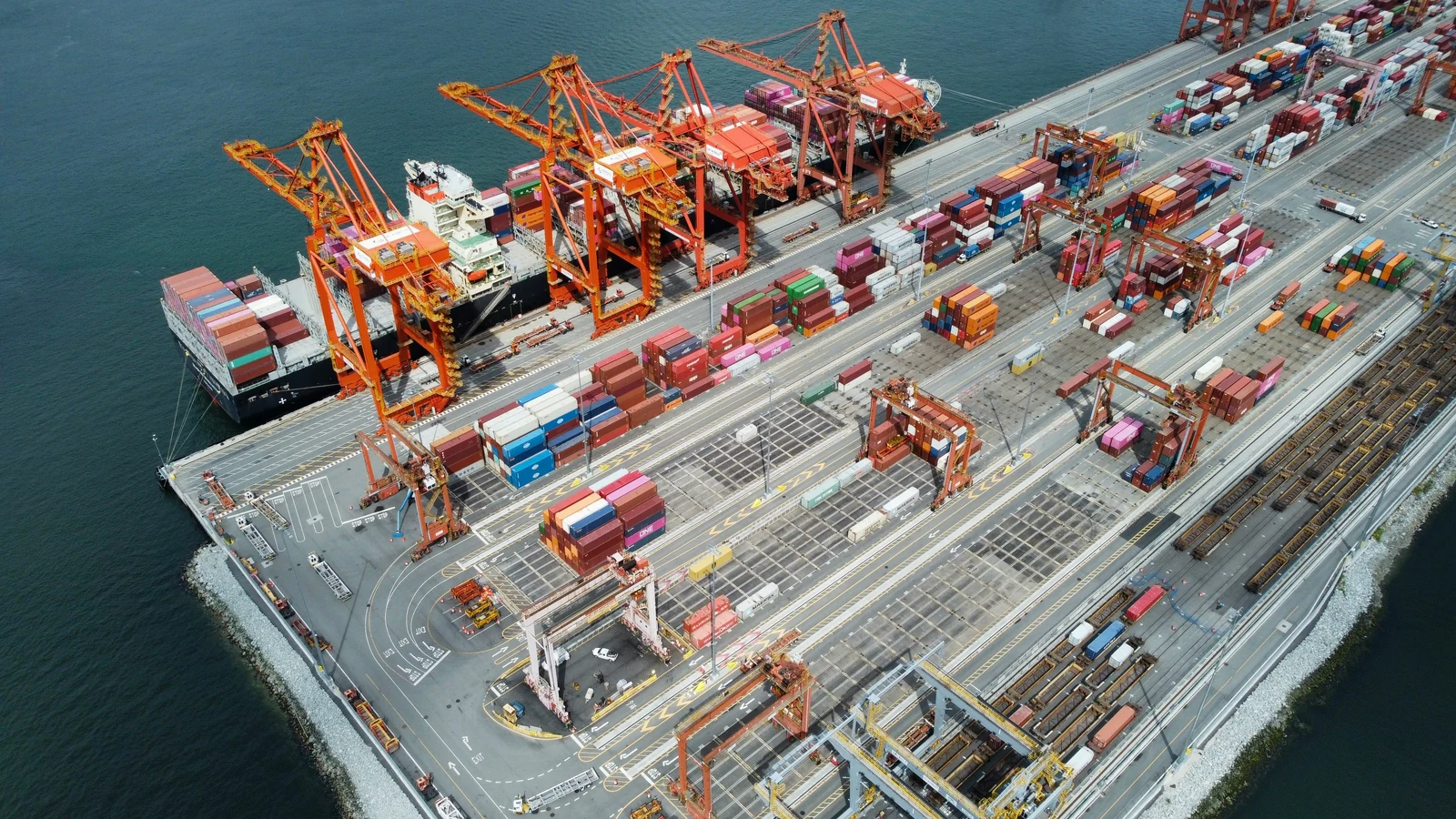
Featured image: Daniel Miksha / Unsplash. Aerial view of a container ship being handled at the Port of Vancouver, Canada. The image is illustrative and does not show an AD Ports Group facility. Used under the Unsplash License. Diagram: Tide Signal News.