Academy · Operations · Markets
Maritime Chokepoints Explained: Hormuz, Suez, Malacca and Shipping Risk
Maritime chokepoints are narrow passages with wide consequences. They shorten voyages in normal times, but when confidence breaks, they can reshape routing, freight markets, insurance costs, vessel schedules and the commercial risk behind global trade.
Maritime chokepoints are narrow sea passages where large volumes of energy cargoes, container traffic and bulk trade are concentrated. When they work normally, they make shipping faster and more efficient. When they become risky, congested or politically exposed, the effect can move quickly through voyage planning, freight markets, insurance desks and port schedules.
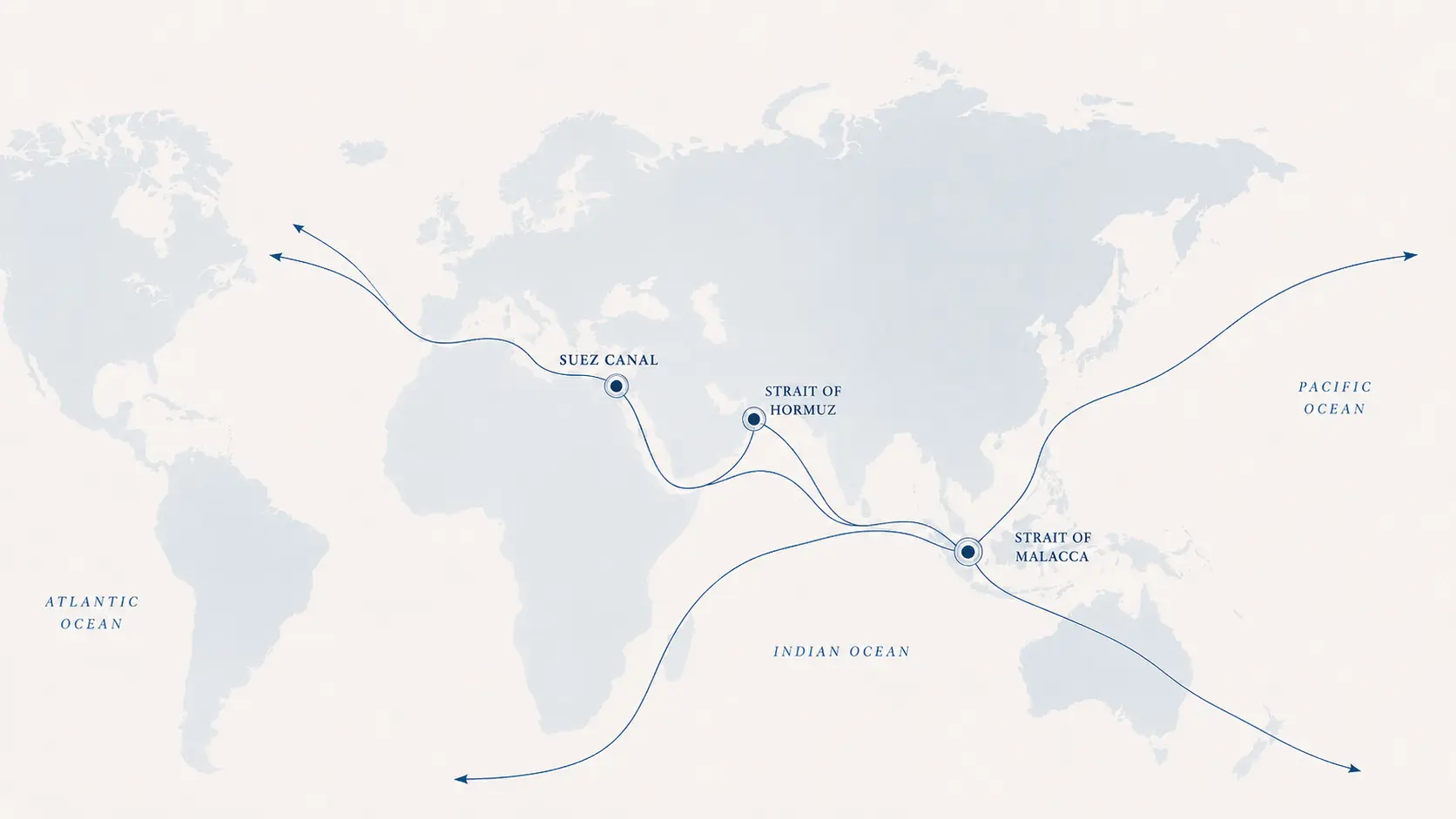
That is why chokepoints matter far beyond geography. A delay near the Strait of Hormuz, a diversion away from the Suez Canal or congestion around the Strait of Malacca can affect bunker consumption, vessel earnings, cargo timing, charterparty exposure, port rotations and market confidence.
For shipping companies, the practical question is not simply where the chokepoint is. The better question is what happens to the voyage if that chokepoint becomes slower, more expensive or less predictable.
This is where maritime chokepoints become a serious commercial signal. They show how a narrow corridor on a chart can create wider consequences across global trade.
Quick Answer
Maritime chokepoints are critical shipping passages such as the Strait of Hormuz, the Suez Canal and the Strait of Malacca. They matter because they concentrate trade flows. If security risk, congestion, drought, conflict or closure affects one of these routes, shipping companies may face longer voyages, higher fuel use, changed ETAs, extra insurance costs, rerouting decisions and freight market volatility.
The supply-side context is covered in Tide Signal’s Shipping Week Ahead: Suez Return, $11,000 Container Rates and Hormuz Risk.
Maritime Chokepoints Snapshot
Critical for Gulf oil, products and LNG movements.
A shortcut between Asia, Europe and the Mediterranean.
A major corridor for Asia-related energy and trade flows.
Longer routes affect time, fuel, schedules and fleet capacity.
What Is a Maritime Chokepoint?
A maritime chokepoint is a narrow passage that connects two larger bodies of water and concentrates shipping traffic because vessels have limited practical alternatives. Some chokepoints are natural straits. Others are canals built to shorten trading routes.
Their value comes from access and distance. A vessel may use a chokepoint because it is the shortest route to a market, the only practical exit from an energy-producing region, or the most efficient link between major trading areas.
Their risk comes from concentration. If a large share of vessels depends on one narrow corridor, any disruption can create wider consequences. Those consequences may include rerouting, congestion, higher insurance costs, changed ETAs, missed port windows and freight volatility.
Tide Signal view: a chokepoint is not only a place where ships pass. It is a place where shipping risk becomes visible.
1. Strait of Hormuz: Energy Flows and Security Risk
The Strait of Hormuz connects the Persian Gulf with the Gulf of Oman and the wider Indian Ocean. It is one of the world’s most important energy shipping routes because large volumes of crude oil, petroleum products and LNG move through the area.
Hormuz is different from many other maritime chokepoints because the risk is closely linked with energy security, regional tension and war-risk exposure. A change in the security picture can affect tanker confidence, naval guidance, insurance terms, route planning and the willingness of owners to accept certain employment.
For tanker operators and charterers, the issue is not only whether ships can pass. The issue is whether they can pass with stable insurance terms, predictable timing and acceptable commercial exposure.
A short disruption near Hormuz can create immediate concern in oil markets. A longer disruption can affect voyage planning, fleet positioning, cargo scheduling, demurrage exposure and freight expectations.
Hormuz Signals to Watch
Security alerts: reported incidents, suspicious approaches, projectiles, drones or military activity near commercial vessels.
War-risk premiums: higher cost or stricter cover terms can change the voyage result.
Traffic behaviour: waiting, slower transit, selective employment or reduced confidence around the passage.
Tanker freight sentiment: risk can influence crude, product and LNG market expectations before full disruption is visible.
2. Suez Canal: Distance, Time and Schedule Reliability
The Suez Canal is a man-made maritime shortcut connecting the Mediterranean Sea with the Red Sea. For Asia-Europe trade, it can save significant distance compared with sailing around the Cape of Good Hope.
That distance advantage is why Suez matters. When the route is available and safe, it supports shorter voyages, lower bunker exposure and more predictable schedules. When the route becomes risky or unavailable, vessels may need to reroute around southern Africa.
A Cape of Good Hope diversion does not only add nautical miles. It changes the vessel cycle. Ships take longer to return to loading areas, effective fleet capacity tightens, port calls shift and cargo arrival patterns become harder to manage.
This is why Suez disruption can be felt beyond the canal itself. A vessel delayed on one leg may be late for the next employment. A container service may need more ships to maintain weekly frequency. A tanker or dry bulk ship may face changed bunker exposure, different weather routing and altered voyage economics.
| Route Issue | Commercial Effect | Who Feels It |
|---|---|---|
| Longer distance | Higher bunker consumption and longer voyage duration. | Owners, charterers and cargo interests. |
| Schedule disruption | Late arrivals, missed windows and changed port rotations. | Operators, ports and logistics teams. |
| Fleet absorption | More ships may be needed to move the same cargo volume. | Container lines, tanker desks and dry bulk operators. |
| Freight pressure | Reduced effective capacity can support higher freight rates. | Charterers, owners and freight buyers. |
| Insurance and security | Risk perception can affect cover, premiums and company approvals. | Insurance, legal and operations teams. |
3. Strait of Malacca: Volume, Asia Trade and Congestion Risk
The Strait of Malacca connects the Indian Ocean with the South China Sea and the wider Pacific trading system. It is a key route for trade between East Asia, the Middle East, Europe and other major markets.
Malacca matters because of volume. Large numbers of container ships, tankers, bulk carriers and other commercial vessels use the route. That concentration makes the passage commercially important even when there is no single headline crisis.
The risks around Malacca are not always the same as Hormuz or Suez. They may include congestion, traffic density, piracy concerns in wider regional waters, weather exposure, collision risk, port scheduling pressure and limited alternatives for some trades.
When a high-volume chokepoint slows, the effect may be less dramatic than a closure headline but still important. Delays can compound. Port windows can move. Bunker planning can change. Operators may need to adjust ETA assumptions before the wider market reacts.
Why Malacca Deserves Attention
- It supports major Asia-related trade lanes and energy flows.
- It concentrates many vessel types in a narrow operating environment.
- Small delays can matter because traffic density is high.
- Alternative routes may add time, cost and operational complexity.
- It links maritime risk directly with Asian manufacturing and energy demand.
4. Why Rerouting Is Not a Simple Fix
When a chokepoint becomes risky, the first answer often sounds simple: reroute the vessel. In practice, rerouting is not just a line drawn on a chart.
A longer route changes the whole voyage. It affects fuel consumption, ETA, speed instructions, weather exposure, port arrival windows, crew planning, emissions calculations and the next employment of the ship.
Recent research on maritime chokepoint disruptions shows that chokepoint risk is dynamic rather than static. Rerouting can reduce losses for some directly exposed ports, but delayed vessel cycles can create later losses at other port calls and dependent regions.
For shipping companies, this is the practical lesson: the cost of a chokepoint disruption may continue after the first rerouting decision. A ship that arrives late today can still be out of position tomorrow.
Commercial point: rerouting solves the immediate navigation problem, but it creates a new timing problem. Shipping desks need to measure both.
5. How Chokepoints Affect Freight Markets
Freight markets react to chokepoints because chokepoints affect capacity, time and confidence. If ships take longer routes, effective supply can tighten. If insurance costs rise, voyage economics change. If cargo timing becomes uncertain, charterers may pay for flexibility.
The freight effect depends on duration, vessel type and available alternatives. A short disruption may create noise but limited lasting impact. A longer disruption can absorb tonnage, increase waiting time and change the balance between cargo demand and available ships.
Tanker markets may react to energy flow risk around Hormuz. Container markets may react strongly to Suez and Red Sea diversions because schedules and service frequency matter. Dry bulk markets may react through port delays, changed ballast legs, regional congestion and bunker exposure.
This is why maritime chokepoints are market signals. They are watched not only by operators, but also by chartering desks, commodity traders, insurers, ports and freight buyers.
What Shipping Companies Should Monitor
- Official alerts from maritime security bodies, canal authorities and port agencies.
- Traffic flow through key routes, including waiting areas, anchorage patterns and AIS behaviour.
- War-risk premiums and changes in insurance terms, notice requirements or underwriter appetite.
- Rerouting behaviour among major operators and vessel segments.
- Bunker exposure created by longer voyages, weather routing or changed speed instructions.
- Port windows and whether delay is spreading to later calls.
- Freight sentiment in exposed tanker, container and dry bulk markets.
6. Chokepoints Are Also Legal and Insurance Problems
A chokepoint disruption can quickly become a legal and insurance issue. If a vessel is ordered through an area that is considered unsafe or commercially unreasonable, the owner, master, charterer and insurer may all have different concerns.
War-risk clauses, deviation clauses, force majeure wording, safe port obligations, delay provisions and additional premium clauses can become central. The wording of the contract matters because it affects who bears cost, delay and risk.
BIMCO’s war-risk clauses are important in this context because they give commercial parties a framework for dealing with exposure to war risks and related threats. The commercial details still matter: amendments, voyage facts, timing, notice, evidence and the master’s reasonable judgement can all affect the position.
In practice, this means companies should not treat chokepoint risk as only an operations issue. Legal, insurance and chartering teams should be aligned before the vessel reaches the decision point.
7. Why Chokepoints Matter Even When They Stay Open
A chokepoint does not need to close completely to affect shipping. It only needs to become less predictable.
If vessels slow down, wait for instructions, seek additional approval, face higher premiums or avoid the route selectively, the commercial effect has already started. The passage may still be open, but the voyage may no longer be normal.
This is one of the most important lessons from recent shipping disruptions. The market is affected not only by physical closure, but also by confidence, uncertainty and the time ships lose while adapting.
Hormuz, Suez and Malacca: Different Risks, Same Lesson
Hormuz, Suez and Malacca are different chokepoints with different risk profiles. Hormuz is closely linked with energy security and war-risk exposure. Suez is closely linked with distance, schedule reliability and Asia-Europe routing. Malacca is closely linked with traffic volume, Asian trade and navigational density.
But the commercial lesson is the same. When a chokepoint becomes uncertain, shipping companies must measure more than the route. They must measure time, cost, legal exposure, insurance terms, vessel behaviour and market confidence.
Chokepoint risk is not static. It changes with events, traffic patterns, underwriter appetite, naval advice, political decisions and the behaviour of other vessels.
Final View
Maritime chokepoints matter because they turn geography into commercial exposure. They can shorten a voyage in normal times and reshape the market in disrupted times.
For shipping companies, the strongest approach is disciplined monitoring. Watch official alerts, traffic behaviour, war-risk premiums, routing changes, port delays and freight sentiment. The warning sign is not only closure. The warning sign is when confidence starts to weaken.
In shipping, a narrow passage can create a wide market impact. That is why maritime chokepoints belong at the centre of serious voyage planning, risk management and market analysis.
Frequently Asked Questions
What are maritime chokepoints?
Maritime chokepoints are narrow sea passages or canals where shipping traffic is concentrated because vessels have limited practical alternatives. Examples include the Strait of Hormuz, the Suez Canal and the Strait of Malacca.
Why do maritime chokepoints affect freight markets?
They affect freight markets because disruption can increase voyage distance, absorb vessel capacity, raise bunker consumption, delay cargo arrival and change the balance between available ships and cargo demand.
Which chokepoints matter most for shipping risk?
Hormuz, Suez and Malacca are among the most closely watched because they influence energy flows, Asia-Europe routing, container schedules, tanker movements and global trade reliability.
The supply-side context is covered in Tide Signal’s LNG Prices Surge to $26 as Asia Imports Hit 8-Year Low.
Is rerouting always the solution?
No. Rerouting can avoid the immediate risk, but it may create longer voyages, higher bunker cost, delayed port calls, changed ETAs and later vessel-cycle problems.
Sources and Further Reading
For further context, readers may consult EIA analysis of world oil transit chokepoints, EIA notes on the Strait of Hormuz as a critical oil chokepoint, UNCTAD Review of Maritime Transport 2024, BIMCO CONWARTIME 2025 war-risk clause, BIMCO VOYWAR 2025 war-risk clause, research on systemic impacts of maritime chokepoint disruptions, and recent research on adaptive rerouting and chokepoint disruptions.